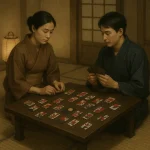
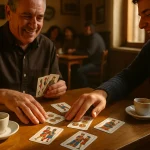
In a candle-lit Viennese salon two centuries ago, nobles gathered around tables not to gamble, but to think. The game was Tarock — an elegant fusion of cards, memory, and intuition that would come to define Central European play. Long before poker or bridge reached the drawing rooms of Vienna, Tarock was already there, weaving luck and logic into a cultural ritual that endures to this day.
The Origins of Tarock


Tarock, also spelled Tarot or Tarocchi, began in 15th-century Italy, but its transformation into a strategic trick-taking game happened north of the Alps. By the 18th century, the Austrian Empire had adopted and refined it into something distinct from its mystical French cousin.
While Tarot in France became associated with divination, the Austro-Hungarian version remained a game of skill. It was especially popular among the educated and upper classes — officers, professors, and musicians — who saw it as both intellectual challenge and social pastime.
By the 1800s, Tarock had spread through Austria, Hungary, Slovenia, Croatia, and Poland, becoming a symbol of Central European identity. Its regional versions — Königrufen, Hungarian Tarokk, Cego, Industrie und Glück — all carried the same DNA: a duel between chance and mastery.
The Deck: A Bridge Between Art and Play
A traditional Tarock deck contains 54 cards, though regional variants use 42, 54, or 78. Unlike poker or bridge decks, Tarock cards feature unique suits and trumps, combining medieval imagery with mathematical order.
Structure of a Tarock Deck
- Four Suits: Hearts, Diamonds, Clubs, Spades (in German pattern or French suits)
- Trumps: Numbered 1–21 (plus a special Fool or Sküs)
- Court Cards: King, Queen, Cavalier (Knight), and Jack
The Fool acts as a wild card or “excuse,” symbolizing the card of fate — it can be played anytime and often rescues a player from losing a valuable trick.
Each deck feels like a miniature artwork. In older Austrian editions, hand-painted trumps depicted emperors, allegories, or mythic figures, creating a playable gallery of European imagination.
How to Play Tarock
Though dozens of local variations exist, the basic rhythm of Tarock remains consistent — a blend of bidding, trick-taking, and partnerships.
Setup
- Players: Usually 4
- Deck: 54 cards (22 trumps, 32 suit cards)
- Goal: Win valuable cards and fulfill contracts
Each player receives 12 cards, with a talon (stack of six) in the middle. Bidding begins to determine who becomes the declarer, the player who will play against the others and try to achieve a declared objective.
The Phases of Play
- Bidding (Auction) – Players announce contracts such as Three, Two, or Solo, each representing increasing difficulty and points.
- Exchange – The declarer may draw from the talon, depending on the contract, to improve their hand.
- Play – Tricks are played clockwise; each player must follow suit or play a trump. Highest trump wins.
- Scoring – After all tricks, players count points based on captured cards and completed goals.
Card Values
| Card | Value |
|---|---|
| Kings | 5 points |
| Queens | 4 points |
| Cavaliers | 3 points |
| Jacks | 2 points |
| Others | 1 point |
Each trick’s outcome contributes to final totals, with 35 points typically considered the threshold of victory.
A Game of Contracts and Consequence
Where Bridge uses declarers and defenders, Tarock deepens that dynamic with contracts — risk-based promises that define how a hand must be played.
Common contracts include:
- Three / Two / One – The number of cards exchanged with the talon.
- Solo – No talon exchange; pure skill.
- Trischaken – A special negative game where the aim is not to take tricks.
- Königrufen (Calling the King) – A team version where the declarer secretly “calls” a King, whose owner becomes a silent partner.
Failing a contract doesn’t just lose points; it brings poetic justice. The same Viennese humor that shaped waltzes and cabarets lives inside Tarock tables — teasing a failed declarer was as much tradition as counting scores.
Regional Variations
Tarock evolved differently across the empire:
- Austrian Königrufen – The national standard, played with 54 cards and deep strategy; still used in official tournaments.
- Hungarian Tarokk – Known for its aggressive bidding and “ultra” scoring systems.
- Cego (Baden) – A variant for 3 players where one always plays solo.
- Industrie und Glück (Industrial Fortune) – The name of an iconic 19th-century deck used across Austria, with rich allegorical illustrations.
Each variation reflects local culture — Hungarian Tarokk’s bold play mirrors its national temperament; Königrufen’s intricate contracts fit Austria’s precision and discipline.
The Mathematics and Mind Games
Like chess, Tarock rewards foresight and memory. Every card played reveals information; every silence carries meaning.
Elite players track trumps, predict hands, and calculate outcomes several turns ahead.
Strategic layers include:
- Counting trumps – Knowing which are gone determines timing.
- Psychological play – Bluffing or feinting through suit selection.
- Risk calibration – Choosing a contract that matches probability and ego.
Many scholars compare Tarock to an early form of game theory — a card version of calculated diplomacy.
Tarock in Austrian Culture
More than pastime, Tarock became a language of social connection.
In 19th-century Vienna, composers like Johann Strauss II and Brahms reportedly played Tarock between rehearsals. Café culture adopted it; officers in the Austro-Hungarian army used it as a means of camaraderie during long winter posts.
Even today, Tarock clubs in Graz, Linz, and Budapest keep the game alive through weekly gatherings and championship events. The Österreichischer Tarockverband (Austrian Tarock Association) formalized rules and scoring, ensuring that the old game survives in modern cafés and digital platforms alike.
Tarock vs. Tarot: Game or Mysticism?
It’s a common misconception that Tarock and Tarot are the same.
While both share ancestry in Renaissance Italy, they split paths centuries ago:
- Tarot evolved toward fortune-telling, emphasizing symbolism and divination.
- Tarock pursued strategy and mathematics, emphasizing probability and partnership.
To play Tarock is not to read fate — it’s to outthink it.
Five Intriguing Facts About Tarock
- Royal Roots – Once favored by Emperor Franz Joseph’s court, Tarock was considered the “intellectual’s bridge.”
- Artistic Decks – Some 19th-century Tarock decks were hand-painted by fine artists; originals now sit in museums in Vienna and Prague.
- Linguistic Influence – “Tarockieren” (to play Tarock) entered the Austrian dialect as a synonym for both playing and scheming.
- Mathematical Depth – The number of possible Tarock hands exceeds 80 septillion, making it statistically richer than chess openings.
- Cultural Resilience – Despite wars and borders, the same game is still played from Tyrol to Transylvania — virtually unchanged in spirit.
Why Tarock Still Matters
In an age of instant entertainment, Tarock reminds us that games can be slow, deliberate, and human.
It’s not about luck or bluff alone; it’s about understanding rhythm — of cards, of people, of consequence.
Each hand becomes a miniature story: risk and restraint, triumph and irony. And somewhere in that balance lies the charm of Austrian culture itself — graceful, precise, quietly philosophical.
To play Tarock is to step into the mind of Europe’s past, where strategy met art, and time itself seemed to pause between every trick.