In Hearts, winning doesn’t feel like winning—it feels like escaping. You watch tricks slide across the table like small waves, and you try not to drown in them. Every heart you take is a bruise. The Queen of Spades is the punchline nobody wants to hear.
At its best, Hearts is a quiet psychological contest: who can stay calm, track what’s gone, and time the moment when “safe” becomes “fatal.” It’s also one of the most widely played trick-avoidance games in the world—helped massively by the fact that it shipped on millions of computers as part of Microsoft Windows in the late 20th century.
This is Cardanoir’s complete guide to Hearts: History of Hearts, core rules, scoring, shooting the moon, how to win at Hearts, and major variations (Black Maria).
- History of Hearts : From European “Reverse” Games to American Living Rooms
- What Hearts Is, in One Sentence
- Components and Setup
- Core Rules: How to Play Hearts
- Scoring: Why the Math in Hearts Feels So Clean
- The Most Famous Move: Shooting the Moon
- How to Win at Hearts: Strategy That Actually Works
- 1) Learn the real objective: avoid unplanned tricks
- 2) Passing strategy: build a void, manage the Queen, protect your exits
- 3) Count what matters (you don’t need perfect memory—just the key signals)
- 4) The Queen is a timing bomb—defuse it, don’t admire it
- 5) Don’t be the table’s trash can
- 6) Moon-shooting is a threat even when it fails
- Variations: Black Maria and the Wider Hearts Family
- Modern and Digital Hearts
- Five Interesting Facts About Hearts
- Hearts as a Game About Restraint
History of Hearts : From European “Reverse” Games to American Living Rooms
Most modern sources trace Hearts back to older European trick-avoidance games—especially Reversis / Reverse, a 17th–18th century “reverse” (trick-avoidance) game family where taking certain tricks was bad news.
Hearts itself, as a distinct game, is generally placed in the United States around 1880. Britannica notes it “first appeared in the United States about 1880,” while still deriving from much older European predecessors. Wikipedia adds a vivid detail: The Standard Hoyle (1887) reported Hearts had only been played there for “the last five years,” suggesting a fast rise from novelty to staple. (1)
Then came the modern megaphone: software. Britannica points out that a version of Hearts was included with Windows, and that this helped standardize and spread the game through computers and later online play.
Surprising truth: Hearts didn’t just survive history—it rode technology.
What Hearts Is, in One Sentence
Hearts is a four-player trick-taking game where your goal is to avoid penalty points—mainly hearts and the Queen of Spades—until someone hits the target score (often 100), and the lowest score wins.
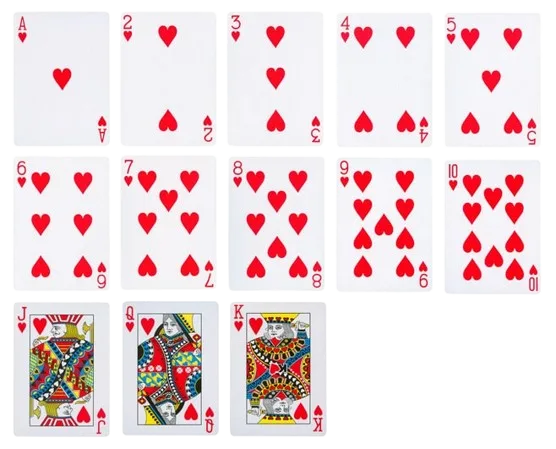
Components and Setup
What you need
- 1 standard 52-card deck
- 4 players (classic format)
Card ranking
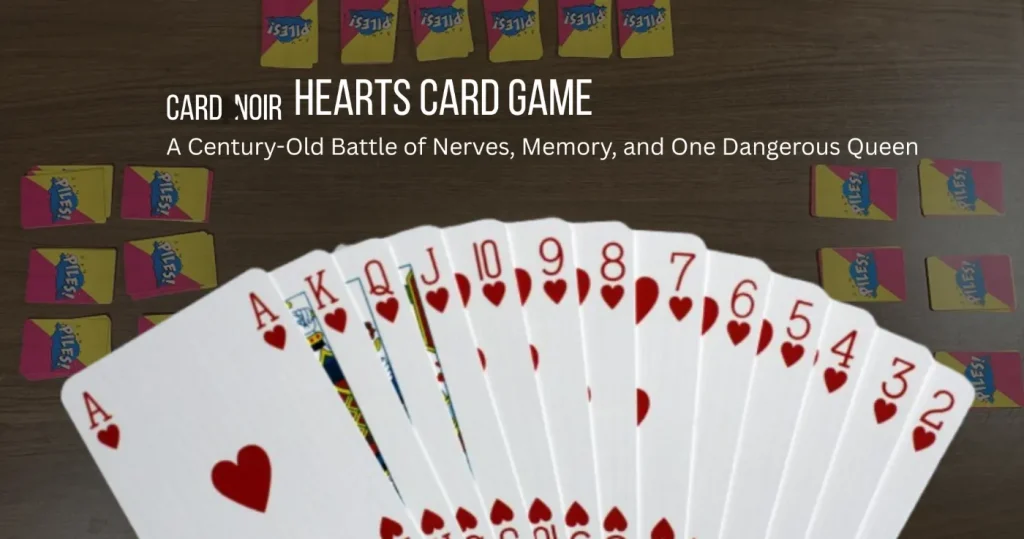
- Typically: A (high), K, Q, J, 10 … 2
Deal and hand structure
Each hand contains 13 tricks (because 52 cards / 4 players = 13). No fancy components. Just pressure.
Core Rules: How to Play Hearts
If you’ve played Whist-style trick games, Hearts will feel familiar—until it starts punishing you for “winning.”
1) The pass (the part that quietly decides the hand)
In standard Hearts, players pass three cards before each hand, rotating the direction:
- pass left
- pass right
- pass across
- no pass
…and repeat.
This pass is where your long-term plan begins: you’re shaping your future voids, your safety valves, and sometimes your weapon.
2) Opening lead
Commonly, the player with the 2 of Clubs leads the first trick (a widely taught standard). The lead suit must be followed if possible.
3) Following suit and taking tricks
- You must follow suit if you can.
- If you can’t follow suit, you may discard another suit (and this is often where danger enters).
- Highest card of the lead suit wins the trick (unless a house rule uses trumps—classic Hearts has no trump).
4) “Breaking” hearts
A classic restriction: Hearts can’t be led until they’ve been “broken” (played on a trick because someone couldn’t follow suit). This prevents instant heart-dumping from turn one and forces a more gradual escalation.
Scoring: Why the Math in Hearts Feels So Clean
Hearts is famous for scoring that’s easy to learn and brutal to experience:
- Each Heart = 1 point
- Queen of Spades = 13 points
That means a full hand contains 26 total penalty points (13 hearts + the Queen’s 13). Bicycle Cards notes that the “aggregate total of all scores for each hand must be a multiple of 26,” a neat mathematical fingerprint that helps you sanity-check scoring.
Most games are played to 100 points (though some groups choose 50).
The Most Famous Move: Shooting the Moon
If you take all hearts and the Queen of Spades in a single hand, you’ve captured all 26 penalty points. Many rulesets treat this as shooting the moon: instead of you getting +26, either you get 0 and everyone else gets +26, or your total score is reduced by 26 depending on house rules.
This is the moment Hearts becomes storytelling. One successful moon shot can flip a whole match from “slow grind” to “legend.”
How to Win at Hearts: Strategy That Actually Works
Hearts is a game of controlled vulnerability. You don’t win by never taking points—you win by taking points on your terms, while forcing the worst cards onto someone else.
1) Learn the real objective: avoid unplanned tricks
Taking a trick is not always bad. Taking a trick you can’t control is worse. Tricks give you the lead—meaning you control what suit gets played next. When you can’t control the table, you’re just waiting to get spiked by the Queen.
2) Passing strategy: build a void, manage the Queen, protect your exits
During the pass, experienced players often aim for one of these plans:
- Create a void (get rid of an entire suit) so you can later discard hearts safely when that suit is led.
- Manage the Queen of Spades: if you hold it, decide whether you can safely “bleed spades” first (forcing out higher spades) or whether you should pass it away.
- Keep exit cards (mid/low cards that let you lose tricks when you need to).
A common beginner mistake is passing “random high cards.” The smarter pass is about shaping future control.
3) Count what matters (you don’t need perfect memory—just the key signals)
You’ll win more simply by tracking:
- Has the Queen of Spades fallen yet?
- Are hearts broken?
- Who is short in which suit? (you can often infer this from who sloughs off-suit early)
Even light counting improves your decisions dramatically.
4) The Queen is a timing bomb—defuse it, don’t admire it
If you’re holding the Queen, your safest path is often to get rid of it before hearts are broken and before players have voids that let them throw hearts on your tricks. But you can’t just toss it anywhere—you need the lead suit to be spades, and you need the Queen to lose.
So you try to “pull spades” (lead spades repeatedly) to force out higher spades—then dump the Queen when it can’t win. That’s the chess inside the card game.
5) Don’t be the table’s trash can
Players love dumping hearts when they’re void. That means you should be cautious about winning tricks once hearts are broken—especially if you suspect multiple players are void in the lead suit. In Hearts, the “safe lead” becomes unsafe the moment two people can’t follow.
6) Moon-shooting is a threat even when it fails
A failed moon shot can be catastrophic. But the attempt can still help: it forces opponents to make uncomfortable defensive choices (like taking a heart they didn’t want just to stop you). Learn to recognize when someone is collecting hearts intentionally and shift into defense early.
Variations: Black Maria and the Wider Hearts Family
Hearts isn’t one game. It’s a family tree.
Black Lady vs Black Maria: the naming trap
In many places, “Black Lady” refers to Hearts where the Queen of Spades is the major penalty card. “Black Maria” is sometimes used interchangeably in casual speech, but in formal descriptions it can refer to a distinct British variant with extra penalty spades.
Black Maria (variation)
Black Maria is commonly described as a Hearts-group game where you still avoid hearts, but additional spade penalties may apply, depending on the ruleset.
A widely documented scoring option is:
- Each heart = 1
- Queen of Spades = 13
- King of Spades = 10
- Ace of Spades = 7
This shifts the game’s emotional center: spades become a minefield, not just the Queen. Suddenly, “I’m safe, it’s just spades” stops being true.
Why variations exist at all
Hearts invites house rules because it’s structurally simple. Players adjust it to:
- make moon-shooting rarer or more dramatic
- speed up games (lower target score)
- increase punishment (extra penalty cards)
- tune how defensive play feels
That flexibility is why it shows up everywhere—from families to competitive online lobbies.
Modern and Digital Hearts
Britannica highlights how the Windows version of Hearts became a widely recognized standard in the late 20th century, and online play further spread it.
Digital Hearts also taught generations of players a key lesson: good Hearts strategy isn’t about luck—it’s about predictability. Computers punish sloppy timing because they don’t get distracted by table talk.
Five Interesting Facts About Hearts
- Hearts is generally traced to older European “reverse” trick-avoidance games like Reversis / Reverse.
- It “first appeared” in the U.S. around 1880, per Britannica.
- The Standard Hoyle (1887) described Hearts as a recent import—played for only “the last five years.”
- The total penalty points in a standard hand are 26, and score totals per hand align with that math.
- The Windows era helped standardize Hearts rules across huge audiences.
Hearts as a Game About Restraint
Most games reward appetite. Hearts rewards restraint.
It teaches you to let good cards go, to lose on purpose, to watch your own impulses like they’re opponents at the table. It teaches you that the loudest mistake isn’t taking points—it’s taking points you didn’t choose.
And that’s why Hearts has lasted: it turns a plain deck into a small drama of self-control. You aren’t building an empire. You’re surviving a storm. One trick at a time.