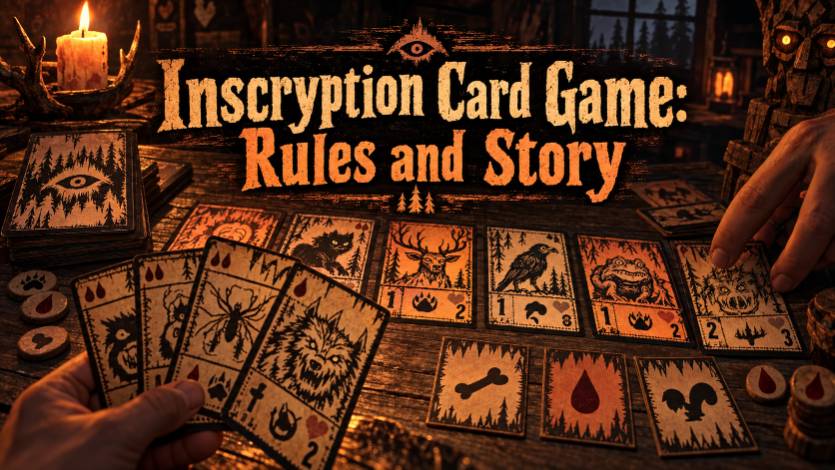
cardanoir.com – The Inscryption card game starts in a dark cabin. A figure you cannot quite see deals you a hand. He tells you the rules as you go, and he does not explain what happens if you lose.
Daniel Mullins built it. Devolver Digital published it in October 2021. It won Best Independent Game at The Game Awards that year, and it has spent every year since being recommended by people who refuse to say why.
A Note on Spoilers First
This guide covers how the Inscryption card game works. It does not spoil the story.
That distinction matters more here than in any other game on this site. Inscryption is built on a series of turns you are not expecting, and knowing about them in advance genuinely reduces the experience.
So everything below describes the cabin — the opening hours that teach you the game. Later chapters change the rules, and we will leave those alone.
What the Inscryption Card Game Is
At heart, the Inscryption card game is a roguelike deckbuilder. You climb a map, fight card battles, collect new cards, and lose everything when you die.
However, it is also an escape room. The cabin around the table is a real space. You can stand up, walk around, and examine things, and there are puzzles hidden in the furniture.
Then there is a third layer: found footage, a story about the disc itself, and a mystery that sits underneath both of the others. Consequently, calling it a card game is accurate but incomplete.
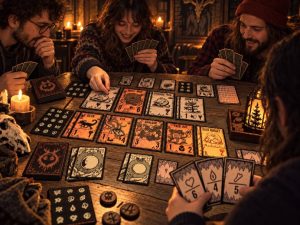
Inscryption Card Game Rules: The Board
First, the table has four lanes. You play creatures into your four slots. Your opponent plays into the four opposite.
Each turn follows the same short sequence.
- Draw one card. You choose between your deck and a separate squirrel pile.
- Play creatures by paying their cost.
- Ring the bell to end your turn and attack.
- Creatures attack straight ahead. If a lane is empty, that damage hits your opponent.
That squirrel choice is the first real decision in the game. Squirrels do nothing on their own. Still, you need them constantly, and you will see why in a moment.
Blood and Bones: Paying for Cards
Notably, there is no mana here. Instead, two costs run the cabin.
Blood is paid by sacrificing your own creatures on the table. A card costing two blood means two of your creatures die to summon it. That is why squirrels matter — they exist purely to be killed.
Bones are earned when any creature dies, yours or theirs. Bone cards cost nothing in sacrifices, so they reward a board where things keep dying.
Because of that, the Inscryption card game turns its own economy into a horror theme. Your resources are your creatures, and progress means feeding them into something.
The Scales Decide the Match
In the Inscryption card game, you have no life total. There is a set of scales instead.
Every point of damage tips the scales toward one side. Win the match by getting five points ahead of your opponent.
That threshold changes everything. A five-point lead is small, so a single good turn can end a fight. Meanwhile, damage you take is not permanent loss — it is simply weight on the other side, and you can tip it back.
There is also a way to add weight manually. It costs you something, and discovering what is part of the game.
Sigils Carry the Inscryption Card Game
In the Inscryption card game, creatures have attack and health. Sigils are what make them interesting.
- Airborne — attacks fly over defenders and hit the scales directly
- Mighty Leap — blocks airborne attackers
- Touch of Death — kills anything it damages
- Bifurcated Strike — attacks both diagonal lanes instead of straight ahead
- Waterborne — submerges on your opponent’s turn and cannot be hit
- Worthy Sacrifice — counts as three blood when sacrificed
Of course, dozens more exist. Crucially, you can move sigils between cards at certain points on the map, which is where deck building really happens.
A weak card with the right sigil beats a strong card without one. Therefore the best runs come from stacking abilities onto a single creature rather than chasing big numbers.
Inscryption Card Game Rules: Between Battles
The map between fights is where runs are won or lost. Each node offers something, and most offer a trade.
- Campfire. Boost a card’s attack or health. Push your luck twice, though, and the card may be taken.
- Merchant. Buy cards using pelts you earned from hunting nodes.
- Sigil transfer. Move an ability from one card onto another.
- Card choice. Pick one of three new creatures.
- Boss. Each one breaks a rule you thought was fixed.
In addition, you carry items, up to three at a time, and candles, which act as lives. Lose your last candle and the run ends.
Failing is not a reset, though. When you die, the game asks you to make a card out of yourself. That card then appears in later runs, including other people’s. It is a small idea, and it is the moment most players realise what kind of game they are in.
Why It Became a Cult Hit
The Inscryption card game earned its following for three reasons, in order of importance.
The rules are a story device. Most games separate mechanics from narrative. Here the mechanics are the narrative, and when the story changes, the card game changes with it.
The opening hours are genuinely excellent on their own. Even stripped of the twists, the cabin is a tight roguelike deckbuilder.
It respects your attention. The whole game runs around ten hours. Nothing is padded.
It sits in the same lineage as Slay the Spire, which proved a card game could be a complete single-player experience. Inscryption took that idea and asked what else a card game could hide.
Kaycee’s Mod: The Endless Version
Naturally, plenty of players finish the story and then want the cabin back. Mullins built exactly that.
Kaycee’s Mod is a free update that turns the opening chapter into an endless roguelike. You apply challenge modifiers, climb difficulty levels, and unlock new cards as you go.
It arrived in March 2022 and is included with the game at no cost. If the cabin was your favourite part, this is the mode you will spend the most hours in.
Where to Play It
The Inscryption card game runs on PC via Steam, Epic, GOG, and Humble. Console versions followed: PlayStation 4 and 5 in August 2022, and Nintendo Switch in December 2022.
Still, play it on PC if you can. Some of the game’s ideas depend on being on a computer, and while the console ports handle this cleverly, the original is the intended version.
One last piece of advice. Do not look anything up while you play, and do not watch a playthrough first. The Inscryption entry on Wikipedia is thorough but spoils the structure completely, so save it for afterwards.
For more games that reshaped what a card game can be, our digital and online card games section covers the field.