cardanoir.com – Most people who grade trading cards for the first time lose money on it. Not because grading is a scam. Because they send the wrong cards.
A grading fee is the same whether your card comes back a 10 or a 4. So the skill is not in submitting. It is in knowing which cards are worth the fee before you pay it.
What Grading Actually Means
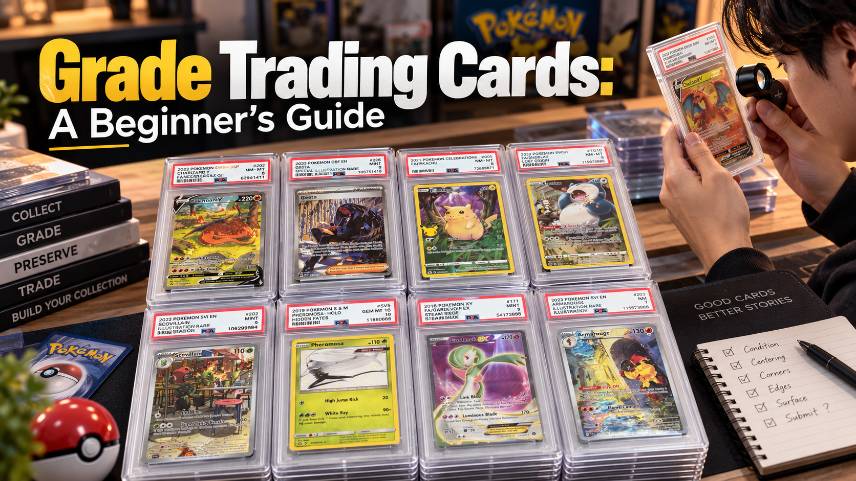
When you grade trading cards, the company does two jobs. First, it authenticates the card. Second, it assigns a condition grade, usually on a 1 to 10 scale.
After that, it seals the card in a tamper-evident plastic holder, called a slab, with the grade printed on the label.
That slab does something simple but valuable. It turns a subjective argument into a number a buyer can trust without holding the card.

Should You Grade Trading Cards at All?
Of course, you should run the maths before anything else. Here is the rough test.
- The card must be worth roughly 5 to 10 times the grading fee in its likely grade.
- The card must be in genuinely strong condition. A 9 rarely pays for itself on modern cards. A 10 does.
- There must be demand. Check completed sales for that exact card, in that exact grade.
A $20 card graded for $20 is a $20 card in plastic. Meanwhile a $300 card that grades 10 might sell for $900.
Vintage is the exception, though. Older cards get graded at much lower values, because authentication alone matters when counterfeits are common.
What Graders Check When They Grade Trading Cards
Every company assesses the same four factors when they grade trading cards. Learn them and you can pre-screen your own cards.
Centering. How evenly the border frames the image, front and back. This is the most common reason a card misses a 10, and you can measure it with a ruler.
Corners. Look for sharpness under a light. Any softness, fraying, or whitening drops the grade fast.
Edges. Check for nicks, chipping, and whitening along all four sides. Dark-bordered cards show this brutally.
Surface. Scratches, print lines, dimples, and loss of gloss. Tilt the card under a bright light and look across it, not at it.
Where to Grade Trading Cards in 2026
Notably, the landscape shifted hard this year, so ignore any guide written before summer.
| Company | Rough cost | Turnaround | Best for |
|---|---|---|---|
| PSA | From about $80 | 40–50 business days | Maximum resale value |
| CGC | About $12–17 bulk | 100–130 business days | Cheap bulk submissions |
| SGC | About $15–25 | 20–50 business days | Vintage cards |
| BGS (Beckett) | About $20–80 | Varies | Subgrades and Black Label |
| TAG | About $12–19 | 15–30 days | Machine grading with detailed reports |
Three things you need to know before choosing.
PSA paused its Value tiers in June 2026. The cheap $25 option is gone for now. The cheapest active PSA service is Regular, at roughly $80 per card. That single change broke most people’s grading maths overnight.
PSA still resells highest. A PSA 10 typically fetches 10 to 30% more than a CGC 10, and the gap can reach 50% on modern sports cards. So the higher fee is sometimes still correct.
Ownership consolidated. Collectors Holdings now owns PSA, SGC, and Beckett. CGC is the only large independent left. Whether that matters to you is a judgement call, but it is worth knowing who you are paying.
Prices and pauses move constantly. Always check the company’s own page the week you submit.
How to Grade Trading Cards Yourself First
Before you pay anyone to grade trading cards, screen them yourself. This step separates profitable submissions from expensive ones.
- Work under bright, angled light. A desk lamp at 45 degrees shows surface flaws that overhead light hides.
- Use a loupe or your phone’s macro mode on all four corners.
- Measure centering. Compare the left and right borders, then top and bottom. Anything worse than roughly 60/40 will not hit the top grade.
- Check the back too. Plenty of perfect fronts fail on back centering.
- Be pessimistic. Assume the grade one level below what you hope for, then check whether the card is still worth submitting.
Several services now offer AI pre-grading from photos for a fraction of a dollar. They are not perfect. Still, they cost far less than a wasted $80 submission.
Preparing a Submission
Besides picking the right cards, you must pack them properly. Otherwise you will damage them in transit.
- Penny sleeve first, opening facing up.
- Then a semi-rigid holder, the Card Saver 1 style. Never use a top loader for submissions.
- Never tape the holder shut.
- Never clean, trim, or press a card. All three count as alteration, and getting caught ends your account and the card’s value.
- Fill the online form first, then pack in the order the form lists.
- Insure the package for its declared value, both directions.
In addition, budget for the hidden costs. Shipping runs $15 to $30 each way, and insurance adds a few dollars per hundred of value.
Selling a Graded Card
Once you grade trading cards successfully, you have four realistic selling routes. Naturally, they trade price against effort.
eBay reaches the most buyers. Fees run around 13%, so factor that in before celebrating a sale price.
Auction houses such as Goldin or Heritage suit cards above roughly $1,000. They take a cut but reach serious money.
Card shops and shows pay less, usually 60 to 70% of market. In exchange you get cash today and no shipping risk.
Consignment services sit in between. They handle photos, listing, and shipping for a percentage.
Whichever route you pick, price against completed sales of that exact card in that exact grade. Asking prices are fiction. Only sold prices are data.
Scams and Altered Cards
Sadly, this corner of the hobby attracts fraud. So learn the two main forms.
Altered cards have been trimmed, recoloured, or pressed to hide flaws. If a raw card’s edges look too perfect for its age, be suspicious.
Fake slabs exist too. Every major grader has an online population report and certificate lookup. Type the cert number in before you buy anything expensive. It takes ten seconds.
Also treat “guaranteed 10” claims as a red flag. Nobody can guarantee a grade, including the person selling you a pre-screening service.
A Realistic First Submission
Start small. First, pick three to five cards you already believe are near-perfect, and where the graded value clearly justifies the fee.
Then pick a company based on the card, not on habit. Vintage goes to SGC. Bulk modern goes to CGC. A genuine chase card goes to PSA if it clears the fee.
Finally, keep your expectations honest. Grading is not an investment strategy, and most cards are worth more as cards than as slabs. The PSA site publishes current pricing, population reports, and the certificate lookup for free.
For more on the collectible side, our collectible and trading card games section covers the games behind the cards, and the Disney Lorcana guide is a good example of a modern set where chase cards drive the grading market.