It began as a fictional duel in the pages of a manga — and became a global phenomenon that reshaped how the world plays cards. The Yu-Gi-Oh! Trading Card Game (TCG) is more than a contest of monsters and spells; it’s a bridge between imagination and competition, a twenty-five-year experiment in strategy, creativity, and community.
The Rise of a Global Duel
The modern Yu-Gi-Oh! TCG was launched by Konami on February 4, 1999, transforming Kazuki Takahashi’s manga concept of Duel Monsters into a real, playable card system. What started in Japanese classrooms spread like wildfire — to North America in 2002, distributed under license by Upper Deck Entertainment, and then fully unified under Konami by 2008.
By July 2009, Guinness World Records named Yu-Gi-Oh! the best-selling trading card game on the planet, having sold over 22 billion cards. As of 2025, that number exceeds 35 billion, spanning tournaments, local shops, and digital platforms worldwide.
Unlike its Western counterpart Magic: The Gathering, Yu-Gi-Oh! bridged storytelling and competitive gaming: every duel echoed the anime’s drama, every monster reflected the spirit of a character.
From Manga to Mechanics


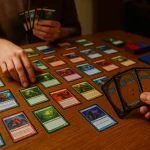
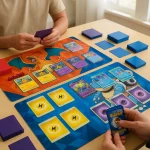
At its core, Yu-Gi-Oh! is a two-player duel where each starts with 8,000 Life Points and a 40–60-card deck. The battlefield, known simply as the Field, is divided into zones that determine where monsters, spells, and traps are placed.
The Deck and Its Arsenal
Each deck contains three categories of cards:
- Monster Cards (orange) – The heart of every deck, used to attack, defend, and summon powerful allies.
- Spell Cards (green) – Magical abilities that boost monsters, draw cards, or change the state of play.
- Trap Cards (purple) – Strategic surprises that counter opponents’ moves.
Players may also prepare an Extra Deck (Fusion, Synchro, Xyz, Link Monsters) and an optional Side Deck for between-match adjustments.
How a Duel Unfolds
A turn in Yu-Gi-Oh! follows a six-phase rhythm — Draw, Standby, Main 1, Battle, Main 2, End — a deliberate pacing that balances preparation and aggression.
Victory can come in several ways:
- reducing the opponent’s Life Points to zero,
- forcing them to draw from an empty deck, or
- fulfilling a special win condition (such as completing Exodia the Forbidden One).
Each move is governed by the game’s sacred structure: the chain system, a stack-like mechanic that allows both duelists to respond in sequence, mirroring the tactical back-and-forth of a chess match with supernatural flair.
The Evolution of Summoning

No other trading card game re-engineers its mechanics as often — and as boldly — as Yu-Gi-Oh! has.
Each generation of anime introduced new summoning systems that changed the competitive meta:
| Era | Mechanic | Debut | Concept |
|---|---|---|---|
| Classic | Fusion Summon | 1999 | Combine monsters using Polymerization. |
| GX Era | Ritual Summon | Early 2000s | Tribute specific monsters via ritual spells. |
| 5D’s Era | Synchro Summon | 2008 | Tune monsters together to match a level. |
| ZEXAL Era | Xyz Summon | 2011 | Overlay monsters of equal level to call rank-based power. |
| ARC-V Era | Pendulum Summon | 2014 | Use pendulum scales to summon multiple monsters at once. |
| VRAINS Era | Link Summon | 2017 | Create directional networks that open new zones. |
Each innovation kept the ecosystem alive, introducing fresh strategies without discarding the old. The result is a layered, ever-evolving universe where a 2002 Blue-Eyes White Dragon can still face a 2025 Firewall Dragon Darkfluid.
Inside the Competitive Arena

The global scene operates under Konami’s Advanced Format, updated quarterly via the Forbidden and Limited List. Certain cards — like Change of Heart or Pot of Greed — rotate between freedom and restriction, shaping deck archetypes and tournament metas.
Players compete in local shops, regionals, and Yu-Gi-Oh! Championship Series (YCS) events, culminating in the World Championship. With formats ranging from Traditional (looser bans) to Time Wizard (retro metas), the community honors every era of the game’s history.
Two modern variants have further diversified the landscape:
- Speed Duel (2019) — a simplified, fast-paced mode inspired by the Duel Links mobile game; 4,000 LP, three monster zones, and Skill Cards themed after iconic anime duelists.
- Rush Duel (2020) — launched in Japan with the Yu-Gi-Oh! Sevens series, featuring streamlined summoning and unlimited monster plays per turn.
Both were designed to make Yu-Gi-Oh! more approachable for newcomers while preserving its strategic DNA.
A Universe of Archetypes
The brilliance of Yu-Gi-Oh! lies in its archetypes — themed card sets that tell self-contained stories:
- Dark Magician and Blue-Eyes White Dragon recall the rivalry of Yugi and Kaiba.
- Elemental HERO champions the superheroic optimism of the GX era.
- Sky Striker, Salamangreat, and Dragon Link reflect modern cyber warfare.
Each archetype represents not just strategy, but identity: a blend of art, lore, and mechanical philosophy that invites creative deck-building across generations.
Beyond the Table: Digital and Impact Of Yu-Gi-Oh!
Yu-Gi-Oh! was never confined to cardboard. The anime, beginning in 2000 with Duel Monsters, turned dueling into an emotional narrative of friendship, courage, and destiny. Characters like Yugi Mutou, Seto Kaiba, and Joey Wheeler made the mechanics feel human.
Digitally, Konami extended that vision through Yu-Gi-Oh! Duel Links (2016), Master Duel (2022), and Cross Duel (2023) — platforms where millions duel globally in real time, with official rule sets and cross-platform leaderboards.
Culturally, Yu-Gi-Oh! helped define early-2000s childhood alongside Pokémon and Digimon. It pioneered the concept of a narrative-driven trading card game, merging fiction and play, and inspired countless fan creators, artists, and cosplayers worldwide.
Five Facts That Define the Phenomenon
- Guinness World Record Holder – First TCG to surpass 22 billion cards sold (2009).
- Cross-Media Origin – Began as a manga mini-arc before spawning anime, films, and a real card empire.
- Continuous Reinvention – Over 10,000 unique cards released, each compatible with earlier sets.
- Cultural Integration – From café duels in Rome to official esports-style arenas in Tokyo.
- Global Longevity – Still actively updated by Konami Digital Entertainment after 26 years.
Strategy, Art, and the Human Duel
Every duel in Yu-Gi-Oh! is a conversation between creativity and control. Victory demands calculation, but triumph feels emotional — a reflection of its anime roots, where heart and logic coexist.
The game teaches anticipation, adaptation, and respect — values that extend beyond play. As players draw their opening hands, they inherit a shared ritual connecting school desks in 1999 Tokyo to livestream finals in Los Angeles 2025.
More than monsters and traps, Yu-Gi-Oh! is a reminder that imagination is a force worth dueling for.