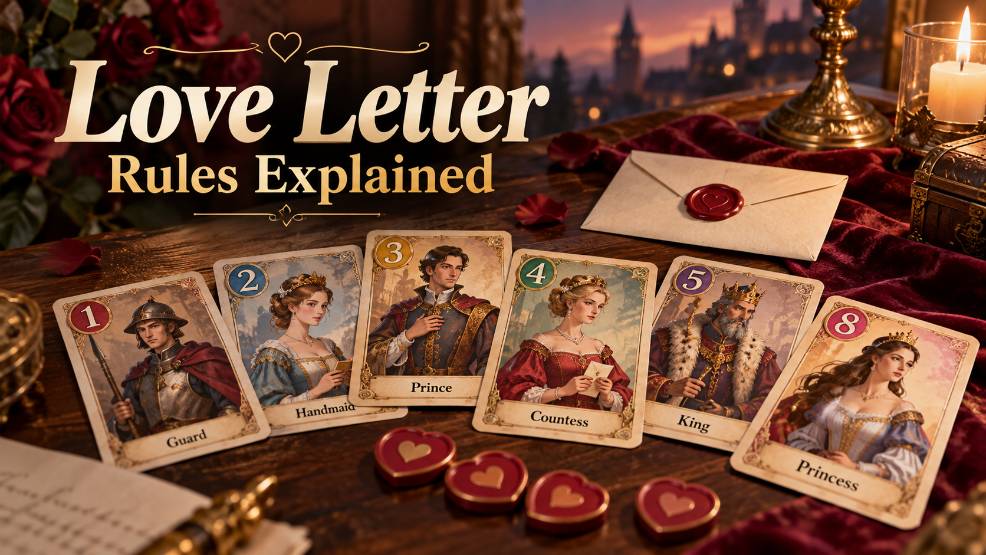
cardanoir.com – The Love Letter rules fit on the back of the box. You hold one card. On your turn you draw a second, then play one of them. That is the entire game.
Seiji Kanai designed it in 2012 with sixteen cards and nothing else. It went on to become the template for an entire category of tiny games, and it still beats most of them.
What Love Letter Is
The Love Letter rules pit two to six players against each other, all trying to deliver a letter to the Princess. Mechanically, you are trying to be the last player standing, or to hold the highest card when the deck runs out.
Each round lasts two or three minutes. You win a round, you take a token, and then you deal again.
Crucially, you only ever hold one card between turns. So the whole game is deduction: working out what everyone else is holding from what they played and how they behaved.

Love Letter Rules: Setting Up
- Shuffle the deck.
- Remove one card face-down, without looking. Nobody ever sees it.
- Deal one card to each player.
- Youngest player goes first, or use any method you like.
That removed card is the reason the game works. Because one card is always missing, you can never deduce the table with certainty, and that sliver of doubt keeps every round tense.
Love Letter Rules: Taking a Turn
Of course, your turn is only three steps, always in this order.
- Draw one card. You now hold two.
- Play one of them, face-up in front of you.
- Resolve its effect.
You keep the other card. That is it. Then play passes to your left.
Meanwhile, played cards stay visible, which matters more than beginners realise. Anyone can look around the table and count what has already gone.
Love Letter Rules for Every Card
Notably, these are the values from the current edition. The classic 2012 set uses the same characters minus two, with values shifted down by one.
| Card | Value | Effect |
|---|---|---|
| Spy | 0 | If you are the only player who played or discarded a Spy, take a bonus token |
| Guard | 1 | Name a card, guess another player’s hand. Correct, they are out |
| Priest | 2 | Look at another player’s hand |
| Baron | 3 | Compare hands privately with another player. Lower value is out |
| Handmaid | 4 | You cannot be targeted until your next turn |
| Prince | 5 | Choose any player, including yourself, to discard and draw a new card |
| Chancellor | 6 | Draw two cards, then put two of your three on the bottom of the deck |
| King | 7 | Swap hands with another player |
| Countess | 8 | Must be played if you also hold the King or Prince |
| Princess | 9 | If you ever discard this card, you are out |
One restriction applies throughout. If every other player is protected by a Handmaid, you must still play a card, but its effect simply does nothing.
The Guard cannot be guessed. Naming “Guard” is never a legal guess, which trips up new players constantly.
Two Love Letter Rules That Punish You
Two cards carry Love Letter rules that work against you rather than for you.
The Countess must be played the moment you also hold the King or the Prince. You have no choice. However, you may also play her voluntarily at any time — and clever players do exactly that, because a voluntary Countess makes everyone suspect you are holding royalty.
The Princess eliminates you if she ever leaves your hand. Not if she is beaten. If she is discarded, for any reason, you are out. So a Prince played at the right moment is the most brutal card in the game.
Those two interact. Getting hit by a Prince while holding the Princess is the classic way to lose a round you were winning.
How a Round Ends
Under the Love Letter rules, a round ends in one of two ways.
Everyone else is eliminated. The last player standing wins.
The deck runs out. Every remaining player reveals their card, and the highest value wins.
Either way, the winner takes a token of affection. The number of tokens needed depends on the player count — in the classic edition, seven for two players, five for three, and four for four. Larger games in the current edition need fewer.
Love Letter Rules for Two Players
Although the game plays the same, the two-player version needs one change. It is easy to miss.
After removing the usual face-down card, also remove three more cards face-up where both players can see them. Those three are out of the round, and both of you know it.
That adjustment exists because a two-player deck would otherwise be too predictable. With three cards visible, deduction still works, but it is not solved.
The 2019 Edition and the Classic 16
First, the original 2012 game is sixteen cards, two to four players. It is still excellent, and plenty of people prefer it.
The current edition adds five cards: two Spies, two Chancellors, and one extra Guard, bringing the deck to twenty-one and the player count to six. Artwork changed too, along with the card values, which all shifted up by one to make room for the Spy at zero.
Want the classic experience from the new box? Remove the Spies, the Chancellors, and one Guard. You are back to the original sixteen.
In practice, both work. Still, for a group of five or six, only the newer edition handles it properly.
Strategy That Actually Works
Once the Love Letter rules are clear, these habits win rounds.
- Count the Guards. There are six, and they are a third of the deck. If several have gone, bluffing gets safer.
- Track what is played. Every discard is public. Two Princes are out? Your Princess is far safer.
- The Priest is not weak. Knowing one hand for certain is worth more than a random Guard guess.
- Play the Handmaid when you are the obvious target, not just when you have nothing better.
- Guess high with the Guard early. A 5 or higher in someone’s hand is more likely at the start of a round.
- Hold the King carefully. Swapping hands gives away information about what you had.
Why It Works Anywhere
The whole game fits in a pocket, and a round takes minutes. That combination is why Love Letter ends up at airports, in restaurants, and on camping trips.
Besides that, it teaches deduction painlessly. Children pick it up in one round, and adults still find the bluffing interesting on the hundredth.
Above all, elimination does not hurt here. You are out for ninety seconds, then you deal again. That is the trick almost every other elimination game gets wrong.
For a fuller look at the game’s design, Meeple Mountain’s review covers both editions well. Our family and party card games section has more for mixed groups, and the Codenames guide is the natural companion when your group is larger than six.