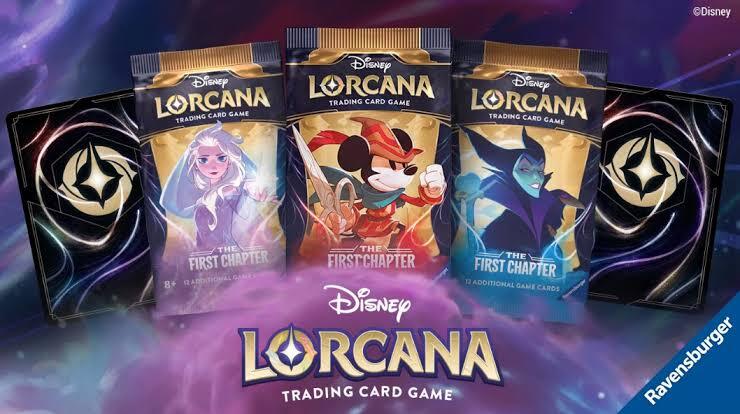
cardanoir.com – The Disney Lorcana rules are the friendliest entry point in modern trading card games, and that is not an accident. Ravensburger built the game for people who had never touched a TCG before, so the whole system fits on a single page.
You are not casting spells or reducing an opponent to zero. Instead, you are collecting lore, and the first player to 20 wins. Everything else exists to speed that up or slow your opponent down.
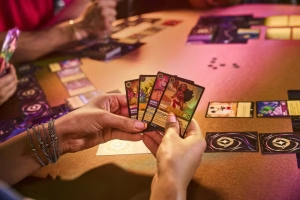
What Disney Lorcana Actually Is
Ravensburger launched Disney Lorcana in August 2023, with Ryan Miller and Steve Warner leading the design. It was the publisher’s first trading card game, and it arrived with an enormous licence behind it: characters from across Walt Disney Animation, The Disney Afternoon, and now Pixar as well.
In the game’s fiction you play an Illumineer, summoning glimmers — magical versions of Disney characters — to gather lore. A match runs about 30 to 45 minutes, the box says ages 8 and up, and honestly that age rating holds up.
Disney Lorcana Rules: What You Need to Play
Deck construction is short enough to memorise in one read:
- Minimum 60 cards. There is no maximum, but almost nobody goes above 60.
- Maximum 4 copies of any card with the same full name.
- Maximum 2 ink colours per deck. This is the big one.
- A lore tracker for each player, counting from 0 to 20.
That two-ink limit shapes everything in the Disney Lorcana rules. It forces real choices during deck building, and it stops the format collapsing into decks that play the best card from every colour.
The Six Inks
Every card belongs to one of six inks, and each one has a personality:
- Amber — support, healing, and wide boards of small characters
- Amethyst — card draw, bouncing characters back to hand, and trickery
- Emerald — evasive characters, discard effects, and disruption
- Ruby — speed, aggression, and direct damage
- Sapphire — ink ramp, items, and long-game value
- Steel — durable characters, banishment, and brute removal
Nothing in the Disney Lorcana rules favours one ink over another, and beginners usually do best pairing one aggressive ink with one that draws cards, though every combination has competitive decks somewhere.
Disney Lorcana Rules: How a Turn Works
Each turn follows the same short sequence:
- Ready. Turn all your exerted cards upright again.
- Set. Resolve anything that triggers at the start of your turn.
- Draw. Take one card. The player going first skips this on turn one.
- Main phase. Do as much as you can afford, in any order.
- End. Pass the turn.
The main phase holds every real decision. You may ink one card per turn, placing a card from your hand face-down in your inkwell as a permanent resource — but only cards with the swirl symbol beside their cost qualify. That single restriction is the heart of the game, because inking a card means giving up whatever that card would have done for you.
Then you spend ink to play characters, items, actions, and locations. Characters cannot quest, challenge, or sing on the turn you play them; players call this drying, and only the Rush keyword bypasses it.
Questing or Challenging: The Heart of the Disney Lorcana Rules
Every dry character can do exactly one thing per turn, and choosing between the two options is the entire game.
Questing means exerting a character to gain lore equal to the diamond value on its card. That is how you actually win.
Challenging means exerting your character to attack an opposing character that is already exerted. Both characters deal damage equal to their Strength to each other, and a character is banished once damage reaches its Willpower. Crucially, damage stays on characters between turns.
So the tension is permanent. Quest, and your character sits exerted and vulnerable. Hold back to challenge, and you gain no lore that turn. Because you can only attack exerted characters, an opponent who quests aggressively hands you targets — which is why racing to 20 without defending rarely works.
Disney Lorcana Rules for Songs, Items, and Locations
Three card types sit alongside characters, and the Disney Lorcana rules treat each differently.
Songs are actions with a singer cost printed on them. Rather than paying ink, you may exert a dry character whose cost equals or exceeds that number, and the song plays free. Learning to sing instead of paying is the first real skill jump for new players.
Items stay on the board and provide ongoing or activated effects. Many need exerting to use, so they compete for nothing else on your turn.
Locations arrived in the third set. They have a cost, willpower, and often lore, and they generate that lore automatically at the start of your turn. You can move characters into a location for its move cost, which usually protects them or powers them up.
Keywords You Will Meet Early
- Rush — can challenge the turn it is played
- Evasive — only other Evasive characters can challenge it
- Bodyguard — must be challenged before your other characters
- Ward — cannot be chosen by opponents’ effects
- Support — adds its Strength to another character when it quests
- Challenger +N — gets bonus Strength while challenging
- Resist +N — reduces incoming damage
- Shift — play this version on top of a same-named character for a cheaper cost
- Reckless — must challenge if able, and cannot quest
Keywords stack on top of the basic Disney Lorcana rules rather than replacing them. Shift is worth extra attention, since it lets you skip the cost curve entirely and is central to many competitive decks.
Where the Game Stands in 2026
Ravensburger ships four sets a year plus one standalone cooperative release, which is a fast pace even by TCG standards. Thirteen main sets have landed since The First Chapter, ending most recently with Attack of the Vine! in July 2026, which brought in Monsters, Inc. glimmers. Hyperia City follows on 23 October 2026 with Coco characters, and Illumineer’s Quest: The Great Hunny Rescue arrives the same month as a four-difficulty cooperative box.
One thing new players should understand before spending: Lorcana rotates. The Core Constructed competitive format drops older sets as new ones arrive, while Infinity Constructed keeps the full card pool subject to its own banned list. So a card you buy today stays legal somewhere permanently, but not necessarily in the format your local shop runs next year.
How to Actually Start Playing
Buy a starter product rather than boosters. The 2-Player Starter Set released in May 2026 is the cleanest option, since it contains two complete 60-card decks — Amber and Emerald against Amethyst and Ruby — plus lore trackers and tokens, so two people can play immediately with nothing else.
After that, play the decks as they came for a few games before changing anything. Then add a booster box of whatever set is current, build toward one of your two inks, and ignore chase card prices entirely while you learn. The official Disney Lorcana site publishes the full rulebook and the current banned lists for free, and you should read the rulebook once properly — it takes about fifteen minutes and settles most table arguments before they start.
For a sense of how this compares to other collectible games, our collectible and trading card games section covers the wider field, and the One Piece Card Game guide makes a useful contrast — same category, completely different resource system.