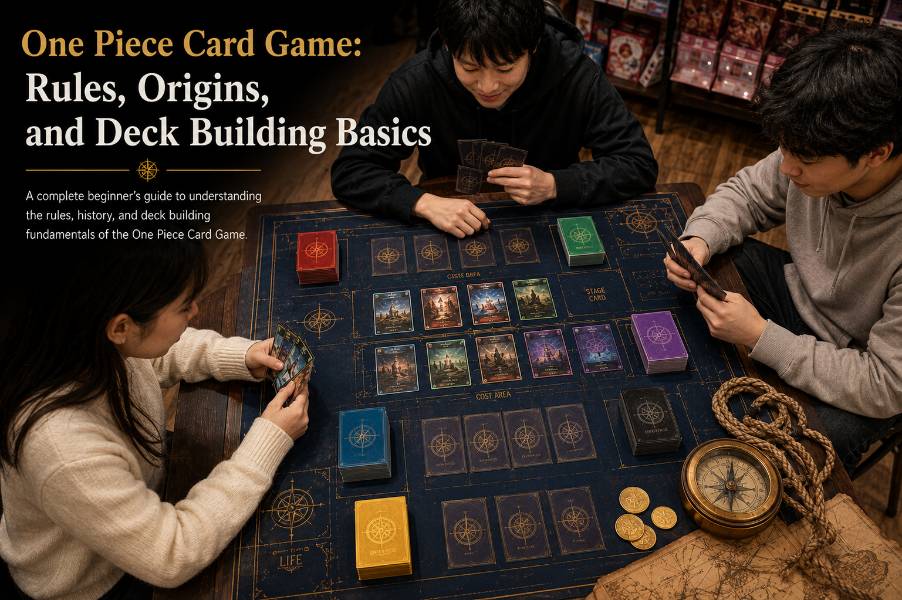
cardanoir.com – Few trading card games have grown as fast as Bandai’s take on the world’s best-selling manga. The One Piece card game rules look intimidating from the outside — a second deck made of shouting resource cards, life totals that feed your hand, colors that lock your deck list — but the whole system clicks after one or two games. There is no mana screw, no complicated summoning chain, and no long ramp-up before the fun starts.
This guide walks through the complete One Piece card game rules: where the game came from, what you need to play, how a turn flows, how battles resolve, and how to build a legal deck that actually works.
What Is the One Piece Card Game?
The One Piece Card Game is a two-player trading card game published by Bandai, based on Eiichiro Oda’s long-running manga and anime series. Each match takes roughly 15 to 20 minutes and is built around one central idea: your Leader is your captain, and the game ends when one captain takes one hit too many.
Unlike older collectible card games, there are no resource cards clogging your deck. Every player gets the same resource ramp on schedule, so games rarely stall out. What separates a good player from a bad one is sequencing — when to attack, when to hold back cards for defense, and how much power to commit each turn.
The Origins of the Game
Bandai launched the One Piece Card Game in Japan in July 2022, followed by the English release in December of the same year. The timing was close to perfect. The manga was deep into its final saga, the anime audience was global, and the trading card market was hungry for something new after years dominated by the same handful of names.
The design borrowed the automatic resource system familiar from digital card games, then layered on a defense mechanic that gives the defending player the last word in every battle. That single decision — that you are never truly helpless on your opponent’s turn — is a big part of why the game caught on with competitive players rather than staying a collector’s product.
What You Need to Play
- A Leader card (1 per deck)
- A main deck of exactly 50 cards
- A DON!! deck of exactly 10 cards
- An opponent with the same setup
- A playmat or flat surface, and around 20 minutes
A Starter Deck gives you all of this in one box, which is why most players begin there instead of buying loose boosters.
One Piece Card Game Rules: Setting Up the Match
- Place your Leader card face-up in the Leader Area at the center of your side of the board.
- Decide who goes first by any random method — a coin flip or dice roll works.
- Shuffle your 50-card deck and draw 5 cards.
- Take your mulligan if you want one. Each player may return their whole hand once, shuffle, and draw 5 new cards.
- Set your Life cards. Take cards from the top of your deck equal to your Leader’s Life value — usually 4 or 5 — and place them face-down in the Life Area.
- Place your 10-card DON!! deck face-down to the side.
The player going first takes 1 DON!! card and skips their draw for that first turn. This offsets the advantage of acting first.
One Piece Card Game Rules: Turn Structure
Every turn follows the same five phases:
- Refresh Phase — Return any DON!! attached to cards back to your Cost Area, then set all your rested cards upright (active) again.
- Draw Phase — Draw 1 card. The player going first skips this on turn one.
- DON!! Phase — Add 2 DON!! cards from your DON!! deck to your Cost Area, face-up and active. On the very first turn of the game, the starting player adds only 1.
- Main Phase — Play cards, attach DON!!, activate effects, and attack in any order you like.
- End Phase — Resolve any “end of turn” effects, then pass to your opponent.
Costs are paid by resting DON!! cards — turning them sideways. Since DON!! refreshes every turn, your available resources climb steadily instead of depending on lucky draws.
The Five Card Types
- Leader: Your captain. It sets your deck’s colors, carries a Life value, has its own Power so it can attack and be attacked, and stays on the field for the entire game.
- Character: Your crew. These make up most of your deck and carry a Cost, Power, and Counter value. Characters can’t attack on the turn they’re played unless they have Rush.
- Event: One-shot effects played from hand, then sent to the Trash. Many double as Counter cards during your opponent’s turn.
- Stage: Persistent cards that sit on the field and change what’s possible, usually with an activated effect once per turn.
- DON!!: Your resource. They pay costs, and attaching one to a Leader or Character during your turn adds +1,000 Power to it.
How Battles Actually Work
Attacking is where most of the One Piece card game rules live, and the sequence is short:
- Declare the attack. Rest an active Character or your Leader and choose a target — your opponent’s Leader, or one of their rested Characters. Active Characters can’t be attacked.
- Block step. The defender may rest a Character with the Blocker keyword to redirect the attack onto itself.
- Counter step. The defender may play Counter cards from hand or use Event cards to raise the defending card’s Power. This is the defender’s real chance to survive.
- Compare Power. If the attacker’s Power is equal to or higher than the defender’s, the attack succeeds.
When an attack on a Character succeeds, that Character is KO’d to the Trash. When an attack on a Leader succeeds, the defender takes the top card of their Life Area into their hand — and if that card has a Trigger effect, they may activate it for free right then.
You win by landing a successful attack on a Leader whose Life Area is already empty. The alternative win condition is decking your opponent out: if a player cannot draw when required, they lose.
Deck Building Basics
The construction rules are strict but simple:
- Exactly 50 cards in the main deck.
- Exactly 10 DON!! cards in the DON!! deck.
- Maximum 4 copies of any card, counted by card number rather than name.
- Every card in your deck must share at least one color with your Leader.
That last rule is the one that shapes everything. A mono-color Leader gives you a tighter, more consistent deck; a two-color Leader opens up a much wider card pool but asks for more careful curve management.
The six colors each play differently:
- Red — aggressive, cheap Characters, Rush effects
- Green — resting and reactivating cards to control the board
- Blue — bouncing Characters back to hand and controlling the deck
- Purple — DON!! ramp, trading resources for early power
- Black — cost reduction and removal
- Yellow — life manipulation and comeback effects
A common beginner mistake is filling a deck with high-Cost bombs. In practice, most competitive lists are heavy on Characters costing 1 to 5 with strong Counter values, because a card sitting in your hand as defense is worth as much as one on the field.
Tips for New Players
- Read Counter values before you play a card. Every Character you drop is one less point of defense in hand.
- Don’t over-attach DON!!. Attached DON!! only counts during your own turn, so dumping everything into one swing leaves you exposed.
- Attack the Leader early. Taking Life cards forces your opponent to spend resources defending, even if it also feeds their hand.
- Watch your opponent’s active Characters. They can’t be attacked, but they can Blocker your next swing.
- Learn your Leader’s effect first. Most Leaders have one ability that defines the entire deck’s game plan.
Why the Game Took Off
The One Piece Card Game did something unusual for a licensed TCG: it built a format that competitive players respect. The Life-into-hand mechanic means falling behind actually arms you, so comebacks are common and matches stay tense. The defender’s Counter step keeps both players engaged during every turn instead of one player watching.
Add a fanbase that already spans decades and artwork pulled from one of the most recognizable series in manga history, and the growth makes sense. Bandai has kept a steady set release schedule since launch, with Starter Decks that stay affordable enough for new players to jump in without chasing a chase card first.
Rules Mistakes New Players Make Most Often
Almost every misplay in a first match traces back to the same handful of misunderstandings:
- Attacking active Characters. You can only attack a Character that is rested. An active Character is untouchable until it commits to something.
- Forgetting that attached DON!! goes home. Any DON!! attached to a card returns to your Cost Area during your next Refresh Phase, so the power boost is strictly temporary.
- Playing a Character and swinging with it immediately. Without the Rush keyword, a Character has to wait until your following turn before it can attack.
- Treating Life cards as pure damage. Each Life card you lose goes into your hand, which means a low-Life opponent is often the one holding more answers.
- Ignoring the Counter symbol. The number in the bottom-left of a Character card is what it’s worth as defense from hand. Cards with a 2,000 Counter are frequently better left unplayed.
Where to Start Buying
Starter Decks are the standard entry point. Each one comes with a Leader, a legal 50-card deck, and the full 10-card DON!! deck, so two boxes are enough for two people to play immediately with no other purchase. They’re tournament-legal as-is, though most players eventually swap in cards from booster sets to tighten consistency.
Boosters are where the competitive staples and alternate-art cards live, but opening them without a deck plan is an expensive way to end up with cards you can’t legally run — remember that every card has to share a color with your Leader. Picking a Leader first, then buying toward it, saves a lot of money in the first few months.
If you’re weighing this against other collectible titles before committing, our overview of collectible and trading card games breaks down how the major TCGs compare on cost, complexity, and community size.