cardanoir.com – Almost nobody reads the rulebook for this one, and the Cards Against Humanity rules are simple enough that it rarely matters. Someone deals, someone explains the round badly, and the game starts anyway. That works, but it also means most groups play for years without ever trying the official variants printed in the box.
So here are the Cards Against Humanity rules in full: the round structure, the special cards, the house rules, and the practical stuff that decides whether a session lands or dies.

What the Game Actually Is
Cards Against Humanity is a fill-in-the-blank party game for four or more players. Eight friends from Highland Park, Illinois built it, funded it on Kickstarter in 2011, and blew past their modest goal almost immediately.
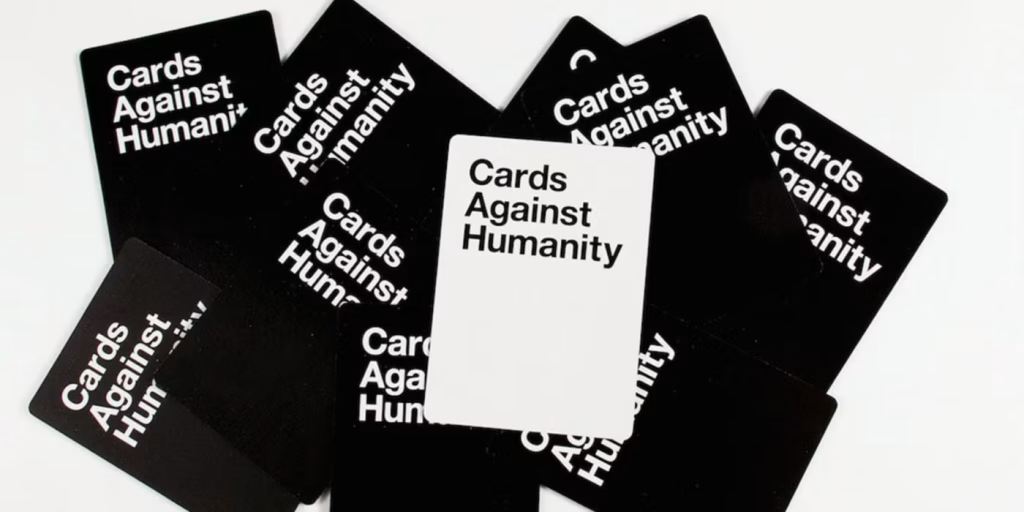
The deck splits into two types. Black cards ask a question or set up a sentence with a blank. White cards supply the answers. Older printings shipped 550 cards, while the current base set runs closer to 600, and dozens of expansion packs exist beyond that.
One detail sets the game apart from every other boxed title: the creators publish the whole thing as a free PDF, and they always have. You can print it yourself legally, though you cannot sell what you print. The Cards Against Humanity rules stay identical whichever version you end up holding.
Cards Against Humanity Rules: The Basic Round
The core loop barely changes from round to round.
- Deal 10 white cards to every player.
- Pick a Card Czar. Whoever most recently pooped starts, according to the rulebook. Any method works.
- The Czar draws a black card and reads it aloud to the table.
- Everyone else answers. Each player picks the white card from their hand they think the Czar will find funniest, then passes it face-down.
- The Czar shuffles the answers and reads every one out loud, ideally re-reading the black card each time.
- The Czar picks a winner. That player keeps the black card as one Awesome Point.
- Everyone draws back up to 10, and the Czar role passes to the left.
Two things carry the whole game, and the Cards Against Humanity rules only hint at both. First, answers must stay anonymous, so the Czar cannot know who played what. Second, the Czar reads everything aloud, because delivery matters more than the card itself.
Cards Against Humanity Rules for Special Cards
Some black cards break the standard shape:
- Pick 2. The black card has two blanks, so each player submits two white cards. Order matters, and you should say which card goes first.
- Draw 2, Pick 3. Players draw two extra cards, then submit three in a set order. These rounds run long, so keep them rare.
Those two formats are the only genuine exceptions in the Cards Against Humanity rules. Beyond them, blank white cards ship with several sets. Groups either love them or ban them by round three, and both reactions are reasonable.
Cards Against Humanity Rules: How the Game Ends
Officially, you play until you run out of black cards or people get bored. Neither is a real ending, so most groups pick one of these instead:
- First to a set score. Five or seven Awesome Points works well for a single evening.
- A fixed number of rounds, so everyone gets the Czar seat an equal number of times.
- Whenever the energy drops. Honestly, this is the correct answer. The game peaks and then declines sharply, and stopping on a high beats grinding to a total.
Variants That Bend the Cards Against Humanity Rules
The official rulebook includes a set of house rules, and most players have never tried them. These are the ones worth your time:
- Rando Cardrissian. Each round, draw one random white card and add it to the pile as an invisible extra player. If Rando wins the game, everyone else should go home. It works better than it has any right to.
- God Is Dead. Remove the Czar entirely. Everyone answers, then everyone votes, and nobody can vote for themselves.
- Never Have I Ever. Any player may discard a card they do not understand, but they must confess their ignorance to the table first.
- Rebooting the Universe. At any point, a player may trade in one Awesome Point to discard their hand and draw ten fresh cards.
- Packing Heat. For every Pick 2 round, everyone draws an extra card first. This one just makes the long rounds better.
- Survival of the Fittest. After the Czar reads all the answers, they discard the worst ones one at a time, narrating why. Cruel, and very funny.
- Serious Business. The Czar ranks the top three answers, awarding three, two, and one point. It rewards consistency over one lucky card.
Mix at most two of these at a time. Otherwise the round structure gets muddy and the pace dies.
Party Tips That Actually Matter
None of this appears in the printed Cards Against Humanity rules, yet it decides how the night goes.
Group size is everything. Four players is the legal minimum, but the game really works between five and eight. Above ten, each player waits too long between turns, and the reading takes forever. Therefore, split a big party into two tables rather than running one giant game.
Rotate the reading energy. The Czar has to perform. If someone reads flatly, the round dies regardless of the cards, so encourage people to commit to the bit.
Play at a table, not on a sofa. Players need somewhere to place face-down cards, and they need to not see each other’s hands.
Cap the session. Forty-five minutes to an hour hits the sweet spot. The humour is repetitive by design, and a shorter game leaves people wanting another round next time.
Skip the drinking rules. Plenty of groups bolt on shots for losing a round. It reliably ruins the pacing, and the game is already loud enough.
Read the Room Before You Deal
This part matters more than any variant. The game deliberately includes cards about race, disability, sexual violence, and death, because shock is the entire mechanic. That works with a group that opted in knowingly. It goes badly with colleagues, in-laws, or anyone who did not.
So do the boring thing beforehand: pull the cards you know will land wrong, and tell people what the game contains before they sit down. Removing cards costs nothing, since nobody tracks the deck contents mid-game. A quick “anything in here you’d rather not see, say so now” also works, and it takes ten seconds.
If the group is mixed, choose a different game entirely rather than a censored version of this one. There are plenty.
Family Edition and Cleaner Options
The publishers eventually built the obvious answer themselves. Cards Against Humanity: Family Edition is a complete rewrite rather than a filtered version of the original, with 600 all-new cards aimed at players aged eight and up, leaning heavily on toilet humour instead of shock. The Cards Against Humanity rules themselves do not change at all; only the content did. They released a free print-and-play version too.
Beyond that, Apples to Apples runs the same mechanic with no edge at all, and it predates Cards Against Humanity by more than a decade. For groups who want the format without the content, that remains the most reliable swap.
Where to Get It Without Buying It
The full game stays available as a free download on the official Cards Against Humanity site, along with printing instructions. All you need is a printer, scissors, and some patience; cutting 600 cards takes a while, so recruit help.
That free version makes this a good first purchase to skip. Print the base set, play it three times, and then decide whether your group wants the boxed copy and the expansions. Most groups discover they only ever needed the base set anyway.
If you want more games that work at this table size, our family and party card games section covers options for mixed groups, while the card game rules guide explains the mechanics these party formats borrow from.