cardanoir.com – Blackjack is the rare card game where the correct play in every single situation has already been calculated. You do not need instinct, and you certainly do not need a feeling about the next card. Blackjack basic strategy is simply a lookup table: your hand on one axis, the dealer’s upcard on the other, and one right answer where they meet.
Computers worked all of this out decades ago by simulating hundreds of millions of hands. So the only real question left is whether you have memorised the answers.
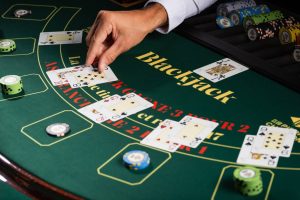
What Blackjack Basic Strategy Actually Is
Basic strategy is the set of decisions that produces the highest expected return using only two pieces of information: the total in your hand, and the card the dealer is showing. It never guesses what comes next, because it does not need to. Instead, it weighs every possible outcome and picks the play that loses the least money over time.
The numbers behind it are stark. A casual player who trusts their gut typically hands the house somewhere around 2% or more. Follow the chart perfectly, however, and that edge drops to roughly 0.5% depending on the table rules. In other words, blackjack basic strategy does not turn the game in your favour — it turns a bad bet into the closest thing a casino floor offers to a fair one.
Why the Chart Works
Two facts drive nearly every decision on the chart.
First, the dealer has no choices. They follow a fixed script: draw to 16, stand on 17. Therefore you can calculate exactly how often they bust from each upcard. A dealer showing 5 or 6 busts roughly 42% of the time, while a dealer showing an Ace busts only about 17% of the time.
Second, you act first. Because of that, busting costs you the hand immediately, even if the dealer would have busted afterwards. So the chart tells you to stand on weak totals when the dealer looks likely to break, and to take risks when the dealer looks strong.
That is the whole logic. Stiff hand against a weak upcard? Stand and let them bust. Stiff hand against a strong upcard? Hit, because standing loses anyway.
Blackjack Basic Strategy Chart: Hard Totals
These charts assume the most common casino setup: four to eight decks, dealer stands on soft 17, doubling after a split allowed, late surrender available.
Key: H = Hit · S = Stand · D = Double (hit if not allowed) · P = Split · Rh = Surrender (hit if not allowed)
| Your hand | 2 | 3 | 4 | 5 | 6 | 7 | 8 | 9 | 10 | A |
|---|---|---|---|---|---|---|---|---|---|---|
| 8 or less | H | H | H | H | H | H | H | H | H | H |
| 9 | H | D | D | D | D | H | H | H | H | H |
| 10 | D | D | D | D | D | D | D | D | H | H |
| 11 | D | D | D | D | D | D | D | D | D | H |
| 12 | H | H | S | S | S | H | H | H | H | H |
| 13 | S | S | S | S | S | H | H | H | H | H |
| 14 | S | S | S | S | S | H | H | H | H | H |
| 15 | S | S | S | S | S | H | H | H | Rh | H |
| 16 | S | S | S | S | S | H | H | Rh | Rh | Rh |
| 17+ | S | S | S | S | S | S | S | S | S | S |
Hard 12 against a dealer 2 or 3 trips up almost every new player. It looks like a stand, but the maths says hit, because those upcards bust far less often than a 4, 5, or 6.
Blackjack Basic Strategy Chart: Soft Totals
A soft hand contains an Ace counted as 11, so you cannot bust with one more card. That safety net is exactly why the chart doubles so aggressively here.
| Your hand | 2 | 3 | 4 | 5 | 6 | 7 | 8 | 9 | 10 | A |
|---|---|---|---|---|---|---|---|---|---|---|
| A,2 (13) | H | H | H | D | D | H | H | H | H | H |
| A,3 (14) | H | H | H | D | D | H | H | H | H | H |
| A,4 (15) | H | H | D | D | D | H | H | H | H | H |
| A,5 (16) | H | H | D | D | D | H | H | H | H | H |
| A,6 (17) | H | D | D | D | D | H | H | H | H | H |
| A,7 (18) | S | D | D | D | D | S | S | H | H | H |
| A,8 (19) | S | S | S | S | S | S | S | S | S | S |
| A,9 (20) | S | S | S | S | S | S | S | S | S | S |
Soft 18 causes more arguments than any other hand. Players see 18 and stand automatically. But against a 9, 10, or Ace, 18 loses more often than it wins, so hitting is correct — and when the double lands against a 3 through 6, take it.
Blackjack Basic Strategy Chart: Pairs
| Your pair | 2 | 3 | 4 | 5 | 6 | 7 | 8 | 9 | 10 | A |
|---|---|---|---|---|---|---|---|---|---|---|
| A,A | P | P | P | P | P | P | P | P | P | P |
| 10,10 | S | S | S | S | S | S | S | S | S | S |
| 9,9 | P | P | P | P | P | S | P | P | S | S |
| 8,8 | P | P | P | P | P | P | P | P | P | P |
| 7,7 | P | P | P | P | P | P | H | H | H | H |
| 6,6 | P | P | P | P | P | H | H | H | H | H |
| 5,5 | D | D | D | D | D | D | D | D | H | H |
| 4,4 | H | H | H | P | P | H | H | H | H | H |
| 3,3 | P | P | P | P | P | P | H | H | H | H |
| 2,2 | P | P | P | P | P | P | H | H | H | H |
Two rows matter more than the rest. Always split Aces and eights; never split tens or fives. Splitting a pair of tens breaks a 20 — the second-best hand in the game — into two mediocre ones, and yet people still do it every night.
Rules That Change the Chart
Not every table plays identically, so check the felt before you sit down. These variations shift the correct plays:
- Dealer hits soft 17. This costs you about 0.2%. Under this rule you also double 11 against an Ace, and you surrender 15 and 17 against an Ace.
- Number of decks. Single-deck games favour the player slightly; six and eight-deck shoes favour the house.
- No double after split. Several pair splits become hits instead, especially the small pairs.
- No surrender. Every Rh in the chart above simply becomes a hit.
- Blackjack pays 6:5 instead of 3:2. Avoid these tables entirely. That single change adds around 1.4% to the house edge, which wipes out everything basic strategy gains you.
Bets the Chart Never Recommends
Basic strategy also tells you what to skip, and this part is short. Never take insurance, and never accept even money — both carry a house edge of roughly 7%. Meanwhile, side bets such as 21+3 or Perfect Pairs typically run anywhere from 2% to 10% against you. They exist because they are profitable for the house, not for you.
Progressive betting systems belong in the same bin. Martingale, Paroli, and the rest change the shape of your wins and losses, but they never change the underlying edge on any individual hand.
How to Memorise Blackjack Basic Strategy
Do not try to swallow all three charts at once. Instead, learn them in layers:
- Start with the always-rules. Always split Aces and eights. Never split tens or fives. Never take insurance. Always stand on hard 17 or higher.
- Then learn the dealer split. Upcards 2 through 6 are weak; 7 through Ace are strong. Roughly half the chart follows from that single division.
- Add hard totals 12 to 16. These stiff hands cause the most mistakes, and they appear constantly.
- Finish with soft totals and pairs. They come up less often, so they can wait.
- Drill with a trainer app before you play for money. Free browser trainers deal hands and flag every deviation instantly, and an hour of that beats a week of reading.
Printed strategy cards are legal in most casinos, and dealers see them constantly. Still, check house policy first, because a few rooms object to using them at the table.
What Blackjack Basic Strategy Cannot Do
It cannot make you a winner. Perfect play leaves the house with roughly a 0.5% edge, so over enough hands you still expect to lose slowly. Basic strategy simply buys you the longest possible playing time for your money and removes the expensive mistakes.
It also cannot predict cards. No sequence of past hands changes what comes next from a shuffled shoe, and any system claiming otherwise is selling something. Card counting does shift the edge in genuine advantage play, but it demands serious discipline, bankroll, and heat tolerance — and it sits well outside what a chart can teach you.
Finally, treat the money as entertainment spending rather than income. Set a limit before you sit down, walk when you hit it, and never chase a loss. If gambling ever stops feeling optional, contact a support service such as the National Council on Problem Gambling — that decision matters far more than any hand on the chart.
For the wider maths behind decisions like these, our guide to card game strategies covers expected value and probability across other games, while the traditional and classic card games section has more on the table classics.