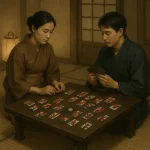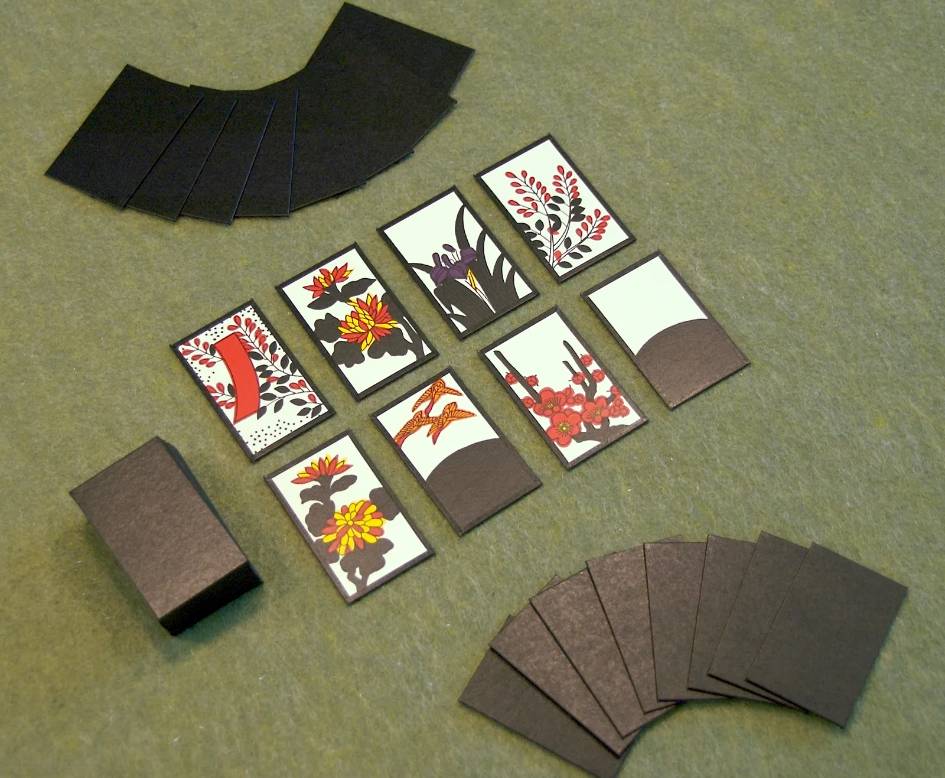
cardanoir.com – A deck of hanafuda cards carries no numbers at all. You will find no ranked indices, no familiar suits, and no face cards — instead, twelve flowers do all the work.
That absence, however, is not decoration. Japanese card makers stripped the numbers out on purpose, because a government that kept banning gambling decks forced them to. So the flowers on hanafuda cards are essentially a workaround that outlived the law it was dodging.
What Hanafuda Cards Actually Are
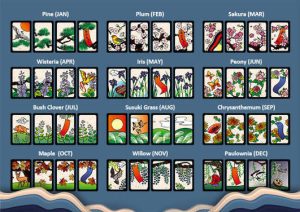
The name means “flower cards.” A full deck holds 48 cards, and the makers split them into 12 suits of 4 — one suit per month of the year, each carrying a plant tied to that season. Western decks flip the same maths: 4 suits of 13.
The physical cards feel unusual too. They measure roughly the size of a matchbox, and they run far thicker than Western playing cards, because traditional makers press several layers of paper together with a stiff backing. As a result, hanafuda cards snap loudly against a table, and the games built on them reward fast, decisive placement.
Since no numbers appear anywhere, you cannot rank a card by glancing at it. Instead, you simply have to know what it is. For most newcomers this feels like the hardest part, though it usually clicks within an evening.
Why Hanafuda Cards Have No Numbers
Portuguese traders brought playing cards to Japan in the mid-1500s, and local makers copied them quickly. Those early Japanese decks still followed the Western pattern, with suits and ranked numbers, and gamblers adopted them almost immediately.
The Tokugawa shogunate then banned them. Later, it banned the replacements too. Each time the authorities outlawed a gambling deck, card makers simply designed a new one that technically was not the banned object — different pictures, different structure, but the same games running underneath. Consequently, the cycle repeated for generations.
Hanafuda emerged from that long argument. By dropping numbers entirely and painting seasonal flowers instead, makers could present the deck as a harmless artistic pastime. Of course, the authorities eventually caught on and banned hanafuda as well. Still, players kept the format alive quietly, and once Japan lifted its playing-card restrictions in the late 19th century, hanafuda came out into the open as the standard Japanese deck.
The Twelve Months in a Hanafuda Deck
Every suit pairs a month with a plant. Learn these twelve pairs and you have essentially learned the deck:
- January — Pine
- February — Plum blossom
- March — Cherry blossom
- April — Wisteria
- May — Iris
- June — Peony
- July — Bush clover
- August — Pampas grass, the moon month
- September — Chrysanthemum
- October — Maple
- November — Willow, also called the rain suit
- December — Paulownia
November behaves oddly in several games, so most players leave that suit until last.
The Four Ranks of Hanafuda Cards
Within each month, the four cards carry different weights. Every card in the deck sits in one of four tiers:
- Hikari (Lights) — 20 points. Only five exist in the entire deck, including the crane, the curtain, the moon, and the phoenix.
- Tane (Animals) — 10 points. Nine cards, mostly creatures such as the boar, the deer, the butterflies, and the cuckoo.
- Tanzaku (Ribbons) — 5 points. Ten cards, each showing a paper strip; some red, some blue, some carrying poetry.
- Kasu (Chaff) — 1 point. The remaining 24 cards, plain and plentiful.
Notice the ratio. Half the deck barely scores on its own, and because of that, the real combinations feel like genuine finds rather than routine draws.
How Koi-Koi Works
Koi-Koi is the two-player game most people mean when they mention hanafuda. First, deal eight cards to each player and lay eight face-up on the table; the rest becomes the draw pile.
On your turn you repeat the same action twice:
- Play a card from your hand. If it matches the month of a card on the table, you take both. Otherwise it stays on the table.
- Flip the top card of the draw pile and resolve it the same way — match and capture, or leave it behind.
You sort your captures into a scoring pile by rank. Then, once those captures form a recognised combination, you face the choice that gives the game its name: bank your points immediately, or call koi-koi, which roughly means “come on, keep going,” and push for a bigger score.
But calling koi-koi keeps the round open for your opponent too. If they finish a combination first, they score and you walk away with nothing. That single decision, repeated every round, essentially is the game.
Combinations Worth Knowing
- Gokou — all five Lights, and by far the rarest hand in the game.
- Sanko — three Lights, excluding the rain card.
- Inoshikacho — the boar, the deer, and the butterflies together; the name simply strings those three animals into one word.
- Akatan — the three red poetry ribbons.
- Aotan — the three blue ribbons.
- Hanami-zake — the sake cup with the cherry blossom curtain, a toast beneath the flowers.
- Tsukimi-zake — the same cup with the moon, the same toast at night.
Those final two carry pure cultural shorthand. After all, drinking under cherry blossoms and drinking while moon-viewing are both real named Japanese customs, so the deck rewards you for assembling the scene.
Nintendo Still Prints Hanafuda Cards
The world’s most famous hanafuda manufacturer is Nintendo. Fusajiro Yamauchi founded the company in Kyoto in 1889 for exactly one purpose: printing and selling hanafuda cards, hand-painted at first. Card making then led the company into other games, later into toys, and eventually into video games.
Most people find the next part harder to believe. Nintendo never stopped. The company still prints hanafuda today under long-running brand names such as Daitoryo, Tengu, and Miyako no Hana, and it separates those brands mainly by card finish and print quality. A Mario-themed deck now sits alongside the traditional designs. Meanwhile, the original Kyoto headquarters still stands, marked with the circled fuku symbol from the old card boxes, and it operates as a hotel these days. Museum collections tell the same story: the Edo-Tokyo Museum digital archive catalogues Nintendo-published hanafuda decks from the Showa era, right down to their 5.4 by 3.3 centimetre dimensions.
Hanafuda Cards Beyond Japan
The deck travelled. In Korea, an adapted version called hwatu spread widely, and the game Go-Stop built on it became enormously popular — arguably more visible in Korean daily life than hanafuda is in Japan today. In Hawaii, meanwhile, Japanese immigrant communities developed their own variant, usually called Sakura, and its local rules evolved separately for decades.
Digital versions finished the job. Hanafuda modes now appear in mainstream game compilations, and Koi-Koi apps let you learn the twelve suits without owning a deck at all. Therefore the one barrier that used to stop most players outside Japan has essentially disappeared.
How to Start Playing With Hanafuda Cards
Buy a physical deck first if you can. Hanafuda cards cost very little, and the weight of them genuinely shapes how the games feel; a Nintendo deck costs less than most board games and lasts for decades.
Then start with Koi-Koi rather than Hachi-Hachi or the older gambling games, because it forgives mistakes and English-language rules cover it best. Keep a month-and-flower cheat sheet beside you for the first few sessions, and do not apologise for it — every player used one. Finally, learn the five Lights first, then the animals, and let the chaff sort itself out through repetition.
If you want to dig into regional decks more broadly, our section on card games around the world covers traditions built on completely different structures, while the history of card games traces how decks like this one crossed continents in the first place.