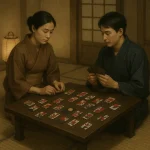
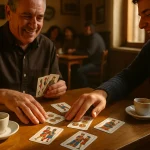
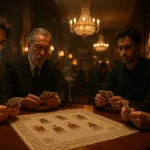
In a smoky Seoul café on a Saturday night, shouts of “Go!” and “Stop!” echo between clattering teacups. Coins slide across the table, crimson cards flash, and laughter rises with every round. The game is Go-Stop — a fierce, fast-paced battle of wit and nerve built on a deck of beautifully painted flowers. For over a century, it has been Korea’s national card obsession — part family pastime, part friendly duel, and entirely cultural ritual.
From Japan’s Hanafuda to Korea’s Hwatu
The roots of Go-Stop stretch back to 19th-century Japan, where Hanafuda (“flower cards”) replaced banned Western-style decks. When Japan occupied Korea in the early 1900s, the floral imagery came along — but Koreans made it their own.
They called the cards Hwatu (화투), literally “flower fighting,” and infused the game with faster scoring, higher stakes, and raucous energy. Over time Go-Stop evolved into a distinctly Korean creation: colorful, loud, and socially magnetic — as integral to modern holidays as kimchi and soju.
The Deck: A Year of Flowers and Symbols
A Hwatu deck contains 48 cards divided into 12 months, each marked by a seasonal flower. Every month has four cards; their artwork encodes scoring symbols that experienced players memorize instantly.
| Month / Flower | Bright | Animal | Ribbon | Junk | Double Junk |
|---|---|---|---|---|---|
| January – Pine |  |
— |  |


|
— |
| February – Plum Blossom | — |  |
 |


|
— |
| March – Cherry Blossom |  |
— |  |


|
— |
| April – Wisteria | — |  |
 |


|
— |
| May – Iris | — |  |
 |


|
|
| June – Peony | — |  |
 |


|
— |
| July – Bush Clover | — |  |
 |


|
— |
| August – Pampas Grass |  |
 |
— |


|
— |
| September – Chrysanthemum | — |  |
 |


|
|
| October – Maple | — |  |
 |


|
— |
| November – Willow |  |
— | — |


|
 |
| December – Paulownia |  |
 |
— |


|
— |
These symbolic designs — bright, ribbon, and junk cards — determine the rhythm of Go-Stop: each combination tells a story of luck, timing, and memory.
Setting Up a Game
- Players: 3 (sometimes 2)
- Deck: 48 Hwatu cards
- Goal: Score ≥ 7 points before opponents, then decide: “Go” (continue) or “Stop” (end and claim winnings).
Each player is dealt seven cards, and six cards are placed face-up on the table. The rest form the draw pile.
How to Play Go-Stop
1 – Matching the Flowers
On a turn, you play one card from your hand that matches the month (flower) of a card on the table. If it matches, you capture both; if not, your played card joins the table. You then draw the top card from the pile — if it matches again, you capture those too.
2 – Scoring Combos
Points come from building sets:
- Five ribbons → 3 points
- Five animal cards → 3 points
- Three brights (광) → 3 points
- Ten junk cards → 1 point
Extra points accumulate for every additional card of a type.
3 – Go or Stop?
Once you reach 7 points, you must shout “Go!” to keep playing for higher rewards, or “Stop!” to lock in your win. But beware — if someone else overtakes you after you call Go, your entire score vanishes. It’s a dance between greed and prudence — very Korean in spirit.
Speed, Psychology, and Strategy
Unlike Western trick-taking games, Go-Stop thrives on immediacy. A single turn can reverse fortune. Skilled players read faces as much as cards, deciding when opponents might explode or fold.
Strategic depth hides behind its simplicity:
- Tracking which flowers remain unseen.
- Blocking an opponent’s bright collection.
- Timing the “Go” call to trap others.
- Reading hesitation — the heartbeat of Korean bluff.
It’s chess played with laughter and adrenaline.
The Social Ritual
To outsiders, Go-Stop may look chaotic, but in Korea it’s almost ceremonial. Families play it during Chuseok and Seollal holidays; friends play it over beer; elders play it for hours in neighborhood cafés.
The slap of cards, the cry of “Se!” (match!), and the teasing between generations form part of its music. It embodies the Korean concept of jeong — emotional connection expressed through play and humor.
Regional and Digital Variations
While the base rules remain universal, regional spins add flavor:
- Jirisan Go-Stop: slower, higher stakes, often used with handmade decks.
- Busan Style: includes “bomb” moves allowing double captures.
- Hwatu Online: mobile versions by Netmarble and Hangame have brought Go-Stop into every smartphone, complete with festive sound effects and virtual coins.
Even in digital form, the tension of “Go or Stop?” remains the same — one tap can turn triumph into disaster.
Cultural Footprint
Go-Stop isn’t just a game; it’s shorthand for life decisions. Korean dramas use it as metaphor: business deals, romance, even politics framed as a duel of timing and nerve.
The deck itself has become pop iconography — appearing on T-shirts, album covers, and even national postage stamps.
Artists admire Hwatu for its miniature aesthetics: compact storytelling through brush and ink. Designers often liken it to a fusion of ukiyo-e and Korean minhwa painting — folk art distilled into strategy.
Fascinating Facts
- Origins of the Name: “Go-Stop” comes from the mandatory choice shouted aloud mid-game — the moment of ultimate risk.
- Color Code: Korean decks are printed in vivid red, yellow, and black — symbolizing fortune, vitality, and energy.
- Censorship Era: Hwatu was once restricted during the 1960s due to gambling concerns, but families continued to play privately.
- World Championship: Annual Go-Stop tournaments in Seoul attract players from Japan, Taiwan, and the diaspora.
- Digital Legacy: The mobile app Go-Stop Plus surpassed ten million downloads, proving tradition still thrives online.
Why Go-Stop Endures
At its heart, Go-Stop mirrors Korean life: rapid, unpredictable, communal. Every hand blends math, emotion, and boldness. To win requires not perfection, but courage to say “Go!” at the right time.
It’s that pulse — the split-second decision between safety and ambition — that keeps Hwatu alive across generations. The flowers on each card may mark months of the year, but the feeling they evoke is timeless: laughter, rivalry, and connection.