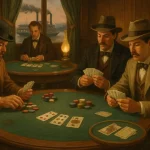
Walk into a smoky saloon in Tombstone, Arizona, around 1880. The piano clinks, boots shuffle, and in the center, a crowd leans over a green felt table. Chips slide, cards flip, and whispers of “bucking the tiger” ripple through the room. That game was Faro, once the most popular card game in America.
It may surprise modern readers that Faro—not poker—ruled the 19th-century gambling halls. Mentioned by writers from Casanova to Mark Twain, and even embedded in famous novels like War and Peace, Faro was more than a pastime; it was a cultural symbol.
Today, Faro is nearly forgotten, but its story reveals how card games mirror society’s tastes, risks, and imagination.
Origins in France
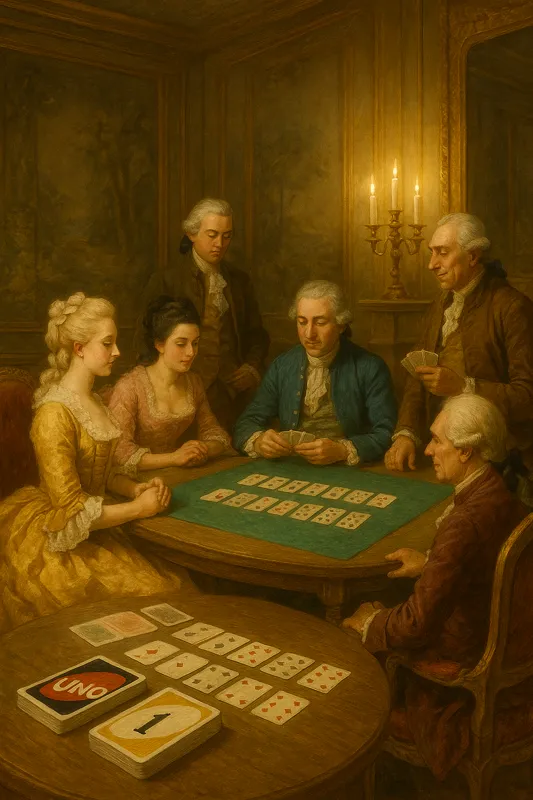
Faro began in late 17th-century France, evolving from the outlawed game Basset. Early versions were called Pharaon, after the Egyptian motif often pictured on French cards. By the 18th century, Faro (or “Pharo”) spread to England, where it became a fashionable salon game among aristocrats.
In Britain, politicians like Charles James Fox were so enthralled that Faro tables were central to social life. By the mid-18th century, observers described Faro as fast, simple, and—when played honestly—fairer than most games of chance.
Across the Atlantic: Faro in America
When Faro arrived in the United States in the early 19th century, it exploded. By the 1820s, it was in nearly every gambling hall from New Orleans to San Francisco. During the Civil War, Washington, D.C. had over 150 Faro houses running at once.
Americans nicknamed it “bucking the tiger,” after the tiger designs on early card backs. Whole districts were called “tiger town” for their Faro activity. The game became shorthand for the frontier spirit—fast, bold, and risky.
The Faro Table and Equipment
Descriptions from period manuals like Sharps and Flats (1894) detail Faro’s setup:
- Faro Box (or Shoe) → A dealing box ensuring cards were drawn one at a time.
- Layout → A board with all 13 card ranks of a suit displayed for betting.
- Check Rack → Tray holding chips (“checks”) for the dealer.
- Case Keeper → An abacus-like device to track cards already drawn.
- Cue Cards → Paper slips where players marked winning/losing ranks.
- Copper Tokens → Small hexagonal markers that could “reverse” a bet.
The whole affair looked like a blend of elegance and tension: green cloth, painted layouts, and neatly stacked counters.
How Faro Was Played
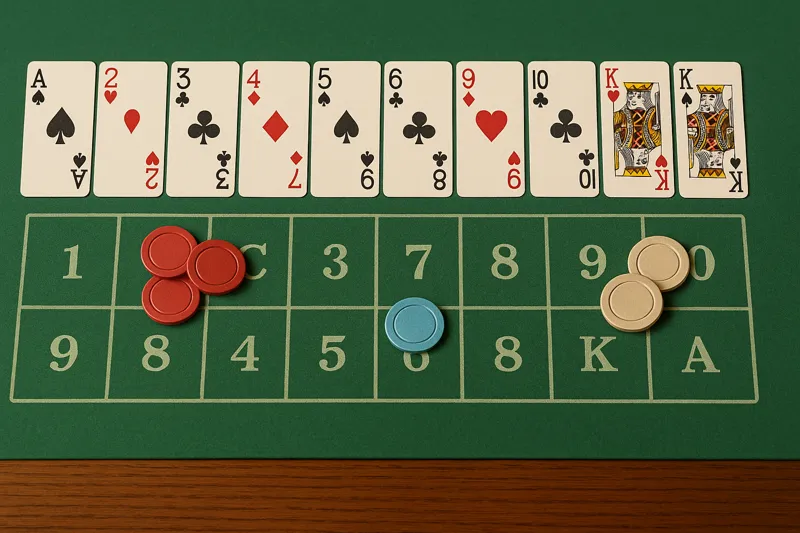
Here’s the simplified flow:
- Players (punters) place bets on card ranks displayed on the layout.
- The dealer draws two cards from the shoe: one is the banker’s card (loser), the other the player’s card (winner).
- Bets on the banker’s card lose; bets on the player’s card win even money.
- Bets that didn’t match stayed on the board or could be moved.
- The last three cards led to a special “call the turn” bet.
This simple rhythm made Faro extremely fast. Games could run all night with nonstop draws.
Why People Loved Faro
- Accessibility → Rules were easy; newcomers could join quickly.
- Pace → Faster than Whist or Poker, with constant action.
- Fair Odds → Historically, Faro had one of the lowest house edges when played honestly.
- Spectacle → Faro tables often drew large crowds of onlookers.
As Mark Twain joked, “A dollar picked up at Faro is sweeter than a dollar earned.”
The Dark Side: Cheating
But honesty was rare. Manuals like Sharps and Flats devoted whole chapters to Faro cheating:
- Rigged Boxes → Dealing shoes with hidden mirrors or slips.
- Stacked Decks → Pre-arranged pairs benefiting the banker.
- Sleight of Hand → Dealers sliding losing bets away from winning cards.
- Player Tricks → Bets tied with invisible threads to “slide” stacks.
The game’s fairness declined as cheating became rampant. Hoyle’s Rules of Games even warned: “Not a single honest Faro bank can be found in the United States.”
Famous Figures and Faro
- Casanova → Mentioned Faro in his memoirs as a favored pastime.
- Charles James Fox → British statesman known for his Faro sessions.
- Wyatt Earp & Doc Holliday → Both dealt Faro in Tombstone saloons.
- Canada Bill Jones → A notorious gambler who said, “It’s the only game in town.”
In fiction, Faro appeared in Tolstoy’s War and Peace, Pushkin’s The Queen of Spades, and even Hollywood films like Tombstone (1993).
Decline of Faro
By the early 20th century, Faro collapsed. Reasons included:
- Poker’s Popularity → Poker was harder to rig and more engaging strategically.
- Cheating Scandals → Reputation damage destroyed trust.
- Legal Restrictions → Anti-gambling laws targeted Faro first.
- House Economics → With such low profit margins, casinos abandoned it.
The last Faro tables in Nevada closed by 1985.
Faro’s Cultural Legacy
Even in decline, Faro left lasting traces:
- Language → The phrase “from soda to hock” (meaning beginning to end) comes from Faro’s first and last cards.
- Geography → The Yukon town of Faro, Canada, is named after the game.
- Art & Literature → Featured in 18th-century salons, Western novels, and operas.
- Museums → Historic Faro layouts and boxes are displayed in collections today.
In short, Faro shaped how people think about risk, spectacle, and fairness in games.
Why Faro Still Matters
Even if nobody plays Faro today, its history shows us:
- Card games aren’t just entertainment—they’re reflections of society.
- Popularity is fragile: what dominates one century can vanish the next.
- Innovations like the Joker card owe their place to Faro’s spread.
Studying Faro helps us understand why card games endure and evolve.
Faro’s Forgotten Lessons
The Faro card game may be gone from our tables, but it still lives in history, literature, and culture. From the glittering salons of Louis XIV to the dusty saloons of Arizona, Faro connected people in laughter, risk, and drama.
Remembering Faro isn’t about nostalgia—it’s about recognizing how types of card games evolve, adapt, and mirror the societies that play them.
And if this story of Faro intrigued you, keep exploring Cardanoir, your window into the fascinating world of classic and forgotten card games.
Referency :