Few card games have crossed as many borders or sparked as much fascination as Poker.
What began as a 19th-century riverboat pastime became a worldwide symbol of logic, composure, and intuition. Poker is more than a game of cards — it’s a language of risk, storytelling, and probability wrapped into a single human drama.
- From Riverboats to Global Tables: The Birth of Poker
- The Anatomy of Poker: How the Game Works
- Main Variants of Poker
- The Mathematics of Poker
- Psychology: The Human Equation
- Cultural Footprint: Poker in Society
- Modern Era: Digital and Educational Poker
- Five Surprising Facts About Poker
- Why Poker Still Matters
From Riverboats to Global Tables: The Birth of Poker

Poker’s earliest form emerged in the United States around the early 1800s, inspired by French Poque and Persian As Nas. Mississippi riverboats carried not only cargo but culture — and with it, the first serious card competitions.
By the mid-19th century, soldiers played poker during the Civil War, refining its mechanics and giving rise to variants like Draw Poker and Stud Poker. As America industrialized, poker mirrored its society — competitive, democratic, and endlessly inventive.
By 1925, the straight flush was officially defined, and in 1970 the World Series of Poker transformed the pastime into a televised intellectual sport. Yet the essence remained: reading people, not just cards this is the history of poker.
The Anatomy of Poker: How the Game Works
At its heart, poker is simple — every player forms the best hand possible from a shared deck and competes through betting rounds that blend mathematics and psychology.
Though rules vary, the essential structure includes:
- Blinds or antes: mandatory opening bets.
- Hole cards: your private information.
- Community cards: shared information for everyone.
- Betting rounds: moments of decision and deception.
Victory isn’t always about having the best hand — sometimes it’s about convincing others that you do.
Main Variants of Poker
Texas Hold’em
Invented in Robstown, Texas in the early 1900s, this version uses two hole cards and five community cards. It’s the most popular form today — the stage for global tournaments and the training ground for countless strategists.
Omaha
A cousin of Hold’em, but with four hole cards. It demands deeper probability awareness and encourages bold, complex plays.read more at : Omaha Poker Strategies
Seven-Card Stud
Before community-card games dominated, Stud reigned supreme. Each player received a mix of face-up and face-down cards, emphasizing memory and observation.
Draw Poker
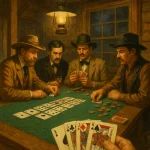
The classic five-card draw — simple, pure, cinematic. It’s the version you’ll see in vintage Westerns.
Each variant refines a different skill: calculation, reading, timing, patience.
The Mathematics of Poker
Poker is often called a game of chance — but the numbers tell another story.
Behind every decision lies probability, combinatorics, and expected value (EV).
Players constantly estimate:
- Odds of drawing a winning card.
- Pot odds — the ratio of potential reward to risk.
- Equity — long-term expected share of the pot.
This is where tools like the Poker Odds Calculator enter the picture, translating centuries of intuition into measurable insight. Understanding math doesn’t erase uncertainty — it makes it beautiful.
Psychology: The Human Equation
If math builds the skeleton, psychology gives poker its soul.
Bluffing, patience, confidence — every facial twitch and pause becomes data.
Great players like Doyle Brunson or Daniel Negreanu aren’t magicians; they’re interpreters of human behavior. In poker, every hand is a silent conversation — who believes what, and why.
The best move often isn’t the statistically correct one but the emotionally timed one.
Cultural Footprint: Poker in Society
From smoky saloons to Hollywood films, poker became shorthand for intellect under pressure.
Movies like Rounders and Casino Royale portrayed it as a test of composure and identity.
Beyond fiction, poker tables became gathering spots — places where strangers learned probability, patience, and empathy in equal measure.
It entered language itself: poker face, all in, the hand you’re dealt — phrases that moved from the table to everyday speech.
Modern Era: Digital and Educational Poker
The 21st century brought online and educational platforms that redefined accessibility.
Now, millions learn strategy from simulations, coaching videos, and analytical tools — not to gamble, but to understand logic and decision-making.
Digital versions emphasize training, probability study, and competitive sportsmanship, distancing the game from its old casino stereotype.
At its best, poker is mental gymnastics — not risk for profit, but risk for growth.
Five Surprising Facts About Poker
- The longest poker game in history reportedly lasted over 8 years in Arizona’s Bird Cage Theatre.
- The phrase “poker face” entered dictionaries in the 1870s.
- Poker inspired early research in game theory by John von Neumann.
- The first televised poker event used hole-card cameras in 1999 — a media breakthrough.
- The mathematical model of poker probabilities laid groundwork for modern AI decision systems.
Why Poker Still Matters
Poker’s endurance lies in its paradox: it’s about chance, yet it rewards mastery.
It’s about reading others, but also yourself. And it thrives because it mirrors life — uncertainty wrapped in structure.
Whether studied through a Poker Odds Calculator, played with friends, or analyzed in books, poker continues to teach discipline, empathy, and adaptability.
It remains one of humanity’s most elegant metaphors for decision-making.