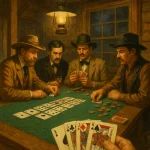
Few games have mirrored human culture as vividly as poker.
Born from smoky saloons and carried by riverboats, poker evolved from a simple pastime into a global symbol of wit, courage, and calculation.
The History of Poker is not just a story of cards — it’s the history of how people learned to read each other, weigh risk, and embrace uncertainty as an art.
- Origins: Europe’s Trick-Taking Roots
- The 19th Century: Riverboats and Frontier Towns
- The Civil War and the Birth of New Variants
- From Saloon to Salon: Poker Becomes Respectable
- The 20th Century: The Era of Texas Hold’em
- The Poker Boom and the Internet Revolution
- Mathematics, Psychology, and the Rise of Strategy
- Cultural Legacy: Poker as a Mirror of Society
- Five Surprising Facts About the History of Poker
- From Cards to Code: The Future of Poker
- A Reflection: Why the History of Poker Still Matters
Origins: Europe’s Trick-Taking Roots
Long before poker reached American shores, Europe was already rich with trick-taking and betting games.
Historians trace its ancestry to Poque in France, Primero in Spain, and Pochen in Germany — all games that involved bluffing, betting, and ranking hands.
When French settlers brought Poque to New Orleans in the 1700s, it found fertile ground in America’s growing tavern and trading culture.
The game was simple: each player received three cards, bet on their hand’s strength, and bluffed to mislead opponents.
The English-speaking colonists soon adapted the name to “poker”, giving it the sharper sound we know today.
The 19th Century: Riverboats and Frontier Towns
If there is a single image that defines poker’s early era, it’s the Mississippi riverboat.
In the 1800s, traders, soldiers, and travelers carried decks of cards along the great river’s routes.
The riverboats weren’t just transport — they were floating social clubs where merchants, engineers, and adventurers met to pass long hours with cards and conversation.
By 1830, poker had spread from Louisiana to Illinois and Missouri.
The earliest written reference appears in Jonathan H. Green’s 1843 book, An Exposure of the Arts and Miseries of Gambling, which described poker as a new and captivating game.
While Green’s moral warning was stern, his writing immortalized poker’s existence — proving it had become a social phenomenon.
The Civil War and the Birth of New Variants

The American Civil War (1861–1865) changed poker forever.
Soldiers from both sides carried decks in their pockets, introducing each other to regional variations.
It was during this time that games like Stud Poker, Draw Poker, and the concept of the straight appeared.
Poker transformed from a frontier curiosity into a shared pastime that united people even in conflict.
It taught calculation, courage, and camaraderie — qualities soldiers valued as much on the battlefield as at the card table.
From Saloon to Salon: Poker Becomes Respectable
By the late 19th century, poker had moved beyond smoky saloons.
It began appearing in gentlemen’s clubs, drawing rooms, and private gatherings across North America.
Magazines published hand-ranking charts and etiquette guides, reframing poker from vice to mental sport.
The introduction of five-card draw standardized play and created recognizable hand hierarchies like flush, full house, and straight flush.
Soon, poker was as likely to be played by bankers and academics as by cowboys and gamblers.
The 20th Century: The Era of Texas Hold’em
The next great transformation came from the American South.
In Robstown, Texas, sometime in the early 1900s, players experimented with a variant that allowed two private cards and five community cards on the table — a faster, more strategic game called Texas Hold’em.
Hold’em didn’t reach mainstream popularity until the 1960s, when Doyle Brunson, Crandell Addington, and others introduced it to Las Vegas.
In 1967, the Golden Nugget casino hosted the first major Hold’em games, and by 1970, the World Series of Poker (WSOP) was born.
Televised tournaments turned quiet strategy into spectacle.
When the “hole-card camera” was invented in 1999, audiences could finally see what players were holding — and the world fell in love with poker’s hidden tension.
The Poker Boom and the Internet Revolution
In the early 2000s, a new era began.
The online poker boom, sparked by televised tournaments and digital platforms, introduced the game to millions who had never set foot in a casino.
The 2003 victory of Chris Moneymaker, an amateur who qualified online for the WSOP, became a global legend.
His story proved that poker wasn’t about access or wealth — it was about skill, patience, and nerve.
Suddenly, poker transcended geography. Players from the Philippines, Brazil, or Finland could challenge each other in real time.
Digital platforms also gave rise to a new kind of learning: analytical tools, hand-history databases, and the now-famous Poker Odds Calculator, which turned raw instinct into measurable insight.
Mathematics, Psychology, and the Rise of Strategy
As poker matured, players realized it wasn’t just a game of chance — it was a game of decision-making.
Statisticians began applying game theory, developing concepts like expected value (EV) and optimal play.
Meanwhile, psychologists studied bluffing, body language, and emotional regulation — turning poker into a case study in human behavior.
Modern players balance data and intuition; they know when to fold mathematically, and when to call emotionally.
It’s no longer just a game of luck — it’s a performance of intellect.
Cultural Legacy: Poker as a Mirror of Society
Poker’s journey mirrors humanity’s own progress.
In the 19th century, it represented freedom and risk.
In the 20th, it stood for competition and self-expression.
In the 21st, it symbolizes analysis, equality, and digital community.
Films, literature, and music have celebrated poker as a metaphor for life — The Cincinnati Kid, Rounders, Casino Royale, and even classic country songs capture the poetry of betting on yourself.
Poker’s influence reaches beyond entertainment:
- Economists reference it to explain market behavior.
- Negotiators cite it when reading opponents.
- AI researchers use it to train adaptive algorithms in uncertainty.
Five Surprising Facts About the History of Poker
- The earliest poker decks used 20 cards, not 52, and were played by four players each receiving five cards.
- Poker introduced the world to the concept of the “bluff”, later adopted in politics, diplomacy, and business language.
- The first poker chips were made from bone and ivory in the mid-1800s to standardize betting value.
- Poker’s spread along railroads mirrored America’s westward expansion — cards were as common as whiskey.
- By the 1970s, poker was considered part of American heritage, taught in math classes as a probability model.
From Cards to Code: The Future of Poker
Today, poker thrives in a hybrid world — half-digital, half-human.
Online communities host tournaments, while universities analyze strategies.
Even artificial intelligence has entered the arena, with programs like Libratus and Pluribus mastering heads-up and multi-player poker against pros.
Yet despite technology, one truth endures: poker is a game about people.
The tension of waiting, the courage to call, the grace to lose — these are eternal.
The numbers may evolve, but the human story remains the same.
A Reflection: Why the History of Poker Still Matters
Studying poker’s history is like studying human evolution in miniature — we see how play becomes culture, how luck becomes learning, and how chance becomes art.
Poker survived every era because it adapts, just like we do.
Whether played on a steamboat in 1850 or a laptop in 2025, poker continues to ask the same timeless question:
Can you make the right choice when everything is uncertain?
And perhaps that’s why the history of poker will never fold.