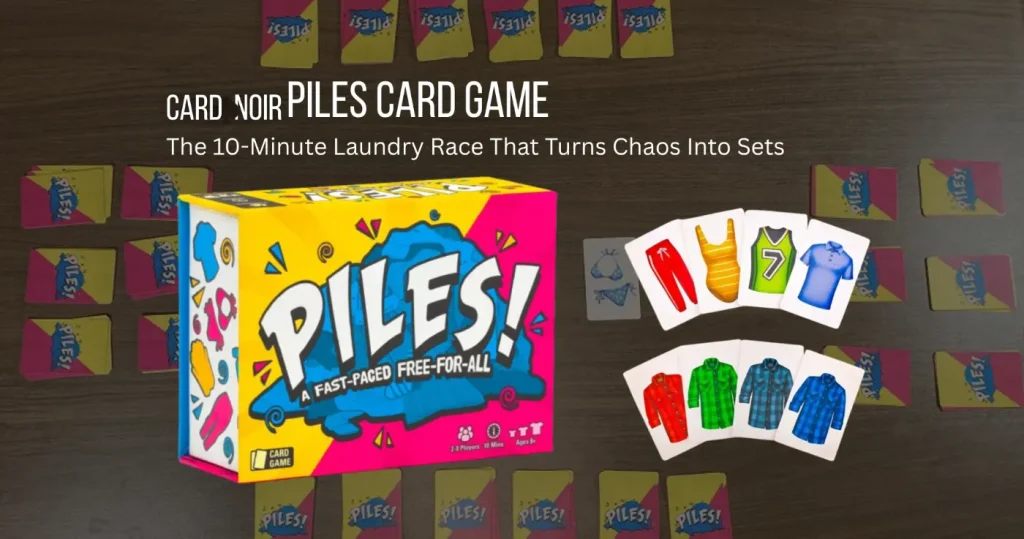
The Piles card game feels like somebody looked at a messy laundry basket and said: “What if this was fun—and also a sprint?”
Piles! is a real-time, simultaneous-play set-collection game where everyone plays at once, swapping cards through a shared center to build matching clothing sets. It’s quick, loud, and oddly satisfying—because the moment you complete a pile, you flip it face up like a tiny personal victory flag. The first player to finish all their piles wins by shouting “PILES!”.
What follows is Cardanoir’s deep guide: where Piles came from, how it plays, what rules matter most, the variant modes, and the strategy behind the “controlled chaos.”
Origins: Who Made Piles and When It Arrived
Piles! was designed by Cameron Ring, Corey Schrimpl, and K.C. Schrimpl, and published by Lost Boy Entertainment. The official rulebook credits the game as © 2023 Lost Boy Entertainment LLC and lists Alex Nikiforov as illustrator and Chris Doughman as graphic designer.
The theme is deceptively clever: clothing items that look similar on purpose—so you have to pay attention to shapes, not just colors. The rulebook even warns that some clothing is designed to “look similar” to trick you.
And in a neat example of modern tabletop distribution, Piles later showed up through Asmodee channels in various regions, with Asmodee promoting it as a fast-paced clothing-set race built around a “universal discard pile.”
What’s in the Box and What You’re Really Sorting
Piles is built from 50 sets of matching clothing. Each set is four cards showing the same item of clothing in different colors. That makes 200 cards total.
The set structure matters because the game isn’t “match colors.” It’s “match the exact clothing item.” GeekDad gives a perfect example: different socks exist, so you must match sock shape/style even if colors vary.
The Goal: Win by Completing Six Sets
Your objective is simple: be the first player to turn all six of your personal piles into complete matching sets (each pile becomes four-of-a-kind in clothing identity).
When you’ve done it, you yell “PILES!” to stop the game and claim the win—then everyone checks your piles, because mistakes happen in the scramble. If you’re wrong, play resumes immediately.
Setup: How to Build the Deck (This Changes With Player Count)
Piles does something smart: it scales by changing how many clothing sets are included in the deck.
- You don’t always use all 50 sets.
- The number of sets depends on player count.
GeekDad summarizes a commonly used rule-of-thumb: (number of players × 6) + 1 sets, meaning 13 sets for 2 players and 49 sets for 8 players. The rulebook also confirms that you select only the necessary number of sets and return the rest to the box.
Then:
- Shuffle the built deck thoroughly.
- Deal each player six piles of four cards, all face down.
- Place four cards face down in a row in the center. Everyone must be able to reach them.
- Players may rearrange their six piles for table space.
- Nobody looks at cards until the start.
How a Game Starts: The Countdown Flip
Piles is a race with no turns—everyone plays simultaneously.
To start, you count down from three and flip the four center cards face up at the same time. Only then can players look at their own piles and begin swapping.
A small but important detail: the rulebook explicitly says the center will get messy and that’s fine—as long as the cards remain reachable and visible.
That line tells you what kind of game this is. Piles isn’t trying to be tidy. It’s trying to be alive.
Core Rules: What You Can and Cannot Do
This is where Piles becomes a true real-time design, not just “set collection but faster.”
You can only hold one pile at a time
You pick up a pile, look at it, and you can manipulate only that pile while it’s in your hands.
You may only swap with the center
You cannot move cards between your own piles. The only legal exchange is your held pile ↔ center cards.
You must discard a card to the center before picking one up from the center.
One card at a time
Swaps happen one card at a time—no “two-card scoop.”
Piles you’re not holding stay face down
Unless a pile is completed (a full matching set), it stays face down when it’s on the table.
Completed sets flip face up
When a pile becomes a full set, you place it face up in front of you as a completed set.
You can pick up cards you discarded
Yes, you can discard something, then later grab it back—if it’s still in the center when you need it.
No stealing from other players
You cannot take from an opponent’s piles—only the center is shared territory.
What It Feels Like: Controlled Chaos With a Memory Core
If you’ve played games like Speed or Spoons, you’ll recognize the energy: eyes flicking, hands moving, people half-laughing while half-panicking. Asmodee even frames Piles for players who enjoy classics like Speed and Spoons.
But Piles also has a quieter skill under the noise: memory. Because you can’t keep all piles face up, your brain starts tracking where you saw “that jacket shape” or “those scarf edges.” GeekDad describes the experience as “partially controlled chaos,” especially at higher player counts. (1)
A Clear Example Turn (So You Can Teach It Fast)
Imagine you pick up one of your six piles. You see:
- 2 cards of the same clothing type (say, two matching shirts)
- 2 cards that don’t belong
You look at the center. There’s a card that matches your shirt set.
You:
- discard one wrong card from your held pile to the center
- take the matching center card
- now your held pile is closer to a complete set
- you put the pile face down again (unless it’s complete), then grab another pile
You repeat until you’ve built six completed sets.
That’s it. The rules stay light so the speed can stay high.
Variant Mode: Make the Center Wilder
Piles includes a built-in variant for more chaos:
- add one more clothing set when building the deck
- deal eight cards to the center instead of four
This increases both opportunity and interference. More center cards means more possible matches—but also more reasons to hesitate, because your eyes have more to scan before your hands move.
Strategy: How to Win Without Just Being the Fastest Hand
Speed matters, but speed alone is sloppy. In Piles, sloppy loses because one bad “almost match” can trap you in a pile you keep revisiting.
Here are the tactics that consistently improve results:
1) Build “two-card anchors”
The moment a pile has two of the same clothing type, treat that pile as a likely future set. Don’t abandon it too quickly unless the center clearly pushes you elsewhere.
2) Don’t chase perfect—chase progress
Because you can only swap through the center, waiting for the “perfect” third and fourth card can waste time. Sometimes the best play is to improve another pile while your target item circulates.
3) Use the center like a conveyor belt
Remember: you can pick up cards you previously discarded.
That means discarding is not always “losing a card.” It can be parking a card where you might reclaim it—if you can keep track of it in the mess.
4) Learn the “lookalikes”
The rulebook warns that some items are designed to look similar.
Winning players train their eyes to recognize silhouette differences fast (shirt vs tank top, one scarf style vs another).
5) When you’re at five completed sets, slow down just a hair
The endgame is where misreads happen. If you shout “PILES!” with one incorrect pile, the game resumes and you’ve just announced your progress to everyone.
Speed still matters—just don’t donate a free comeback.
Cultural Notes: Why Piles Works With Families (and Why It Shows Up on Social Feeds)
Piles is short—commonly described as around 10 minutes—and supports 2–8 players with an accessible 8+ age range. GeekDad+1 That combination is basically the sweet spot for family play: it’s long enough to feel real, short enough to run back instantly.
Theme helps too. Laundry sorting is universal. It’s not fantasy lore you have to learn; it’s life. GeekDad points out that you can play it anywhere—floor, bed, blanket, camping—because the “board” is just your piles and the center cards.
And the real-time scramble makes it watchable. People don’t just play Piles—they perform it, accidentally, which is why it fits perfectly in short-form videos.
Five Fun, Surprising Facts About Piles
- The game includes 50 clothing sets, but an 8-player game uses 49, meaning the full table plays with almost the entire collection.
- The rulebook explicitly says the center will become messy—and that mess is acceptable.
- You must discard before you take, which prevents “snatch and stash” hoarding
- You can legally reclaim a card you discarded later if it’s still in the center.
- There’s an official chaos variant that doubles the center from 4 cards to 8.
The Beauty of Order You Earn in a Hurry
Piles is a game about turning clutter into clarity—fast.
You start with six unknown stacks, a tiny shared market of four cards, and the certainty that someone else is reaching for the same lifeline you want. You learn to recognize patterns in a glance, to trust your memory under pressure, and to let go of “almost right” in favor of “moving forward.”
And that’s why Piles sticks. It’s not just a quick party game. It’s a small lesson in modern life: the world gets messy, the table gets crowded, and you rarely get turns. You win by noticing what matters, acting decisively, and building order one clean set at a time.