cardanoir.com – The Briscola rules fit on a beer mat, which is roughly where most Italians learn them. Three cards in hand, no obligation to follow suit, first to 61 points wins. A round takes ten minutes.
Then you play a few games and realise the simplicity was a trap. The Briscola rules leave almost every decision open. Because you never have to follow suit, every single card you play is a free choice, and that turns a tiny rule set into a game about memory, timing, and reading the person across the table.
What Briscola Is
Briscola is Italy’s most played card game, and it sits at the centre of bar culture across the country. Two players, four in partnerships, or five in the called variant — all of it runs on the same 40-card deck and the same short rule set.
Nothing in the Briscola rules explains why this works so well, and yet it does. The game belongs to the ace-ten family, the same broad group as Bezique and Pinochle, where the Ace and the Ten (or here, the Three) carry the scoring weight rather than the face cards. That inversion is the first thing new players have to unlearn.
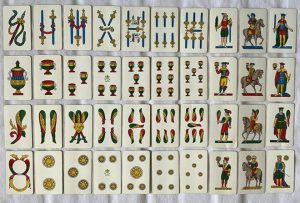
The Deck and the Card Values
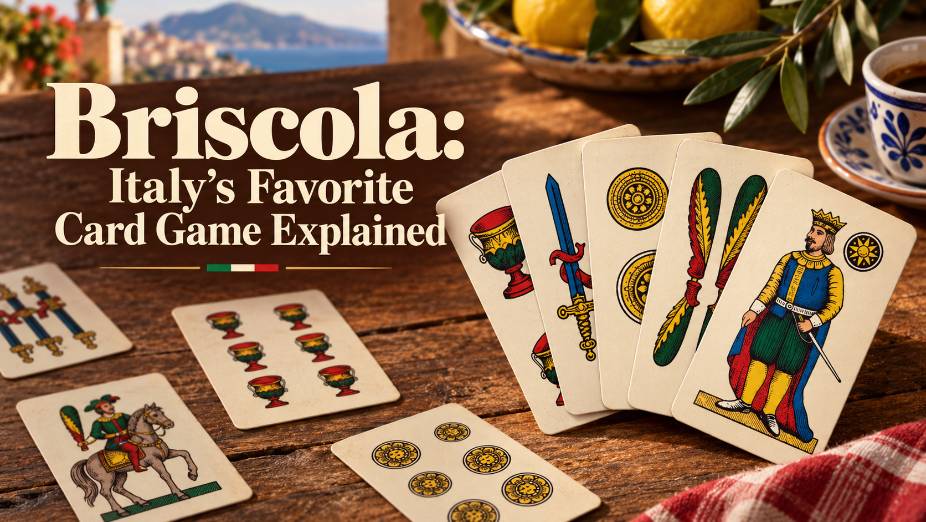
Briscola uses a 40-card Italian regional deck — Napoletane, Piacentine, Bergamasche, or Trevigiane, depending on where you are. The four suits are Denari (coins), Coppe (cups), Spade (swords), and Bastoni (batons), each running 1 to 7 plus three face cards: Fante, Cavallo, and Re.
No Italian deck to hand? Take a standard 52-card pack and remove the 8s, 9s, 10s, and jokers. The Queen stands in for the Cavallo.
Only five cards per suit carry points:
| Card | Italian | Points |
|---|---|---|
| Ace | Asso | 11 |
| Three | Tre | 10 |
| King | Re | 4 |
| Knight / Queen | Cavallo | 3 |
| Jack | Fante | 2 |
| 7, 6, 5, 4, 2 | — | 0 |
The deck holds 120 points in total. Note the ranking, because it catches everyone: within a suit, the Ace beats the Three, the Three beats the King, and the King beats everything below it. So the two most valuable cards are also the two strongest cards.
Briscola Rules: Setting Up a Game
- Deal three cards to each player.
- Turn the next card face up. Its suit is the briscola — the trump suit for this round.
- Place that card half under the remaining deck, face up, so everyone can see it. It is the last card anyone will draw.
- The player to the dealer’s right leads, and play moves counter-clockwise.
That exposed trump card is a small piece of design brilliance. Everyone knows one specific trump is coming at the very end of the deck, and everyone spends the whole game counting toward it.
Briscola Rules: How a Trick Works
Each trick is one card per player, and there is almost nothing restricting you:
- Play any card you like. There is no requirement to follow suit, ever.
- If nobody plays a trump, the highest card of the suit that was led wins.
- If anyone plays a trump, the highest trump wins.
- The winner takes the trick, then draws first from the stock, followed by the others in order.
- The winner leads the next trick.
That is the whole of the Briscola rules for trick play. Once the stock runs out, players simply play out their last three cards. When every card has been played, you count.
Scoring and Winning
Add up the point values of every card in your captured tricks. Reaching 61 or more wins the round, since 120 points exist in total. A 60–60 split is a draw, which Italians call a patta.
Taking all 120 points is a cappotto, and it is rare enough to be worth bragging about. Most groups play best of three or best of five rather than single rounds, and in plenty of Italian bars the losing side simply buys the next coffee.
Why the Ace and Three Change Everything
The Briscola rules give the Ace and the Three an unusual double role, and that is the strategic core of the game. The Ace and Three are worth 21 points between them in every suit, and they are also the two highest cards. Consequently, they are simultaneously your best weapons and your biggest liabilities.
Lead an Ace early and someone trumps it, handing them 11 points for free. Hold it too long and you may never get a safe moment to cash it. Experienced players spend the whole game trying to force out the trump Ace before committing anything valuable.
Meanwhile, the zero-point cards — the 2, 4, 5, 6, and 7 — become genuinely useful. They are what you throw away when you do not want to win a trick, and knowing when not to win is most of the skill.
The Signals Nobody Warns You About
In four- and six-player partnership games, most Italian groups permit communication between partners, and there is a traditional set of facial signals for the trump suit. Stretching your lips over your teeth means you hold the Ace. Twisting your mouth to one side means the Three. A glance upwards is the King, a stuck-out tongue is the Cavallo, and a shrug of one shoulder is the Fante.
Some groups instead allow spoken hints — “play a trump” is fine, naming the exact card is not. Others ban all communication, which is standard in tournaments. Therefore the sensible thing is to settle which version you are playing before the first deal, rather than discovering the difference mid-round.
Briscola Rules for More Players
The Briscola rules scale up without changing much. Four players split into two partnerships sitting opposite each other. The rules are otherwise identical, and 61 points still wins.
Five players unlocks Briscola Chiamata, the called variant, and it is a genuinely different game. Players bid for the right to name the trump suit and call a specific card — usually an Ace. Whoever holds that card becomes the bidder’s secret partner, and nobody else knows who is on whose side until the card appears. The bidding, the hidden alliance, and the betrayal when the called card finally drops make it the version Italians argue about most.
How to Start Playing
Buy a Napoletane deck. They cost a few euros, they are sold in every Italian tobacconist, and Modiano and Dal Negro both ship internationally. The cards are small and stiff, which matters more than it sounds — the whole game is designed around holding exactly three of them.
Learn the Briscola rules two-handed first, since that teaches card counting faster than any partnership game will. Count the trumps out loud in your first few games. There are only ten of them, and tracking those ten is the difference between a beginner and someone who wins.
For the complete rule set including regional variations, Pagat’s Briscola page remains the most reliable reference in English. Our card games around the world section covers other national traditions built on unfamiliar decks, and the history of card games explains where the Latin-suited deck came from in the first place.