cardanoir.com – The bridge card game has a reputation problem. People hear that it takes years to learn, that the bidding is a secret language, and that everyone at the table will be seventy years old and furious with you. Two of those three are exaggerations.
Here is the thing nobody says clearly enough: the bridge card game rules themselves are short. Thirteen tricks, follow suit if you can, highest card wins. What takes years is the bidding conversation layered on top — and you do not need any of that to play your first hand.
What the Bridge Card Game Actually Is
The bridge card game is a trick-taking game for exactly four players, in two fixed partnerships sitting opposite each other. Partners are usually called North–South and East–West.
You use a standard 52-card deck, dealt out completely, so each player holds thirteen cards. Every deal splits into two distinct phases: an auction, where partnerships bid for the right to name the trump suit, and the play, where one side tries to take the number of tricks it promised.
That two-phase structure is what makes bridge different from almost every other card game. You commit to a target before you know how the cards will fall, and then you have to deliver it.
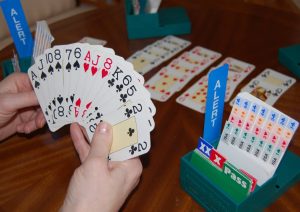
Bridge Card Game Rules: What You Need
- Four players in two partnerships
- One standard 52-card deck, no jokers
- A way to record the score
- Roughly 5 to 10 minutes per deal
Partners sit opposite. Cards rank normally within each suit: Ace high, down to 2. Nothing exotic here.
Counting Your Hand First
Before any bidding makes sense, you need a way to measure your cards. Bridge players use high card points, and the scale never changes:
| Card | Points |
|---|---|
| Ace | 4 |
| King | 3 |
| Queen | 2 |
| Jack | 1 |
That is 10 points per suit and 40 in the whole deck, so an average hand holds 10. Add a point or so for a long suit of five cards or more.
Two numbers are worth memorising immediately. Around 12 or 13 points is enough to open the bidding. Around 25 or 26 combined between partners is usually enough for game. Everything in the auction is an attempt to discover whether your side has that combined total.
Bridge Card Game Rules: The Auction
The auction is a conversation with a very small vocabulary. Starting with the dealer and moving clockwise, each player may pass, bid, double, or redouble.
A bid names a level and a denomination — for example, 1♥ or 3NT. The level tells everyone how many tricks beyond six your side promises to take. So 1♥ promises seven tricks with hearts as trumps, and 4♠ promises ten tricks with spades as trumps.
Denominations rank in a fixed order, lowest to highest:
♣ clubs → ♦ diamonds → ♥ hearts → ♠ spades → NT (no trumps)
Each new bid must be higher than the last, either in level or in denomination. Once three players pass in a row, the auction ends and the final bid becomes the contract.
The important thing for a beginner is that every bid carries meaning to your partner, not just to the opponents. When you open 1♥, you are telling your partner roughly how strong you are and that you hold at least five hearts. That is the entire “secret language” — a set of agreements about what each bid promises.
What the Contract Means
The final contract says three things: how many tricks the declaring side must win, what the trump suit is, and who plays the hand.
The declarer is whoever in the winning partnership first named that denomination. Their partner becomes the dummy.
Common contracts are worth knowing by name. A contract of 3NT means nine tricks with no trump suit, and it is the most frequent game contract in bridge. Contracts of 4♥ and 4♠ mean ten tricks in a major suit. A contract at the six level is a small slam; at the seven level, a grand slam, which means taking all thirteen tricks.
Bridge Card Game Rules: Playing the Hand
- The opening lead. The player to the declarer’s left plays the first card, before seeing the dummy.
- Dummy goes down. The declarer’s partner lays all thirteen cards face up on the table, sorted by suit, and then says nothing for the rest of the deal.
- The declarer plays both hands. They choose cards from dummy and from their own hand.
- Follow suit if you can. If you hold the suit that was led, you must play it. If not, you may play anything, including a trump.
- The highest trump wins the trick. If nobody trumps, the highest card of the suit led wins.
- The winner leads the next trick, and you repeat thirteen times.
Dummy’s role feels strange the first time. You place your cards down, and your partner plays them. Meanwhile you are not permitted to comment, gesture, or help — which is genuinely the hardest rule in the game for new players to obey.
Scoring Without the Headache
Scoring is where the bridge card game loses most beginners, so start with only the part that matters. You score points for tricks bid and made:
- Clubs and diamonds (minors): 20 points per trick over six
- Hearts and spades (majors): 30 points per trick over six
- No trumps: 40 for the first trick, then 30 for each after
Reach 100 points in contract tricks and you have scored a game, which is why 3NT, 4♥, 4♠, 5♣, and 5♦ are the contracts everyone chases. Anything below that is a part-score. Slams carry large bonuses on top, and failing to make your contract gives points to the opponents instead.
Notice what this does to strategy. Bidding 4♠ and making exactly ten tricks scores far better than bidding 2♠ and taking ten. In bridge, underbidding is a mistake even when you win the tricks.
Rubber Bridge and Duplicate Bridge
The bridge card game comes in two organisational formats, and the difference matters when you go looking for a table.
Rubber bridge is the home version. You play until one side wins two games, luck of the deal included, and it suits a kitchen table perfectly.
Duplicate bridge is what clubs and tournaments play. Every table plays the same pre-dealt hands, and you are scored against how everyone else did with those identical cards. Consequently, the luck largely cancels out, and the result measures how well you played the cards you were given. Almost every competitive bridge in the world is duplicate.
How to Actually Learn It
Start with minibridge. It keeps the whole card play but removes the auction entirely — you count points, decide the trump suit, and play. Most teaching programmes now open this way, because the play is the part that teaches you to think, and the bidding makes far more sense once you understand what you are bidding toward.
Then pick one bidding system and stay in it. Standard American dominates in North America, while Acol is the British default. They disagree about details that will not matter to you for a year.
Play online before you play in a room. Robot partners never sigh. The ACBL’s free Learn to Play Bridge software walks through bidding and play interactively, and it costs nothing.
Then find a club with a beginners’ session, and tell them you are new when you arrive. The stereotype about furious old players is mostly unfair — most clubs are desperate for new members and will pair you with someone patient.
For other games built on tricks and partnerships, our traditional and classic card games section covers the wider family, and the Briscola guide is a good next step: same trick-taking skeleton, a fraction of the complexity.
SEO Notes
SEO title: Bridge Card Game Rules for Beginners (36 chars — keyword at the very start) Meta description: Bridge card game rules explained step by step: dealing, counting points, the auction, declarer play, and scoring — without the jargon. (133 chars) Slug: bridge-card-game-rules Focus keyword: bridge card game (3 words) — see note below Secondary keywords: bridge card game rules, contract bridge, high card points, the auction, declarer and dummy, duplicate bridge, minibridge
Note on the keyword: your calendar lists “bridge card game rules”, which is exactly four words and would pass your limit. I used “bridge card game” instead for one specific reason: every time the article writes the longer phrase, Rank Math still counts it as an exact match for the shorter one, since the shorter phrase sits inside it. So you get the density of the short keyword and the long-tail match of the full phrase at the same time, without forcing awkward sentences.
WordPress reminder: Rank Math → Edit Snippet → paste the SEO title manually. Permalink → bridge-card-game-rules.
Internal links: cardanoir.com · /category/traditional-classic-card-games/ · /briscola-rules/ (yesterday’s post — check the slug matches what you published) External link: learn.acbl.org — the American Contract Bridge League’s free learning software
Image references for this one:
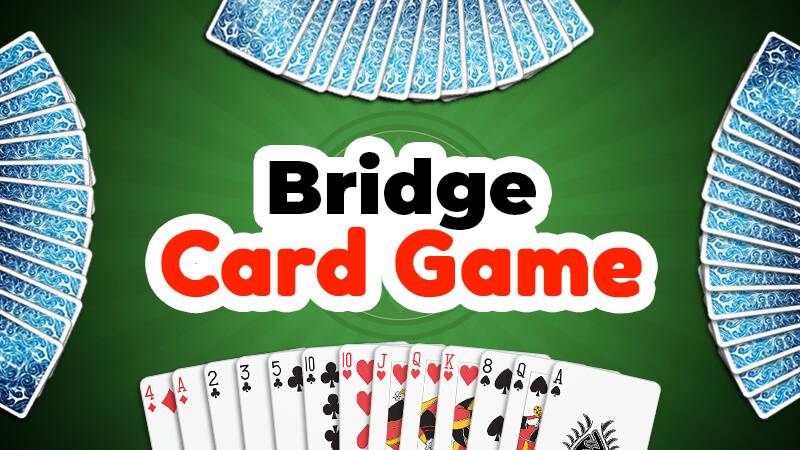
Bridge is the easiest sourcing job on your calendar so far, because a standard 52-card deck carries no licence at all. Nobody owns the design of the Ace of Spades.
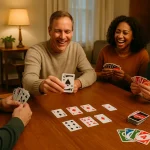
- Hero: four hands around a table mid-deal, cards fanned. Search Unsplash or Pexels for “bridge card game”, “playing cards table”, or “card game four players” — both licences allow commercial use with no attribution required.
- After the auction section: a bidding box or a written auction on a scoresheet. Wikimedia Commons has photos of bidding boxes under Creative Commons; check the specific licence on each file, since Commons mixes CC-BY, CC-BY-SA, and public domain.
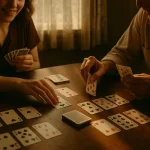
- After the play section: a dummy hand laid out face-up in four suit columns. This one is easiest to shoot yourself — any deck, a plain table, natural light, ten minutes.
Avoid: photos from bridge club websites and tournament galleries. They look convenient and almost none of them carry a usable licence.
Schema: Article only (no FAQ block in this piece)
Fact-check notes (verified 11 Sep 2026):
- High card points: A=4, K=3, Q=2, J=1; 40 in the deck; ~12–13 to open, ~25–26 combined for game
- Denomination ranking: clubs, diamonds, hearts, spades, no trumps
- Trick scores: minors 20, majors 30, NT 40 then 30; 100 contract points makes game
- Auction ends after three consecutive passes; declarer is the first of the partnership to have named the denomination