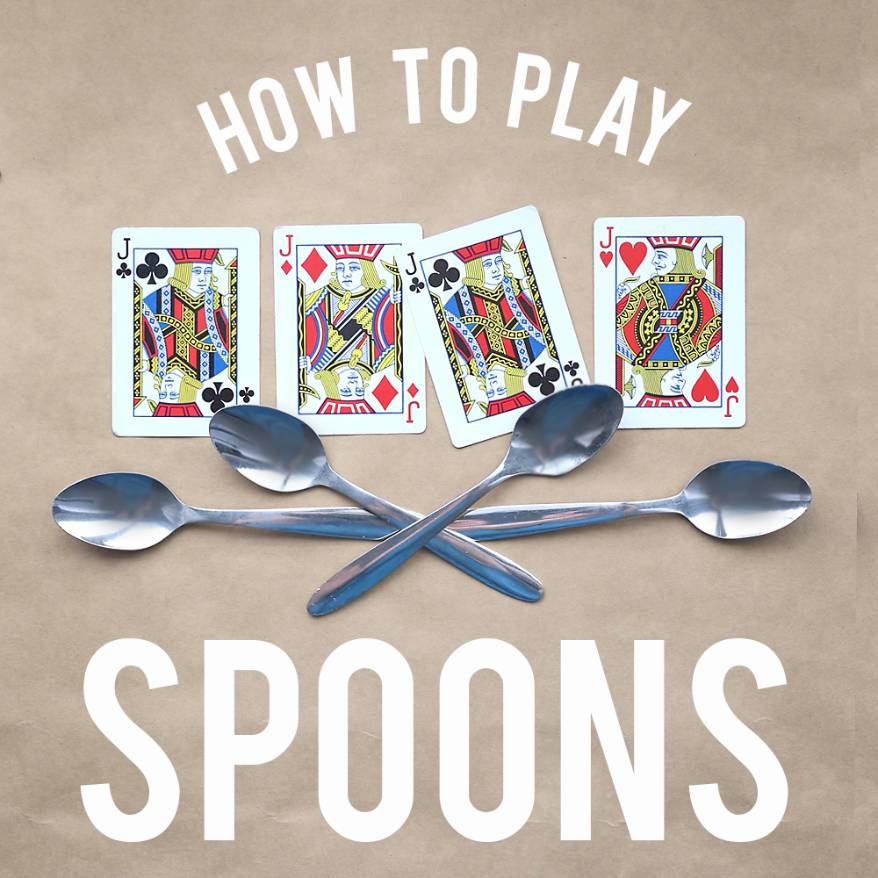
cardanoir.com – The spoons card game is the only card game that reliably ends with someone on the floor. It takes ninety seconds to explain, it works with three players or thirteen, and it turns a quiet room into a loud one faster than anything else you can do with a deck.
The spoons card game rules are simple enough to run from memory: collect four of a kind, grab a spoon, and do not be the person left holding nothing.
What the Spoons Card Game Is
Strip away the noise and this is musical chairs with cards. Everyone passes cards around a circle at the same time, trying to assemble four of a kind. The moment someone succeeds, they take a spoon from the middle of the table — and there are never enough spoons to go around.
The game belongs to a family of passing games that includes Pig, Tongue, and Donkey. All of them share the same engine and differ only in what you grab, or whether you grab anything at all.
One thing worth knowing before you start: the spoons card game has almost no strategy in the traditional sense. It rewards attention and nerve instead, which is exactly why it works with mixed groups where card skill varies wildly.
What You Need for a Big Group
- One standard 52-card deck for three to six players
- Two decks shuffled together for seven or more
- Spoons, one fewer than the number of players
- A table everyone can reach — this is the real constraint
Plastic spoons beat metal ones, and both beat anything fragile. Skip forks entirely, for reasons that become obvious the first time two people grab the same one.
Deck size matters more than people expect. You need four cards per player, so thirteen players uses an entire deck with nothing left over. Consequently, any group above six should add a second deck.
Spoons Card Game Rules: Setting Up
- Place the spoons in the centre of the table, within equal reach of everyone. Use one fewer spoon than there are players.
- Build the deck. Take four cards of the same rank for each player — four Aces, four Kings, four Queens, and so on. With eight players you would use eight ranks, so 32 cards.
- Deal four cards to each player.
- Sit in a circle, and confirm which direction cards will pass. Left is standard.
That deck-building step is the one most groups skip, and it is the reason their game drags. Extra ranks in the deck mean more cards that help nobody, and the round stalls.
Spoons Card Game Rules: How a Round Runs
Everyone plays at once. There are no turns, and that is the whole appeal.
- Look at your four cards and decide which rank you are chasing.
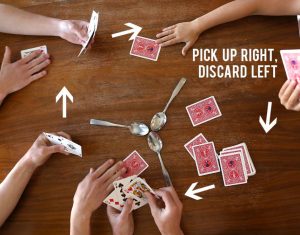
- Pass one unwanted card face-down to the player on your left, and pick up whatever your right-hand neighbour passed you.
- Never hold more than four cards. Pass one before you accept the next.
- Keep going, fast, until someone completes four of a kind.
The rhythm builds on its own. Nobody waits, so the pace comes down to how quickly the slowest person in the circle decides — which is why groups often ban thinking out loud.
The Grab, and Why It Gets Weird
Here is the part that makes the game:
- The first player to collect four of a kind takes a spoon.
- Everyone else may then grab, and they should grab immediately.
- The player left with no spoon loses the round.
Crucially, you do not need four of a kind to grab. You only need to notice that someone else did. So half the game is watching hands rather than cards, and experienced players take a spoon the instant they see any movement at the table.
Sneaky grabbing is entirely legal, and it is the best move in the game. Take your spoon quietly, keep passing cards as though nothing happened, and wait for the table to realise. A good sneak can leave three people still shuffling cards while the spoons are gone.
Elimination or Letters
Two ways to handle the loser, and they suit different groups.
Elimination is the traditional version. The spoonless player drops out, one spoon is removed so there is still one fewer than players, and one rank of four cards comes out of the deck. Play continues until two remain, and both are declared winners.
Letters keeps everyone playing. Each loss earns a letter, spelling S-P-O-O-N-S, and you are out once you complete the word. This version runs longer and suits parties better, since nobody sits out for twenty minutes watching.
For a group of ten or more, letters is almost always the right call.
Tactics That Actually Work
- Watch hands, not cards. The spoons disappear faster than any four of a kind arrives.
- Pass fast, always. Holding a card to think slows the whole circle and helps the person to your left.
- Commit to one rank early. Chasing two ranks at once means you finish neither.
- Sit within easy reach. Corner seats lose more rounds than bad cards do.
- Fake it occasionally. A sudden reach toward the centre sends everyone diving, and you can simply carry on passing.
Spoons Card Game Variants
- Pig. No spoons at all. The winner touches their nose with a finger, and everyone copies. The last to do it loses. It is the safest version for small children and cramped tables.
- Tongue. Identical, except the signal is sticking your tongue out. Silent, ridiculous, and excellent for classrooms.
- Donkey. Grab plastic chips or tokens instead of spoons, and losers collect the letters D-O-N-K-E-Y.
- Stock pile version. Rather than passing simultaneously, the dealer draws from a face-down stock and starts a chain of passing, with the last player discarding to a trash pile. It runs slower and works better with small groups.
Pig deserves a specific mention, since the winner cannot keep passing cards while touching their nose. That removes the sneaky-grab layer entirely, which makes it fairer and slightly less fun.
Running It Safely With a Crowd
This sounds like an overcautious section until you have watched eleven teenagers lunge at the same table.
Clear everything off the table first — drinks, glasses, phones, candles. Use plastic or wooden spoons rather than metal. Put the spoons in the true centre so nobody has an obvious reach advantage, and if your table is long rather than round, split into two circles instead of stretching one.
Agree on one rule before you start: hands grab spoons, bodies stay seated. It sounds fussy, and it is the difference between a great party game and someone’s chipped tooth.
For the full technical rule set and its regional variations, Pagat’s page on Pig and Spoons documents the family properly. Our family and party card games section covers more games that scale to large groups, and the card game rules guide explains the mechanics these party formats share.