cardanoir.com – In the Flesh and Blood TCG you are not a wizard commanding an army. You are the fighter, standing across the pit from another fighter, and every card in your hand is either a weapon or the energy to swing it — never both.
That one design choice drives everything else. The Flesh and Blood TCG rules give you no creatures to hide behind, no board state to rebuild, and no card you can play for free. Each turn you decide what to spend and what to keep, and the answer is never comfortable.
What the Flesh and Blood TCG Is
Legend Story Studios, a New Zealand studio, launched the game in 2019. Seven years and twenty sets later it sits among the few trading card games that grew without a licence attached to it — no franchise, no crossovers, just an original setting called Rathe.
Matches are one-on-one duels. You pick a hero, build a deck around their class, and attack until the other hero’s life hits zero. Adult heroes start around 40 life in the main format, while young heroes start at 20, so the pace changes dramatically depending on which you play.
Flesh and Blood TCG Rules: The Core Loop
Your turn runs through three phases, and the middle one is where everything happens.
- Start phase. Resolve anything that triggers at the beginning of your turn.
- Action phase. Play cards, attack, and defend against nothing — this is your time.
- End phase. Put one card into your arsenal if you want, then draw back up to your intellect.
The limit that shapes the whole game is action points. You get one per turn. Attacking costs it. So without help, you attack exactly once and then pass — unless you play cards with go again, which hands you another action point and lets the turn continue.
Chaining go again effects into a long sequence is the closest thing this game has to a combo, and building toward those turns is most of what deck construction is about.
Pitching: Every Card Is Two Cards
This is the rule that defines the Flesh and Blood TCG. There are no resource cards, and instead every card has a coloured strip in its top corner: red pitches for 1 resource, yellow for 2, blue for 3.
To pay for anything, you pitch cards from your hand, sending them to the bottom of your deck. So playing a strong card means throwing away other cards to afford it.
Notice what that does. Red cards hit hardest and pitch worst. Blue cards pitch best and do the least. Building a deck means balancing that curve, and playing well means knowing which card in your hand is fuel and which one is the point.
Because pitched cards go to the bottom of the deck rather than a discard pile, you also know roughly what is coming back. Strong players track that order deliberately, which is a skill no other major TCG asks for in quite the same way.
Flesh and Blood TCG Rules: Attacking and Defending
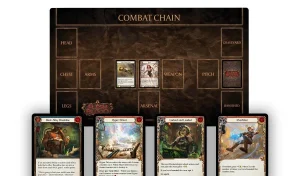
Combat resolves on the combat chain, one link at a time:
- The attacker declares an attack, paying its cost and one action point.
- The defender may block by playing cards from hand for their defence value, or by using equipment.
- Both players may add attack or defence reactions while the chain is open.
- Damage resolves. Anything left over hits the hero’s life total.
Blocking is where new players lose games. Every card you throw in front of an attack is a card you cannot use on your own turn, so defending costs you tempo even when it works perfectly. Consequently, experienced players often take damage on purpose to keep a strong hand intact.
Equipment absorbs damage too, but most pieces break after doing it. You start with head, chest, arms, legs, and a weapon, and losing them is part of the plan rather than a disaster.
Arsenal and Intellect in the Flesh and Blood TCG
At the end of your turn you may place one card face-down in your arsenal. It stays there, available next turn, and your opponent cannot see it.
Then you refill your hand to your intellect, which is four for most heroes. That refill is automatic and complete, which means an empty hand at the end of your turn is efficient, not reckless. Holding cards back usually means you wasted them.
Together, those two rules give the game its rhythm: spend everything, bank one card for later, reload, repeat.
Heroes, Classes, and Talents
Deck building in the Flesh and Blood TCG starts with your hero. Every hero belongs to a class — Warrior, Guardian, Ninja, Brute, Ranger, Runeblade, Wizard, Mechanologist, Illusionist, Assassin, and more — and many also carry a talent such as Light, Shadow, Elemental, or Draconic.
Your deck may only contain cards from your hero’s class and talent, plus generic cards anyone can use. That restriction is tight, and it is why two decks of the same class still feel different: the hero’s own ability, not the card pool, is what defines the plan.
The Formats
- Classic Constructed — the flagship. One adult hero, an 80-card pool including weapons and equipment, a minimum 60-card deck, and up to three copies of any card. Rounds run 55 minutes.
- Blitz — young heroes, smaller decks, faster games. The usual entry point for new players and the format most demo events use.
- Silver Age — launched in November 2025 and heavily pushed through 2026. It uses only common, rare, and basic cards: one young hero, a 55-card pool, exactly 40 cards in the deck, two copies maximum, 35-minute rounds.
- Limited — draft and sealed from booster product, exactly as you would expect.
- Living Legend — the format where retired heroes go, covered below.
Silver Age is the significant one for anyone starting now. Preconstructed Silver Age decks retail around $19.90 and are built to be tournament-legal straight out of the box, which makes it the cheapest competitive entry any major trading card game currently offers.
Living Legend: Why Heroes Retire
This is the mechanic that separates the Flesh and Blood TCG from every other game in the category. Rather than rotating sets out of legality, Flesh and Blood rotates heroes.
Every competitive result a hero achieves earns Living Legend points. Accumulate enough, and that hero — along with their signature weapon — leaves Classic Constructed permanently and moves to the Living Legend format, where every card remains playable forever.
So your cards never become worthless. The hero you built around eventually retires, but the deck still has a home, and the generic cards you bought stay legal across formats. Silver Age handles this differently again, benching heroes for a season based partly on a community vote rather than retiring them outright.
Why Players Love It
Three reasons come up constantly.
It rewards decisions over draws. Pitching, blocking, and arsenal choices mean a skilled player wins far more consistently than variance allows in most card games.
It is built around physical play. LSS deliberately centred organised play on local game stores, from weekly Armory events up to Battle Hardened, Callings, Pro Tours, and a World Championship.
Nothing is wasted. Between Living Legend, the generic card pool, and the new budget formats, cards keep a use long after the metagame moves on.
How to Start in 2026
The cheapest way into the Flesh and Blood TCG right now is a Silver Age preconstructed deck. At roughly $19.90 it is tournament-ready, and it teaches the core rules without the complexity of an adult hero’s full card pool. Grab two if you want an opponent at home.
After that, visit a local store on an Armory night and say you are new. Twenty sets deep, the current release is Usurp the Shadow Throne, out on 25 September 2026 and built around the game’s Shadow heroes, so it is a reasonable place to open your first boosters. The official rules and policy centre publishes every format restriction and banned list for free.
For a sense of how this compares with other collectible games, our collectible and trading card games section covers the wider field, and the Disney Lorcana guide makes a useful contrast — same category, far gentler learning curve.