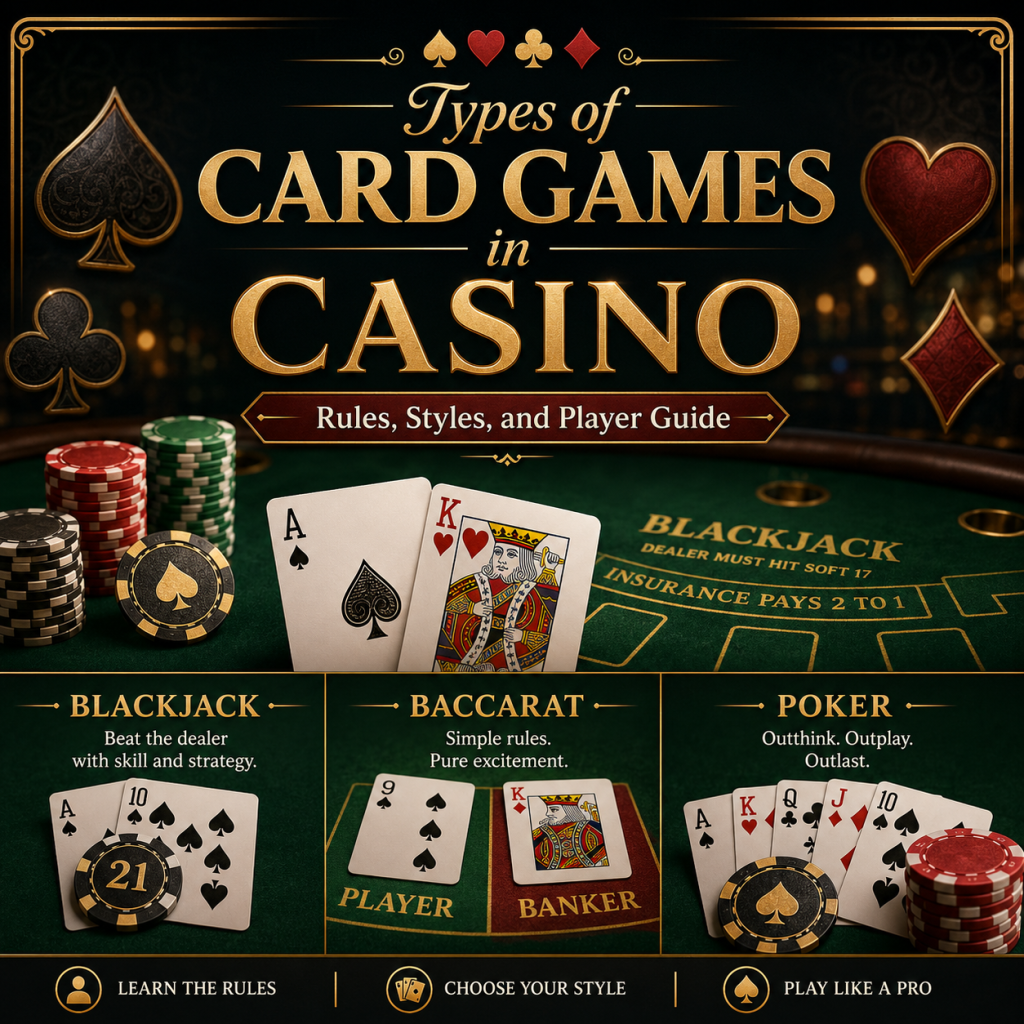
cardanoir.com – Casino floors are filled with flashing machines, spinning wheels, and busy tables, but card games remain among the most recognizable attractions. They combine simple physical tools with rules that can range from extremely easy to deeply strategic.
There are many types of card games in casino environments. Some ask players to compete directly against the dealer, while others place participants against one another. Certain games are decided quickly after only two or three cards, whereas poker variations may involve several betting rounds and more complex decisions.
The atmosphere also changes from one table to another. Blackjack often feels fast and focused. Baccarat creates a more formal rhythm with only a few main betting options. Casino poker games are usually based on fixed hand rankings, while traditional poker rooms involve competition between players.
Understanding these differences helps beginners choose a game that matches their preferred pace, learning style, and level of interaction. It also prevents one common mistake: assuming that every casino card game works like poker.
What Defines a Casino Card Game?
A casino card game is generally played with one or more standard decks and follows rules established by the house. The dealer manages the cards, checks wagers, applies the rules, and settles the outcome.
Most games belong to one of three structures:
- Player versus dealer
- Player versus player
- Player wagering on a comparison between hands
The distinction matters because it determines where the casino’s advantage comes from.
In blackjack, the player competes against the dealer’s hand. In baccarat, the participant usually wagers on whether the Player hand or Banker hand will finish closer to nine. In a poker room, players compete against each other while the venue collects a fee.
Common Elements Found at Card Tables
Although the rules vary, many games use several common elements:
- A dealer
- A betting area
- Standard playing cards
- Minimum and maximum stakes
- Hand-ranking rules
- Fixed payout conditions
- Multiple rounds or decisions
- A house advantage or table fee
Players should always read the table rules because two games with similar names may use different payout structures.
Blackjack: The Best-Known Dealer Game
Blackjack is one of the most familiar casino card games. The goal is to create a hand closer to 21 than the dealer without exceeding that total.
Number cards keep their printed value. Face cards are worth ten, while an Ace can usually count as one or eleven.
Basic Blackjack Actions
Players may encounter actions such as:
- Hit: Take another card.
- Stand: Keep the current hand.
- Double down: Increase the wager and receive one additional card.
- Split: Separate a matching pair into two hands.
- Surrender: Give up part of the wager under certain rules.
The dealer does not make flexible choices in the same way as the player. The house follows fixed instructions, such as drawing until reaching a specific total.
Why Blackjack Feels Strategic
Blackjack gives players more decisions than many other table games. The value of the hand, the dealer’s visible card, and the available rules all influence the correct action.
For example, a total of 16 may feel strong against a weak dealer card but dangerous against a high dealer card. Because the decision changes with the situation, players often use a basic-strategy chart.
However, strategy does not remove uncertainty. It only helps players make decisions consistently according to the mathematical structure of the game.
Baccarat: Simple Choices with a Formal Rhythm
Baccarat may look intimidating because of its elegant presentation, but its core rules are straightforward. Two hands are compared:
- Player
- Banker
Participants may usually wager on:
- Player winning
- Banker winning
- A tie
The winning hand is the one whose total is closest to nine.
How Baccarat Values Cards
Cards are valued as follows:
| Card | Value |
|---|---|
| Ace | 1 |
| 2–9 | Printed value |
| 10, Jack, Queen, King | 0 |
Only the final digit of the total matters. If a hand totals 15, its baccarat value is five.
Why the Banker Bet Is Different
The Banker hand follows drawing rules that give it a slight structural advantage. As a result, many tables apply a commission to winning Banker wagers.
This cause-and-effect relationship is important: because the Banker wager wins slightly more often under standard rules, the house commonly reduces its payout through commission.
Players should check the exact table conditions because commission-free baccarat can use modified payouts or special rules.
Casino Poker and Traditional Poker Rooms
The word poker can refer to two very different experiences.
In a traditional poker room, players compete against one another. The casino does not normally play a hand against them. Instead, it collects a rake or tournament entry fee.
At a casino table game such as Three Card Poker, the participant competes against the dealer according to fixed qualifying rules.
Player-versus-Player Poker
Common poker-room formats include:
- Texas Hold’em
- Omaha
- Seven-Card Stud
- Five-Card Draw
- Tournament poker
- Cash games
These games involve strategy based on position, betting patterns, hand strength, and opponent behavior.
Casino Poker Variations
Casino-style poker games may include:
- Three Card Poker
- Caribbean Stud Poker
- Ultimate Texas Hold’em
- Four Card Poker
- Casino Hold’em
The participant generally makes a fixed opening wager and may receive a later decision to continue or fold.
Why Casino Poker Feels Different
Traditional poker rewards long-term decision-making against other people. Casino poker is more structured because the dealer follows fixed rules.
As a result, bluffing may be central in a poker room but irrelevant in many dealer-based poker games.
Three Card Poker: Fast Hands and Simple Rankings
Three Card Poker uses only three cards per hand. Players may face the dealer through an Ante wager and may also find optional side bets.
The hand rankings differ slightly from five-card poker because combinations have different probabilities.
A common ranking order is:
- Straight flush
- Three of a kind
- Straight
- Flush
- Pair
- High card
Why a Straight Can Beat a Flush
With only three cards, a straight is less likely than a flush. Therefore, many rule sets rank a straight above a flush.
This is a useful reminder that hand rankings depend on the game’s mathematical structure. Players should not automatically apply five-card poker rankings to every variation.
Caribbean Stud Poker: Dealer Qualification Matters
Caribbean Stud Poker uses five-card hands, but the player competes against the dealer rather than other participants.
After seeing the cards, the player usually chooses to fold or continue by placing an additional wager.
The dealer must often qualify with a minimum hand. If the dealer does not qualify, the Ante may be paid while the additional wager is returned.
Main Features of Caribbean Stud
- Five-card hands
- No drawing cards
- No bluffing between participants
- Dealer qualification rules
- Optional progressive jackpot at some tables
Because the player receives all five cards immediately, the main decision is whether the hand is strong enough to continue.
Ultimate Texas Hold’em: Familiar Cards, Different Structure
Ultimate Texas Hold’em uses community cards and familiar Texas Hold’em rankings. However, players compete against the dealer rather than other players.
The game often gives several opportunities to raise:
- Before the flop
- After the flop
- After all community cards are revealed
Earlier decisions may allow larger raises, while later decisions provide more information but smaller betting options.
Risk and Information
The game creates a clear trade-off. Acting early provides less information but may allow a stronger wager. Waiting gives more information, but the available raise may become smaller.
This balance makes the game feel more strategic than many fixed-action table games.
Casino War: One of the Simplest Card Games
Casino War is based on the familiar childhood game of comparing one card against another.
The player and dealer each receive a card. The higher card wins.
If both cards match, the table applies a tie procedure. The player may be able to surrender or continue into a “war” round, depending on the house rules.
Why Casino War Appeals to Beginners
The game is easy to understand because:
- There are no complex hand rankings.
- Each round is short.
- The higher card usually wins.
- Decisions are limited.
Its simplicity also means that players have little influence over the result. The game is driven mostly by card distribution and table rules.
Red Dog: Betting on the Spread
Red Dog is less common than blackjack or baccarat, but it offers a distinctive structure.
Two cards are dealt, and the player wagers on whether a third card will fall numerically between them.
For example:
First card: 4
Second card: 9
Winning third cards would be:
5, 6, 7, or 8The number of ranks between the first two cards is called the spread. A smaller spread generally offers a higher payout because fewer cards can produce a winning result.
Pai Gow Poker: Building Two Hands
Pai Gow Poker combines traditional playing cards with a hand-setting structure inspired by Pai Gow.
Each participant receives seven cards and divides them into:
- A five-card high hand
- A two-card low hand
The five-card hand must rank higher than the two-card hand.
How a Round Is Decided
To win fully, the player generally needs both hands to defeat the dealer’s corresponding hands.
Possible results include:
- Both player hands win
- Both player hands lose
- One wins and one loses, creating a push
Because split results are common, Pai Gow Poker often moves more slowly than blackjack or baccarat.
Why Hand Setting Matters
The same seven cards can sometimes be arranged in several ways. A strong five-card hand may leave a weak two-card hand, while a more balanced division can improve the chance of winning both comparisons.
This makes hand construction the central strategic element.
Let It Ride: Deciding Whether to Withdraw Wagers
Let It Ride is based on five-card poker rankings. Players begin with multiple equal wagers and receive opportunities to withdraw some of them as community information is revealed.
The player is not trying to defeat the dealer. Instead, the hand is compared with a payout table.
The Meaning of “Let It Ride”
At each decision point, the player may:
- Remove an eligible wager
- Leave the wager in action
Choosing to let it ride means keeping the wager active while waiting for the completed hand.
The game creates suspense because players gradually discover whether the final combination reaches a qualifying payout.
Comparison of Popular Casino Card Games
| Game | Main Opponent | Decision Level | Typical Pace | Core Objective |
|---|---|---|---|---|
| Blackjack | Dealer | Medium–high | Fast | Beat dealer without exceeding 21 |
| Baccarat | Hand comparison | Low | Fast | Wager on hand closest to nine |
| Three Card Poker | Dealer | Medium | Fast | Build a stronger three-card hand |
| Caribbean Stud | Dealer | Medium | Moderate | Beat qualifying dealer hand |
| Ultimate Texas Hold’em | Dealer | High | Moderate | Build best five-card poker hand |
| Casino War | Dealer | Low | Very fast | Receive the higher card |
| Red Dog | Card range | Low | Fast | Third card falls inside spread |
| Pai Gow Poker | Dealer | High | Slow | Win both arranged hands |
| Let It Ride | Payout table | Medium | Moderate | Build a qualifying poker hand |
How to Choose the Right Casino Card Game
The best game depends on the type of experience the player wants.
Choose blackjack for frequent decisions. Pick baccarat for simple wagering and quick rounds. Three Card Poker works well for people who want poker rankings without long betting rounds, while Pai Gow Poker suits players who enjoy slower hand construction.
A simple guide:
- For complete beginners: Casino War
- For simple betting choices: Baccarat
- For strategic decisions: Blackjack
- For poker-style hands: Three Card Poker
- For community cards: Ultimate Texas Hold’em
- For slower rounds: Pai Gow Poker
- For unusual mechanics: Red Dog
- For progressive reveals: Let It Ride
Important Rules to Check Before Playing
Tables with the same game name can use different conditions.
Players should check:
- Blackjack payouts
- Dealer hit or stand rules
- Number of decks
- Baccarat commission
- Poker qualification requirements
- Side-bet payouts
- Maximum and minimum stakes
- Tie procedures
- Raise limits
A small rule change can affect both strategy and expected return.
Side Bets Need Separate Attention
Many tables offer optional wagers based on pairs, suited cards, special totals, or premium hands.
Side bets often provide dramatic payouts but occur less frequently. They should be evaluated separately from the main game rather than treated as part of the standard strategy.
A Realistic Review of Casino Card Games
Blackjack offers the strongest sense of player involvement. Decisions appear on nearly every hand, and understanding basic strategy makes the experience more structured.
Baccarat is easier to follow than its formal image suggests. Once card values are understood, the game becomes fast and repetitive. This simplicity can be relaxing, although it provides limited decision-making.
Three Card Poker is enjoyable for short sessions because hands finish quickly and the rankings are easy to memorize. Ultimate Texas Hold’em feels deeper because community cards and multiple raise points create more meaningful choices.
Pai Gow Poker offers a calmer pace. Splitting seven cards into two hands can be satisfying, and frequent pushes reduce the feeling of constant loss. However, beginners may need time to understand the house way and hand-setting rules.
Casino War is immediately accessible but offers almost no strategic depth. Red Dog and Let It Ride provide unusual mechanics that can appeal to players seeking something beyond the most common tables.
Overall, the strongest choice depends less on visual popularity and more on whether the player prefers strategy, simplicity, speed, or social interaction.
Responsible Play and Practical Limits
Casino card games involve financial risk. Rules and strategy can improve understanding, but they do not remove the house advantage or guarantee a winning session.
A responsible approach includes:
- Setting a fixed spending limit
- Using only entertainment funds
- Avoiding attempts to recover losses
- Taking regular breaks
- Understanding the rules before wagering
- Ignoring claims of guaranteed systems
- Stopping when play is no longer enjoyable
A game should remain entertainment, not become a financial solution.
FAQ About Types of Card Games in Casino
1. What is the easiest casino card game to learn?
Casino War is among the easiest because the higher card usually wins. Baccarat is also straightforward once the card values are understood.
2. Which casino card game involves the most strategy?
Blackjack and Ultimate Texas Hold’em involve frequent decisions. Pai Gow Poker also requires careful hand setting.
3. Is casino poker the same as a poker-room game?
No. Casino poker usually places the player against the dealer, while poker-room games involve competition between players.
4. Why do baccarat Banker wins sometimes pay less?
The Banker hand has a slight structural advantage under standard drawing rules, so many tables charge commission or use adjusted payouts.
5. Can strategy guarantee a profit in casino card games?
No. Strategy may reduce mistakes and improve decision quality, but it cannot eliminate randomness or the built-in house advantage.
Conclusion
Exploring the types of card games in casino settings reveals a wide range of experiences. Blackjack emphasizes decision-making, baccarat focuses on simple hand comparison, and poker-based table games use familiar rankings in dealer-controlled formats. Casino War offers speed and accessibility, while Pai Gow Poker rewards careful hand construction. Red Dog and Let It Ride provide less common mechanics for players looking beyond traditional tables. Each game has its own pace, rules, payout structure, and level of strategic involvement. Understanding those differences helps players choose more intelligently, avoid confusing one game’s rules with another, and approach every table with realistic expectations and responsible limits.