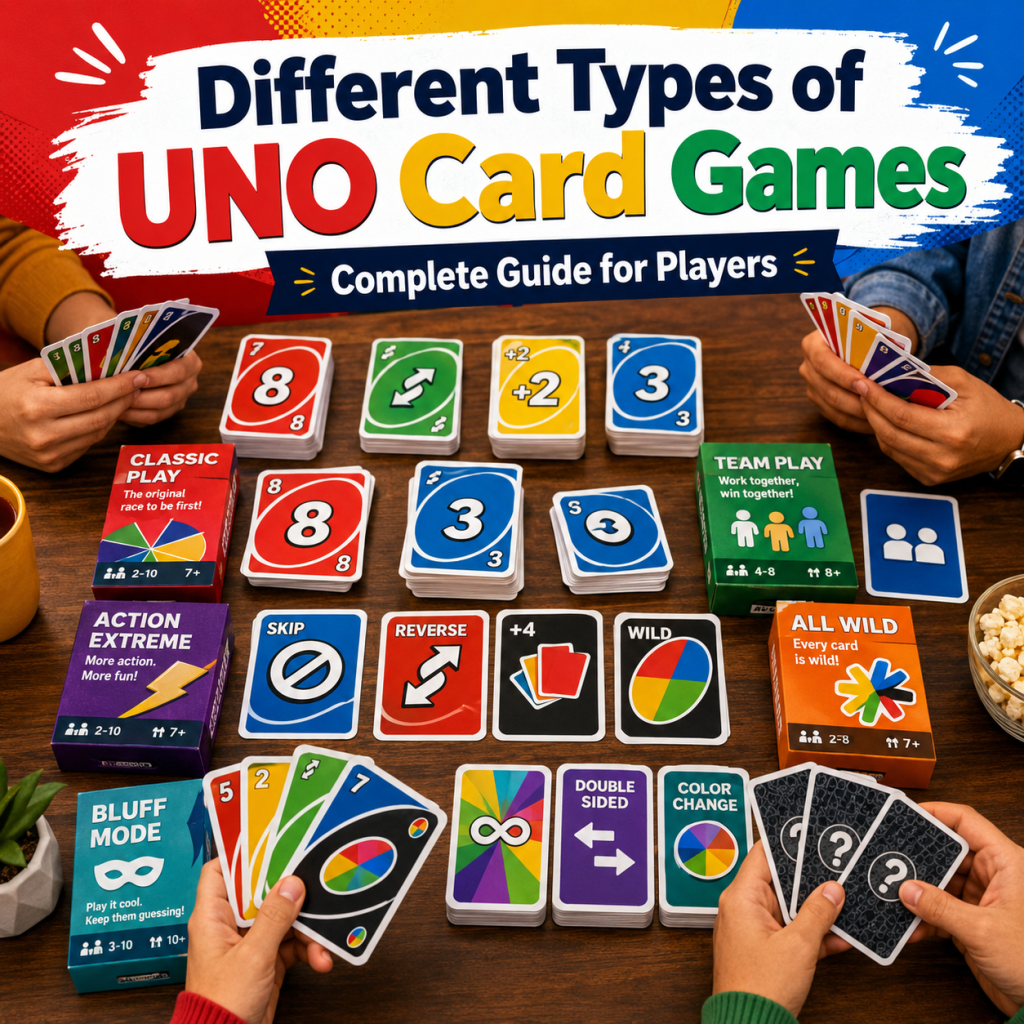
cardanoir.com – UNO has remained one of the most recognizable family card games because its basic idea is wonderfully simple: match a card by color, number, or symbol, use action cards at the right moment, and become the first player to empty your hand.
The familiar rules are only the beginning. Today, there are many different types of UNO card games, and each version changes the experience in a meaningful way. Some versions introduce double-sided cards, while others add electronic launchers, team-based play, bluffing, powerful penalties, collectible characters, or decks made entirely of Wild cards.
This variety is important because not every group enjoys the same style of game. A family with younger children may prefer the predictable rhythm of Classic UNO. A competitive group may enjoy the aggressive rules of UNO Show ’Em No Mercy. Players who like deception can choose Liar’s UNO, while friends who prefer cooperation may have more fun with UNO Teams.
The result is a card-game family that can support almost any kind of gathering—from a quiet evening at home to a loud party filled with strategic revenge.
Why Are There So Many UNO Game Variations?
The original matching system is flexible enough to support new mechanics without becoming unrecognizable. Players still understand the main objective, but each edition introduces a different problem to solve.
For example, changing one card color can create a more tactical game. Adding a launcher makes drawing cards unpredictable. Introducing team rules changes how players communicate and plan their moves.
This creates a clear cause-and-effect relationship:
- The original rules are easy to understand.
- New mechanics can be added without requiring a completely new game.
- Returning players feel familiar with the foundation.
- The added rules create fresh tension and replay value.
- Different groups can choose an edition that matches their preferred playing style.
That balance between familiarity and surprise is the main reason UNO variations continue to attract children, adults, families, collectors, and casual card-game players.
Quick Comparison of Popular UNO Card Games
| UNO Version | Main Gameplay Twist | Interaction Level | Difficulty | Best For |
|---|---|---|---|---|
| Classic UNO | Match colors, numbers, or symbols | Medium | Easy | Families and beginners |
| UNO Flip | Double-sided Light and Dark decks | High | Medium | Players who enjoy sudden changes |
| UNO Flex | Cards can temporarily change color | High | Medium | Tactical players |
| UNO All Wild | Every card is a Wild card | Very high | Easy | Fast and chaotic sessions |
| UNO Attack | Electronic launcher determines card penalties | Very high | Easy | Parties and children |
| UNO Show ’Em No Mercy | Stacking and extreme draw penalties | Extreme | Medium | Competitive groups |
| UNO Teams | Players compete in pairs | High | Medium | Cooperative game nights |
| Liar’s UNO | Bluffing with face-down cards | Very high | Medium | Players who enjoy deception |
| UNO Ultimate | Character powers and special decks | High | Advanced | Collectors and strategy fans |
| Themed UNO | Familiar rules with franchise-specific cards | Medium | Easy | Fans and collectors |
1. Classic UNO: The Original Starting Point
Classic UNO remains the most accessible version for new players. Each player tries to match the top card of the discard pile by color, number, or symbol. Skip, Reverse, Draw Two, Wild, and Wild Draw Four cards can immediately change the direction or momentum of a round.
The modern official version can include 112 cards, including customizable Wild cards that allow a group to write its own house rules. Mattel also adds graphic symbols to help players identify card colors, improving accessibility for people with color-vision differences.
What Makes Classic UNO Appealing?
Classic UNO works because it rarely needs a long explanation. Most players understand the rules after watching only a few turns.
Its strongest qualities include:
- Simple matching mechanics
- Fast setup
- Portable cards
- Flexible player count
- A balance between luck and timing
- Rules that can be adjusted for children or adults
Best Situation for Classic UNO
Choose Classic UNO when several people in the group have never played before. It is also the safest version for a mixed-age family gathering because the basic actions are easy to recognize.
The game can still become competitive, especially when a Draw Two or Reverse card ruins someone’s carefully planned final turn. However, it usually remains lighter and less punishing than the more aggressive editions.
2. UNO Flip: Two Sides, Two Personalities
UNO Flip uses double-sided cards. The game begins on the Light Side, which feels relatively close to traditional UNO. When a Flip card is played, every card in each player’s hand, the draw pile, and the discard pile must be turned over.
The Dark Side introduces harsher actions and a more dangerous atmosphere. A player who appears close to winning on the Light Side may suddenly discover that the cards on the reverse side are far less helpful.
Why UNO Flip Feels More Dramatic
The most interesting part of UNO Flip is hidden information. Players can see the front side of their cards, but they must remember what may be waiting on the back.
That creates tension because a Flip card does more than change the active color. It can completely transform the strength of every hand.
A player who has only two useful Light Side cards may suddenly hold several dangerous Dark Side actions. As a result, the apparent leader can become the weakest player within seconds.
UNO Flip is best for groups that already understand Classic UNO but want more uncertainty and bigger momentum changes.
3. UNO Flex: A More Tactical Matching Game
UNO Flex changes the normal meaning of color. Certain cards can “flex” into another color, allowing players to create matches that would not be legal in Classic UNO.
Power Cards control whether a player can activate the flexible side of a card. A green check means the power is available, while a red X means the player must wait before using another flexible effect.
The deck also includes special actions such as Flex Draw Two, Flex Draw Four, Flex Skip, and Flex Wild All Draw. These cards can affect one selected opponent or, in some situations, several players at once.
What Kind of Player Will Enjoy UNO Flex?
UNO Flex suits players who like planning several turns ahead. The ability to reinterpret a card’s color gives players more choices, but the Power Card system prevents those choices from becoming unlimited.
This cause-and-effect structure makes the game more strategic:
- Flexibility gives players more playable options.
- More options reduce the chance of becoming completely stuck.
- Power limitations force players to save certain effects.
- Saving a power creates opportunities for surprise attacks later.
In practical terms, UNO Flex feels familiar during the first few turns. The strategy becomes clearer when players realize that the visible color of a card is not always its only possible identity.
4. UNO All Wild: Fast, Easy, and Completely Unpredictable
UNO All Wild removes numbered color cards from the traditional formula. Every card can be played because the deck consists entirely of Wild cards.
That does not mean the game lacks variety. The official deck includes actions such as Wild Reverse, Wild Skip, Skip Two, Wild Draw Two, Wild Draw Four, Wild Forced Swap, and Wild Targeted Draw Two.
Is UNO All Wild Too Easy?
The matching process is easier because players rarely need to draw simply because they lack the correct color or number. However, the action effects create constant disruption.
One player may be close to winning, only to have their hand swapped with someone holding far more cards. Another player may choose a specific opponent as the target of a draw penalty.
The game therefore shifts its emphasis:
Classic UNO focuses on finding a legal match, while UNO All Wild focuses on choosing the most damaging action at the right moment.
This version works particularly well when players want a quick game with minimal rule explanation.
5. UNO Attack: Drawing Cards Becomes a Suspense Event
UNO Attack replaces the traditional draw pile with an electronic card launcher. When certain cards are played, the next participant must press the launcher. Sometimes nothing happens. At other times, the machine releases several cards without warning.
The official UNO Attack set combines the random-action launcher with lights, sounds, and a 112-card deck.
Why the Launcher Changes the Atmosphere
Drawing one card from a normal pile is predictable. Pressing a launcher is not.
The machine creates a pause before the result, and that short delay often becomes the funniest part of the turn. Everyone watches, knowing that a large group of cards may suddenly fly out.
UNO Attack is less portable than a standard deck because the launcher is an essential part of the game. It may also feel noisier and more energetic. For that reason, it is better suited to home game nights and parties than quiet travel situations.
6. UNO Show ’Em No Mercy: The Most Aggressive Edition
UNO Show ’Em No Mercy is designed for players who believe ordinary Draw Two and Draw Four cards are not painful enough.
The deck contains 168 cards and introduces actions such as Wild Draw Six, Wild Draw Ten, and Skip Everyone. It also includes an official stacking rule that allows draw penalties to accumulate until someone cannot continue the chain.
Numbers seven and zero trigger hand-swapping effects, while the Mercy Rule eliminates any player who reaches 25 or more cards. A player can win by emptying their hand or by knocking every opponent out of the game.
When Should You Choose No Mercy?
Choose this version when the group:
- Already understands standard UNO
- Enjoys direct competition
- Does not mind long chains of penalties
- Likes dramatic comebacks
- Can laugh when a nearly empty hand suddenly becomes enormous
A Warning About Group Dynamics
This edition can create memorable rounds, but it may not suit every family. The penalties are intentionally severe, and players can target each other repeatedly.
The cause is simple: stronger action cards create more opportunities to attack. The effect is a louder, more emotional, and sometimes longer game.
For competitive friends, that intensity is the main attraction. For very young or easily frustrated players, Classic UNO may be the better choice.
7. UNO Teams: Cooperation Changes the Strategy
UNO Teams changes the usual every-player-for-themselves format. Participants form pairs and work together.
Players still match cards by number, color, or symbol, but both teammates must empty their hands before the pair can win. Special cards and rules allow partners to support each other during the game.
Why Team Play Feels Different
In ordinary UNO, giving another player an advantage is usually a mistake. In UNO Teams, helping your partner is essential.
A good move may not reduce your own hand immediately. Instead, it may create a better situation for your teammate’s next turn.
This produces a more social form of strategy. Players must observe both opponents and partners while avoiding communication that reveals too much information.
UNO Teams is an excellent option for four or more players who want competition without making every decision completely individual.
8. Liar’s UNO: Bluffing Becomes Part of the Rules
Liar’s UNO introduces face-down play and deliberate deception. A player can place a Liar’s Card face down and announce what the card supposedly is.
Another player can accept the claim or challenge it. If the player was lying, the liar must draw a card. If the claim was truthful, the challenger receives the penalty instead.
The Psychology Behind Liar’s UNO
This version is not only about managing cards. Players must also manage facial expressions, voice, timing, and confidence.
Someone who always challenges may collect unnecessary penalties. Someone who never challenges may allow opponents to bluff freely.
The strongest moments happen when a normally honest player suddenly makes a suspicious claim—or when a confident accusation turns out to be completely wrong.
Liar’s UNO is ideal for groups that enjoy social deduction, poker-style bluffing, and playful arguments.
9. UNO Ultimate: Character Powers and Deeper Strategy
UNO Ultimate adds collectible characters, dedicated decks, unique abilities, and a Danger Deck containing Event and Enemy cards.
In UNO Ultimate Marvel, players choose characters with powers they can use throughout the game. The set includes four character decks, collectible foil cards, and more than one way to win a round.
Is UNO Ultimate Still Easy to Learn?
The objective remains connected to traditional UNO, but the character powers and additional decks introduce more information to track.
This makes UNO Ultimate better for players who want:
- Asymmetric character abilities
- Collectible components
- More strategic decisions
- Strong franchise themes
- Greater replay variety
It is not necessarily the best first UNO game. However, it can be one of the most rewarding versions for players who already enjoy modern tabletop games.
10. Themed UNO Editions: Familiar Rules with New Personalities
Themed UNO decks use characters, movies, television programs, sports teams, or entertainment franchises to redesign the familiar cards.
Many themed decks preserve the standard color-and-number matching system while adding one special rule inspired by the featured property.
For example, official Mattel editions have included special franchise-based effects such as Spider-Man’s Web Swing, Superman’s Kryptonite rule, Wicked’s Defy Gravity rule, and Moana 2’s Wayfinder mechanic.
Are Themed Decks Only for Collectors?
Not always. A themed deck can help attract someone who is not normally interested in card games.
A movie fan may initially choose the deck for its artwork, then discover that the special rule creates a genuinely different experience.
However, some themed versions change only a small part of the gameplay. Players seeking a major mechanical transformation may prefer UNO Flip, Flex, Attack, or Show ’Em No Mercy.
11. UNO Splash and Premium Editions
Not every UNO variation changes the rules dramatically. Some versions change the materials, presentation, or playing environment.
UNO Splash uses durable, waterproof cards, making it practical near pools, beaches, or other places where ordinary paper cards could be damaged.
UNO Platinum Edition keeps the classic gameplay but uses heavier linen-finish cards and a holographic foil logo for a more premium appearance and feel.
These editions are useful examples of how a card game can offer variation without rewriting its central rules.
12. Newer Experimental Variations
UNO continues to explore mechanics beyond traditional matching.
UNO Pop, for example, introduces a Pop Pile that grows as numbers accumulate. A Pop +1 or Pop +2 card can force a player to draw the total built-up penalty, creating suspense similar to a ticking timer.
Mattel also offers add-on packs that can be mixed into a Classic UNO deck. These packs introduce selected special cards and effects without requiring players to replace the entire base game.
This modular approach gives regular players a practical way to refresh an existing deck.
Editorial Review: Which UNO Version Feels Best?
From an editorial game-night perspective, there is no single version that dominates every category.
Classic UNO remains the most balanced choice. It is easy to teach, easy to carry, and suitable for almost any age group.
UNO Flip provides the strongest all-around upgrade for players who want something fresh without moving too far away from the original formula. The double-sided cards create memorable reversals, but the rules remain manageable.
UNO Show ’Em No Mercy delivers the most intense competition. It is the version most likely to create dramatic reactions, temporary alliances, and stories that people remember after the game ends.
Liar’s UNO offers the best social interaction because the cards become only part of the contest. Reading another player can matter as much as selecting the correct move.
UNO Teams is the best option for players who prefer shared victories, while UNO Ultimate is the strongest choice for collectors and players who enjoy layered strategy.
Our overall recommendations are:
- Best for beginners: Classic UNO
- Best for families: UNO Flip
- Best for parties: UNO Attack
- Best for competitive groups: UNO Show ’Em No Mercy
- Best for strategic players: UNO Flex
- Best for bluffing: Liar’s UNO
- Best for teamwork: UNO Teams
- Best for collectors: UNO Ultimate
- Best for fast chaos: UNO All Wild
- Best for travel near water: UNO Splash
How to Choose the Right UNO Card Game
Before selecting a version, consider how your group normally plays.
Choose Based on Player Experience
Beginners generally benefit from Classic UNO or a straightforward themed edition. Experienced players can move toward Flex, Flip, No Mercy, or Ultimate.
Choose Based on Group Personality
A calm family may prefer Classic UNO. A loud party may enjoy UNO Attack. Friends who constantly accuse each other of cheating may find Liar’s UNO unusually appropriate.
Choose Based on Available Time
Some versions produce faster rounds, while others can extend the game through stacking, swapping, and larger hands.
UNO All Wild is usually suitable for quick chaos. UNO Show ’Em No Mercy can become longer when penalties accumulate.
Choose Based on Portability
A basic deck fits easily into a bag. UNO Attack requires an electronic launcher, while UNO Ultimate includes more components and separate decks.
Frequently Asked Questions
1. How many different types of UNO card games are there?
There are many official variations, including Classic UNO, UNO Flip, UNO Flex, UNO All Wild, UNO Attack, UNO Teams, Liar’s UNO, UNO Ultimate, Show ’Em No Mercy, themed decks, premium editions, and add-on packs. The available lineup can change as new editions are released.
2. Which UNO game is best for beginners?
Classic UNO is the best starting point because it teaches the basic color, number, and symbol-matching system used across most other variations.
3. What is the hardest version of UNO?
UNO Ultimate has some of the deepest rules because it introduces character powers and additional decks. UNO Show ’Em No Mercy is not necessarily harder to understand, but it is more aggressive and punishing.
4. Which UNO version is best for adults?
Adults who enjoy intense competition may prefer UNO Show ’Em No Mercy. Groups that enjoy bluffing and social interaction may prefer Liar’s UNO, while strategy-focused players may enjoy UNO Flex or UNO Ultimate.
5. Can different UNO decks be combined?
Standard decks should not automatically be mixed because each variation may have its own card balance and rules. Official add-on packs are specifically designed to expand compatible Classic UNO decks.
Conclusion
The different types of UNO card games prove that one simple matching concept can support many completely different experiences. Classic UNO provides an accessible foundation, UNO Flip creates dramatic transformations, UNO Flex rewards tactical decisions, UNO All Wild delivers immediate chaos, and UNO Show ’Em No Mercy turns friendly competition into an unforgiving battle. Other editions introduce teamwork, bluffing, electronic suspense, character powers, waterproof materials, or collectible themes. The best choice ultimately depends on the people around the table: select Classic UNO for simplicity, Flip for balanced excitement, No Mercy for fierce competition, Liar’s UNO for social deception, or Ultimate for deeper strategy. Whichever edition reaches the table, the familiar final-card moment remains unchanged—someone must remember to shout “UNO!”