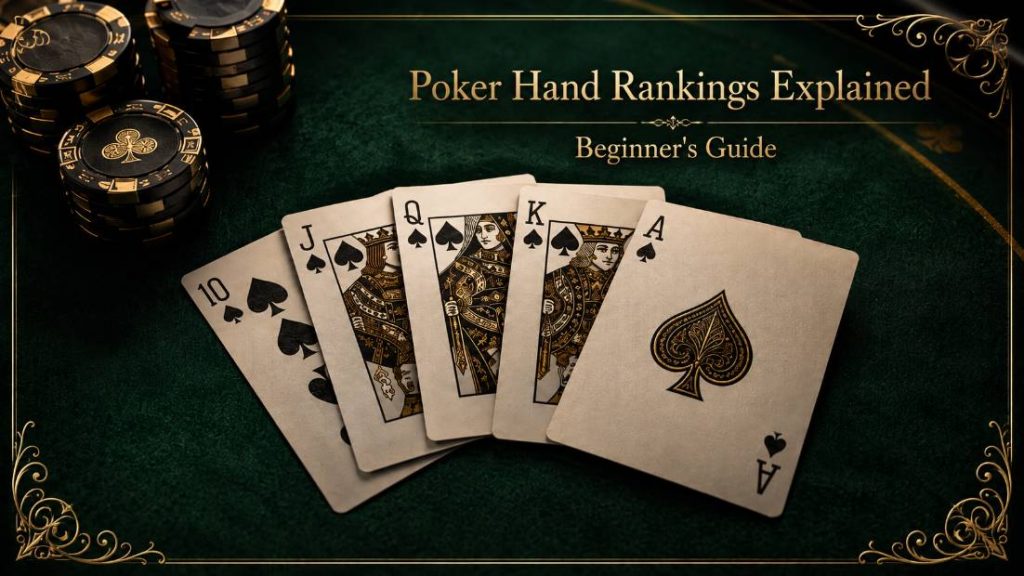
cardanoir.com – If you’ve ever sat down at a poker table and felt a flash of panic trying to remember whether a flush beats a straight, you’re not alone. Poker hand rankings are the foundation of every version of the game, from casual home games to the World Series of Poker, and once they click, everything else about poker starts to make sense.
This guide breaks down all ten poker hands from weakest to strongest, explains how ties are settled, and gives you a few memory tricks so you never have to second-guess yourself at the table again.
Why Hand Rankings Matter
Poker hand rankings exist because the game is built around scarcity. The rarer a combination of cards is, the harder it is to make, and the more valuable it becomes. A Royal Flush is nearly impossible to land by chance, so it sits at the very top. A single high card, on the other hand, is the most common outcome, so it ranks at the bottom.
Almost every popular variant — Texas Hold’em, Omaha, Seven-Card Stud — uses this same ranking system, which is part of why learning it once pays off across the entire poker world.
The Complete Poker Hand Rankings, Highest to Lowest
Below, each hand includes a real card example and its approximate odds of being dealt in a standard 5-card draw from a 52-card deck — a useful reference for understanding just how rare (or common) each hand really is.
1. Royal Flush
Example: 10♠ J♠ Q♠ K♠ A♠ Odds: Roughly 1 in 649,740 hands
The best possible hand in poker. It’s a straight from Ten to Ace, all in the same suit. There’s no way to beat it, and ties are impossible since only one Royal Flush exists per suit — meaning there are only four possible Royal Flushes in the entire deck. Most players will go their whole lives without ever being dealt one in a live game, which is exactly why it carries so much weight in poker folklore. If you ever land one, it’s worth remembering the moment.
2. Straight Flush
Example: 5♣ 6♣ 7♣ 8♣ 9♣ Odds: Roughly 1 in 72,192 hands
Five consecutive cards of the same suit, but not reaching the Ace-high Royal Flush. When two players both have a straight flush, the one with the higher top card wins — a Jack-high straight flush beats an Eight-high one, for example. Because a straight flush is so much stronger than a regular flush or straight, it’s often the hand that busts overconfident players who think they’ve already got the best possible holding.
3. Four of a Kind (Quads)
Example: K♠ K♥ K♦ K♣ 7♠ Odds: Roughly 1 in 4,165 hands
Four cards of the same rank, plus one unrelated “kicker” card. Four Kings will always beat four Queens, and if two players somehow share the same four of a kind (in games with community cards like Texas Hold’em), the kicker breaks the tie. Quads are rare enough that most players treat them as a near-unbeatable hand, though a Royal Flush or Straight Flush can still catch them off guard.
4. Full House
Example: Q♠ Q♥ Q♦ 7♣ 7♠ Odds: Roughly 1 in 694 hands
Three cards of one rank plus two cards of another rank — often described as “three of a kind” and “a pair” combined. When comparing two full houses, the hand with the higher three-of-a-kind wins first, so Q-Q-Q-7-7 beats J-J-J-A-A even though the second hand has a higher pair. Full houses show up often enough in Texas Hold’em to be a genuine trap for players holding a flush, since many beginners underestimate how frequently a full house appears on a paired board.
5. Flush
Example: 2♥ 6♥ 9♥ J♥ K♥ Odds: Roughly 1 in 509 hands
Five cards of the same suit that aren’t in sequence. Suits themselves don’t carry extra value in poker, so a flush is judged by its highest card, then the next-highest, and so on if there’s a tie — this is called the “flush kicker” comparison. A King-high flush beats a Jack-high flush even if every other card matches in rank pattern.
6. Straight
Example: 4♦ 5♣ 6♥ 7♠ 8♦ Odds: Roughly 1 in 255 hands
Five consecutive cards of mixed suits. The Ace can play high (10-J-Q-K-A) or low (A-2-3-4-5), but not both at once, so it can’t “wrap around” a King to make something like Q-K-A-2-3. This is one of the most common tripping points for newer players, so it’s worth memorizing: the Ace is either the highest card in the deck or the lowest, never a bridge between them.
7. Three of a Kind (Trips or a Set)
Example: 9♠ 9♥ 9♦ 4♣ J♠ Odds: Roughly 1 in 47 hands
Three cards of the same rank, with two unrelated side cards. In community-card games, this hand is often nicknamed a “set” when two of the matching cards are in your own hand, and “trips” when it’s formed mostly from shared cards on the board. The distinction matters strategically — a set is much better disguised than trips, since opponents can’t see your hole cards.
8. Two Pair
Example: J♠ J♥ 4♦ 4♣ 9♠ Odds: Roughly 1 in 21 hands
Two separate pairs plus one extra card. The higher pair is compared first between competing hands, then the lower pair, then the final kicker card if needed. Two pair is common enough in Texas Hold’em that it’s frequently the deciding hand at showdown in lower-stakes games, so it pays to know exactly how the tiebreaker order works.
9. One Pair
Example: A♠ A♥ 6♦ 9♣ Q♠ Odds: Roughly 1 in 2.4 hands
Two cards of the same rank with three unrelated side cards. This is one of the most common hands you’ll actually hold at showdown, so knowing your kickers matters more than beginners often expect — a pair of Aces with a King kicker beats a pair of Aces with a Queen kicker in a direct comparison.
10. High Card
Example: 2♣ 5♦ 8♥ J♠ A♣ Odds: Roughly 1 in 2 hands
When a hand doesn’t fit any of the categories above, it’s ranked purely by its highest card, then the next-highest, and so on. An Ace-high hand beats a King-high hand even if neither player made a pair. High card hands are the most common outcome in poker by a wide margin, which is exactly why they sit at the bottom of the poker hand rankings.
How Ties Are Broken
Poker rarely ends in an exact tie, but when it does, here’s the general order of tiebreakers:
- Compare the main combination first (the pair, the trips, the top card of a straight, etc.).
- Move to kickers — the unmatched cards — if the main combination is identical.
- Split the pot only if every card, in every position, matches exactly, which is rare but does happen, especially in Texas Hold’em when the best five-card hand comes entirely from the community cards.
Quick Memory Tricks for Beginners
- Think of the ranking order as a story: “Royal Straight Flush Quads Full Flush Straight Trips Two Pair Pair High” — read it a few times and the rhythm helps it stick.
- Remember that “Full House beats a Flush” trips up more beginners than any other rule. A full house is three-plus-two of matching ranks; a flush is five cards of one suit with no matching ranks required.
- A straight and a flush are both five-in-a-row hands (in rank or in suit), but combining both criteria at once is what makes a straight flush so much rarer — and so much stronger.
Practice Makes Poker Hand Rankings Permanent
The fastest way to really internalize poker hand rankings isn’t memorization alone — it’s repetition at the table. Play a few casual hands, deal out sample hands and rank them against each other, or run through common matchups (like flush versus straight, or two pair versus trips) until the order feels automatic.
Once the poker hand rankings are second nature, you’re free to focus on the parts of poker that actually separate good players from great ones: reading opponents, managing your bankroll, and making sharp decisions under pressure.
Want to put your new knowledge to the test? Try Cardanoir’s Poker Odds Calculator to see how your hand stacks up before the next card even hits the table.