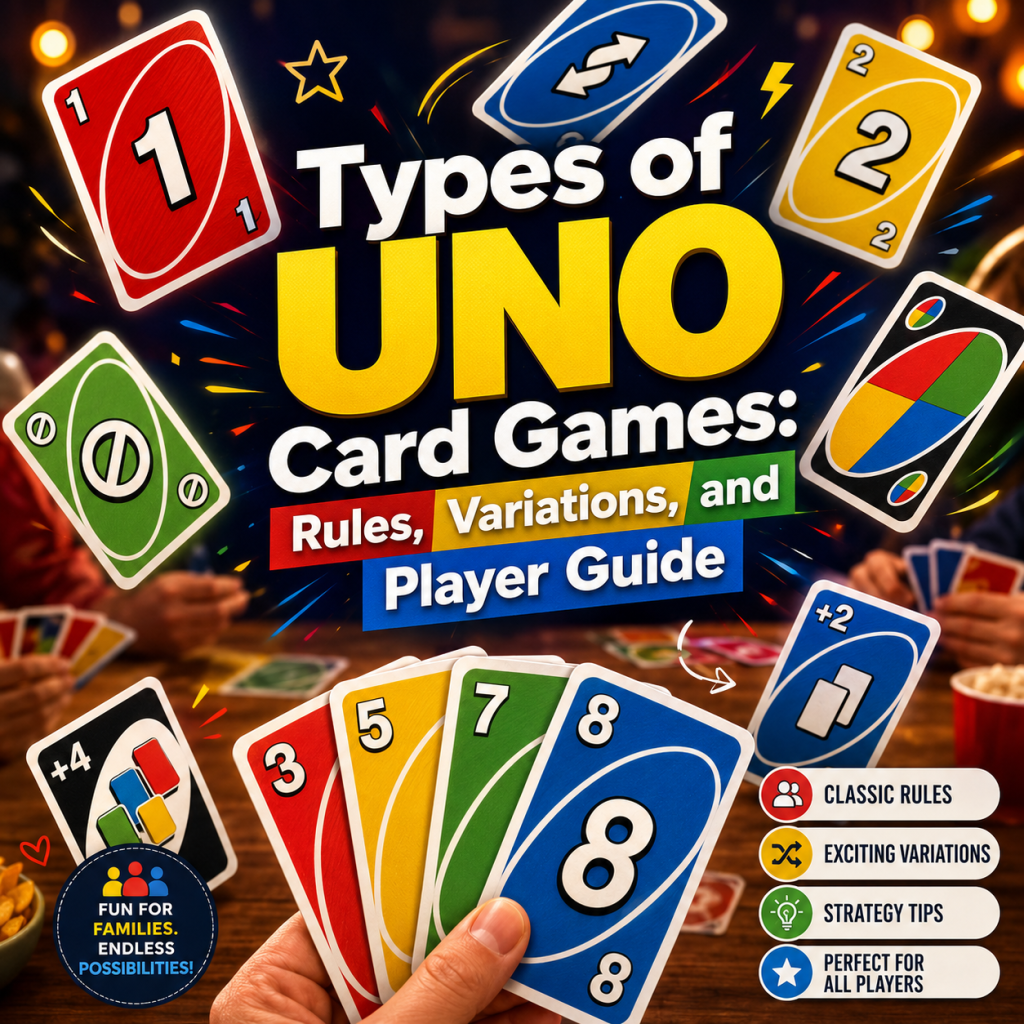
cardanoir.com – UNO is one of those card games that can turn a quiet gathering into a loud and competitive table within minutes. The basic idea is easy to understand: match a card by color, number, or symbol, then try to empty your hand before everyone else. However, the UNO family has grown far beyond the familiar red, yellow, green, and blue deck.
Today, players can find many types of UNO card games, each offering a different pace, challenge, theme, or special mechanic. Some versions preserve the classic structure while adding stronger action cards. Others completely change the experience through double-sided decks, team play, flexible color matching, or unpredictable penalties.
This variety makes UNO suitable for many situations. A family with younger children may prefer a simple version with clear visual symbols. Competitive groups may enjoy versions that introduce harsher penalties and faster turn changes. Players who already know the classic rules can choose a variation that forces them to rethink familiar strategies.
Understanding the differences between each version helps players choose a deck that matches the group, available time, and desired level of chaos.
What Makes a Game Part of the UNO Family?
Most UNO variations retain several core ideas from the original game. Players receive a hand of cards and take turns placing a card that matches the active color, number, or symbol.
The main objective remains:
Be the first player to remove every card from your hand.
Common UNO elements include:
- Four main colors
- Number cards
- Skip cards
- Reverse cards
- Draw cards
- Wild cards
- A discard pile
- The requirement to call “UNO” when one card remains
A variation can still feel very different even when these basic elements remain. Changing the function of one action card can reshape the entire round.
Why UNO Has So Many Versions
UNO is easy to adapt because its central rule is simple. Designers can introduce new experiences by changing:
- Card effects
- Turn direction
- Color systems
- Team mechanics
- Penalty strength
- Deck layout
- Player interaction
- Winning conditions
Because the foundation is familiar, players do not need to learn an entirely new game each time. They only need to understand the additional rules.
Classic UNO: The Original Starting Point
Classic UNO remains the best-known version. Players match cards by color, number, or action symbol.
The standard action cards are:
- Skip: The next player loses a turn.
- Reverse: The direction of play changes.
- Draw Two: The next player draws two cards and loses a turn.
- Wild: The player chooses the new active color.
- Wild Draw Four: The player chooses a color and the next player draws four cards.
Classic UNO works well because the rules are simple enough for new players but still create room for tactical decisions.
Basic Strategy in Classic UNO
A strong player does more than play the first legal card.
Useful decisions include:
- Saving a Wild card for a difficult moment
- Watching which colors opponents avoid
- Keeping several colors available
- Using Reverse strategically in a two-player round
- Preventing a player with one card from taking another turn
The Importance of Calling UNO
When a player has one card remaining, they must call “UNO.” If another player notices the mistake before the next action is completed, the player may receive a penalty.
This small rule keeps everyone alert, even when it is not their turn.
UNO Flip: A Double-Sided Challenge
UNO Flip uses cards with two playable sides: a light side and a dark side. The game begins on the light side, which feels relatively familiar.
When someone plays a Flip card, every player turns their hand over, the draw pile is flipped, and the discard pile changes sides. The dark side contains stronger and more disruptive action cards.
Why UNO Flip Feels More Unpredictable
Players can see only the currently active side of their hand. A card that looks weak on the light side may become extremely useful after a flip.
The dark side can include effects such as:
- Draw Five
- Skip Everyone
- Wild Draw Color
- Stronger penalties
Because one Flip card changes every visible option, long-term planning becomes more difficult.
Best Strategy for UNO Flip
Players should remember valuable cards on the hidden side whenever possible.
A practical approach includes:
- Study both sides when cards are first dealt.
- Notice which side gives your hand better color balance.
- Save Flip cards when the opposite side benefits you.
- Avoid helping an opponent with only one card.
- Prepare for stronger dark-side penalties.
UNO Flip is ideal for groups that enjoy the classic game but want more uncertainty.
UNO All Wild: Faster and More Chaotic
In UNO All Wild, almost every card functions as a Wild card. Players do not need to match colors or numbers in the traditional way.
Instead, the challenge comes from special Wild action cards that affect opponents.
Possible effects include:
- Wild Reverse
- Wild Skip
- Wild Draw Two
- Wild Draw Four
- Wild Targeted Draw Two
- Wild Forced Swap
Why UNO All Wild Moves Quickly
Since almost every card can be played, turns rarely stop because of an unplayable hand. As a result, rounds move faster.
However, easy card placement does not mean the game lacks conflict. Players frequently use action cards to interrupt opponents.
Cause and effect become immediate. Because every card is playable, a player can empty their hand quickly. As a result, opponents must act aggressively before that player reaches one card.
Who Will Enjoy UNO All Wild?
This version works well for:
- Short game sessions
- Large social groups
- Players who dislike waiting
- Casual parties
- Younger players who understand action symbols
Players looking for deeper color-management strategy may find it less challenging than Classic UNO.
UNO Flex: Rules That Can Temporarily Change
UNO Flex introduces cards with standard colors and flexible alternatives. A card may be played normally or through its special flex side when the player has permission to use that effect.
The game often includes power cards or status indicators that determine whether flexible actions are currently available.
How Flex Cards Change Decisions
A player may use a card according to:
- Its normal color
- Its alternative flex color
- Its enhanced action effect
This means a hand that appears blocked may still contain a legal move.
For example, a card that normally acts as a red Skip may be playable as another color through its flex property.
Timing Matters More Than Immediate Use
Flexible cards are valuable because they solve difficult situations. Using them too early may waste their strongest advantage.
Players should consider:
- Whether the normal card can be used instead
- Which opponent is close to winning
- Whether the flex effect changes multiple turns
- How many power opportunities remain
UNO Flex suits players who enjoy additional tactical choices without abandoning the classic structure.
UNO Attack: An Electronic Card Launcher Experience
UNO Attack changes the drawing system by replacing the standard draw pile with an electronic card launcher.
When required to draw, a player presses the launcher button. Sometimes nothing happens. At other times, the machine releases several cards.
Why UNO Attack Creates Suspense
Players do not know exactly how many cards will be launched. The uncertainty turns a simple penalty into a dramatic moment.
The game may include cards that force players to:
- Press the launcher multiple times
- Target another player
- Reverse the direction
- Skip turns
- Trigger surprise draws
Because the launcher can release a large number of cards, a player close to winning can suddenly return to a large hand.
Practical Review of UNO Attack
The physical launcher makes the game more entertaining for groups. It creates laughter and visible suspense that a standard draw pile cannot reproduce.
However, setup takes slightly longer, and the device requires working batteries. The game also feels more luck-driven because the size of the penalty is unpredictable.
UNO Teams: Winning Through Partnership
UNO Teams introduces cooperative play. Players form partnerships and work toward a shared victory condition.
Depending on the rule set, a team may need both members to empty their hands or complete a combined objective.
Team Communication Without Revealing Cards
Partners cannot simply show their hands. They must infer each other’s needs through legal plays.
Team strategy may involve:
- Changing the active color to help a partner
- Blocking an opposing player
- Saving action cards to protect the team
- Avoiding penalties that harm a partner
- Watching which colors a teammate appears to need
Why Team UNO Feels Different
Classic UNO is based on individual survival. Team play changes the emotional structure.
A player may choose a move that is not personally ideal because it helps a partner. This creates more cooperative planning and less purely selfish play.
UNO Show ’Em No Mercy: A Harsher Competitive Version
UNO Show ’Em No Mercy is designed for groups that want stronger penalties, aggressive interactions, and less forgiving rules.
It may include cards with effects such as:
- Draw Six
- Draw Ten
- Skip Everyone
- Stronger Wild penalties
- Hand swapping
- Penalty stacking
Some rule sets also remove players who accumulate too many cards.
Why This Version Feels More Competitive
Classic UNO can already become tense, but this variation intentionally increases pressure.
A single action card may completely change the lead. Players who were close to winning can receive a large penalty and fall behind instantly.
Because draw penalties may stack, holding defensive action cards becomes especially important.
Who Should Choose This Version?
UNO Show ’Em No Mercy is suitable for:
- Experienced UNO players
- Competitive friend groups
- Players who enjoy long chains of penalties
- People who do not mind dramatic reversals
It may be too intense for very young players or groups seeking a calm family game.
UNO Junior: A Simpler Version for Children
UNO Junior adapts the game for younger players. Cards often use animals, simplified symbols, or visual cues that make matching easier.
Different difficulty levels may gradually introduce:
- Simple color and number matching
- Skip cards
- Reverse cards
- Draw penalties
- More complete UNO rules
Why UNO Junior Works for Early Learners
Children can practice:
- Color recognition
- Number recognition
- Turn-taking
- Following instructions
- Basic planning
- Managing disappointment
The visual design reduces the reading requirement, allowing younger players to join without needing full knowledge of written rules.
UNO Spin: A Wheel-Based Variation
UNO Spin includes a wheel that introduces random actions when certain cards are played.
The wheel may require players to:
- Draw cards
- Discard cards
- Exchange hands
- Show specific colors
- Skip turns
- Perform another special action
The Role of Random Events
The spin wheel reduces predictability. A player may trigger an action that helps them or creates a major disadvantage.
Because of this randomness, careful planning can be disrupted at any moment. The game becomes more about adaptation than long-term control.
UNO Spin is entertaining for groups that enjoy physical components and unexpected events.
Themed UNO Editions
Many UNO decks use themes from movies, games, television, sports, or popular characters.
A themed deck usually keeps the core rules but may add one unique action card connected to the theme.
Examples can include:
- Character-based Wild cards
- Special themed penalties
- Custom artwork
- Modified symbols
- Collector packaging
Do Themed Decks Change the Game?
Some themed editions are mostly visual, while others introduce a meaningful new rule.
Before purchasing or choosing a themed deck, check whether it contains:
- Standard UNO rules only
- One exclusive action card
- Several modified mechanics
- Custom winning conditions
Themed editions are especially attractive to collectors and fans of specific franchises.
Comparison of Popular Types of UNO Card Games
| UNO Version | Main Feature | Difficulty | Best For |
|---|---|---|---|
| Classic UNO | Traditional color matching | Easy | Families and beginners |
| UNO Flip | Double-sided cards | Medium | Players wanting surprises |
| UNO All Wild | Every card is playable | Easy | Fast party rounds |
| UNO Flex | Flexible card colors and powers | Medium | Tactical players |
| UNO Attack | Electronic card launcher | Easy–medium | Social groups |
| UNO Teams | Partnership play | Medium | Cooperative groups |
| Show ’Em No Mercy | Strong penalties | Medium–hard | Competitive players |
| UNO Junior | Simplified rules | Very easy | Young children |
| UNO Spin | Random wheel actions | Easy–medium | Casual parties |
| Themed UNO | Unique artwork or special cards | Varies | Fans and collectors |
How to Choose the Best UNO Version
The right choice depends on the players and the atmosphere you want.
Choose Classic UNO when introducing the game to new players. Pick UNO Flip when the group wants a familiar game with stronger surprises. UNO All Wild works well for fast sessions, while Show ’Em No Mercy suits groups that enjoy aggressive competition.
A simple guide:
- For young children: UNO Junior
- For first-time players: Classic UNO
- For quick rounds: UNO All Wild
- For unpredictable play: UNO Flip or UNO Spin
- For tactical choices: UNO Flex
- For physical excitement: UNO Attack
- For partnerships: UNO Teams
- For intense competition: Show ’Em No Mercy
- For collectors: Themed UNO editions
Common House Rules in UNO Games
Many groups add unofficial rules. These can be entertaining, but everyone should agree before the game starts.
Common house rules include:
- Stacking Draw Two cards
- Stacking Wild Draw Four cards
- Jumping in with an identical card
- Drawing until a playable card appears
- Playing multiple cards with the same number
- Swapping hands after certain Wild cards
Why House Rules Can Cause Arguments
Players often assume their local rules are official. When people from different groups play together, expectations may conflict.
To avoid confusion:
- Explain special rules before dealing.
- Separate official rules from house rules.
- Decide whether draw penalties can stack.
- Clarify how challenges work.
- Agree on the winning score or round format.
A Realistic Review of Different UNO Variations
Classic UNO remains the most balanced version. It is simple, familiar, and suitable for mixed-age groups. The strategy is easy to understand, but action cards still create enough conflict to keep the table engaged.
UNO Flip offers the best upgrade for players who already know the original. The double-sided system creates real surprise without making the game unrecognizable. The dark side feels noticeably more dangerous, which gives every Flip card weight.
UNO All Wild is excellent for quick entertainment. Turns move rapidly, and nobody spends long waiting for a playable color. However, players who enjoy planning around colors may find it too straightforward.
UNO Attack produces the loudest reactions. Pressing the launcher creates suspense, but the game depends heavily on the physical device. Show ’Em No Mercy provides the strongest competitive experience, although its severe penalties can make rounds more frustrating for casual players.
Overall, the wide range of UNO versions is a major strength. Players can choose calm family play, fast party chaos, team cooperation, or aggressive competition without abandoning the basic UNO identity.
FAQ About Types of UNO Card Games
1. What is the easiest UNO game for beginners?
Classic UNO and UNO Junior are the easiest options. UNO Junior is specifically designed for younger children.
2. Which UNO variation is the most difficult?
UNO Show ’Em No Mercy can be the harshest because of stronger penalties and aggressive rule interactions. UNO Flex also requires more tactical understanding.
3. What is the main difference between UNO and UNO Flip?
Classic UNO uses one playable side, while UNO Flip uses light and dark sides. Playing a Flip card changes every active card in the game.
4. Is UNO All Wild faster than Classic UNO?
Usually, yes. Since nearly every card is playable, players rarely need to draw because of a color or number mismatch.
5. Are stacking rules official in every UNO version?
No. Stacking is often a house rule unless the specific edition explicitly includes it. Players should check the rule sheet and agree before starting.
Conclusion
Exploring types of UNO card games reveals how one simple matching system can produce many different experiences. Classic UNO remains ideal for beginners and families, while UNO Flip adds double-sided unpredictability, UNO All Wild creates faster rounds, and UNO Flex introduces more tactical freedom. UNO Attack and UNO Spin use physical components to increase suspense, UNO Teams encourages cooperation, and Show ’Em No Mercy delivers a much harsher competitive challenge. The best version depends on the players, available time, and preferred level of strategy or chaos. By understanding each edition’s special rules before dealing the cards, every group can choose an UNO game that keeps the table engaged from the first match to the final call of “UNO.”