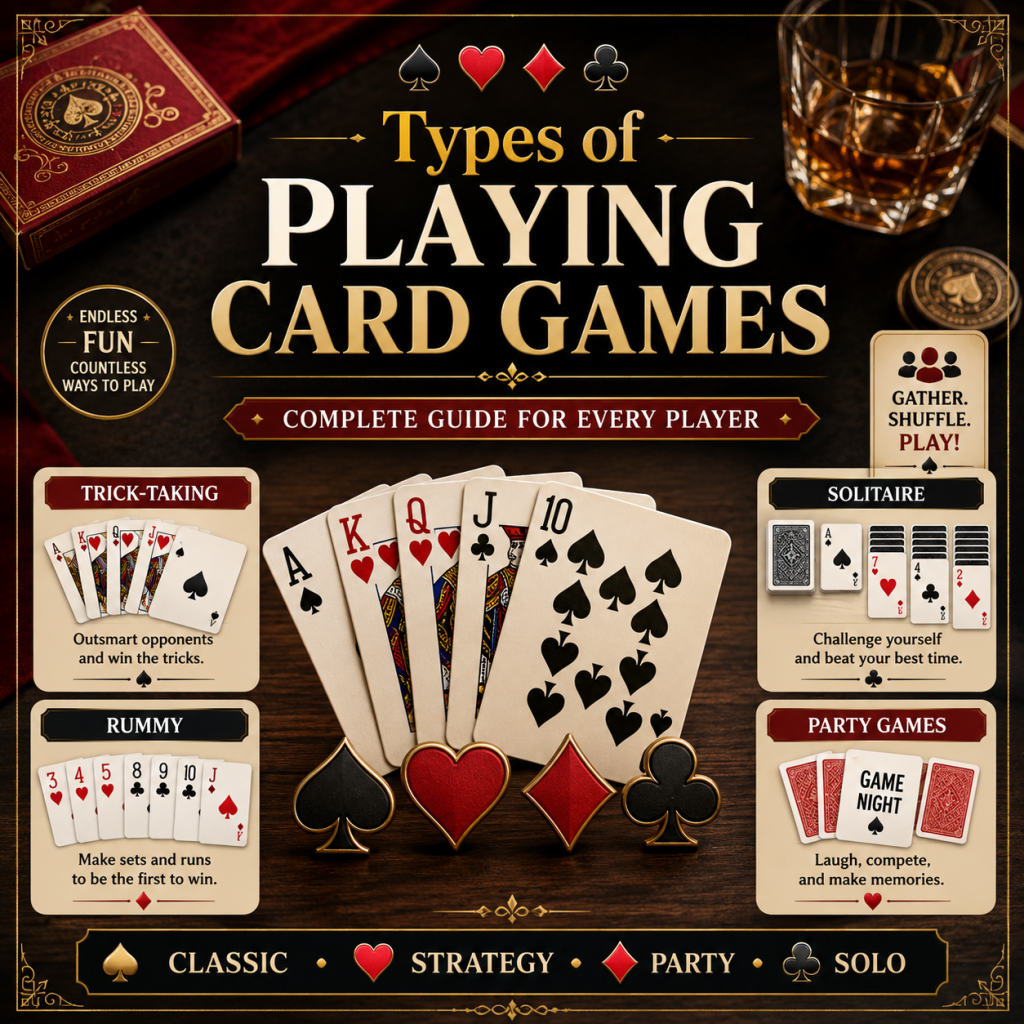
cardanoir.com – Playing cards are among the most flexible forms of entertainment ever created. A single standard deck can support hundreds of games, from quiet one-player puzzles to loud group competitions filled with strategy, laughter, and unexpected reversals.
The many types of playing card games are usually separated according to their main objective. Some ask players to win tricks, while others focus on forming combinations, discarding every card, capturing cards from the table, or comparing the strength of different hands.
This variety explains why playing cards remain popular across generations. The same deck can entertain children during a family afternoon, adults during a game night, travelers during a long journey, or experienced players looking for a serious strategic challenge.
Choosing the right game, however, requires more than simply selecting a familiar name. The number of players, available time, learning difficulty, and preferred level of competition all affect the experience. A game that works perfectly for four experienced players may feel confusing or slow for a large casual group.
This guide explains the major playing card game categories, how they work, and which situations suit them best.
What Are Playing Card Games?
Playing card games are activities that use cards as the main game component. They may use a traditional 52-card deck, a shortened deck, multiple combined decks, or a specially designed set of cards.
A standard deck normally contains four suits:
- Spades
- Hearts
- Diamonds
- Clubs
Each suit includes numbered cards and face cards. Depending on the game, an ace may be the highest card, the lowest card, or both.
The rules determine how players use these cards. A card may represent:
- A numerical value.
- A rank within a suit.
- Part of a sequence.
- A scoring combination.
- A strategic resource.
- A hidden piece of information.
The cards themselves are simple. The interaction between rules, probability, and player decisions creates the depth.
Main Types of Playing Card Games
Most traditional card games can be placed into several broad categories.
| Card Game Type | Main Objective | Common Player Count | Typical Difficulty |
|---|---|---|---|
| Trick-taking | Win rounds or tricks | 3–6 | Medium to high |
| Matching and melding | Form sets or sequences | 2–6 | Easy to medium |
| Shedding | Discard every card first | 2–8 | Easy |
| Capture | Collect cards from the table | 2–4 | Medium |
| Comparing | Build the strongest hand | 2–10 | Medium |
| Bluffing | Mislead opponents successfully | 3–10 | Easy to medium |
| Solitaire | Complete a layout alone | 1 | Easy to high |
| Fishing | Match hand cards with table cards | 2–4 | Medium |
| Memory-based | Remember positions or previous plays | 2–6 | Easy |
| Cooperative | Complete a shared objective | 2–6 | Medium |
These categories often overlap. A game may involve matching and discarding, while another combines trick-taking with teamwork or hidden information.
1. Trick-Taking Card Games
Trick-taking is one of the oldest and most influential playing card formats. Each player contributes one card to a round, which is known as a trick. The winner is determined by card rank, suit, or a special trump suit.
Well-known examples include:
- Bridge
- Hearts
- Spades
- Whist
- Euchre
- Pinochle
How Trick-Taking Games Work
A player usually begins by leading a card. The other players then follow according to the rules.
In many games, participants must follow the suit that was led when possible. If they cannot, they may play another suit or use a trump card.
The highest eligible card wins the trick and normally leads the next round.
Why Trick-Taking Requires Strategy
Players rarely see every card. They must make decisions based on incomplete information.
Experienced players pay attention to:
- Cards already played.
- Suits opponents appear to lack.
- The remaining high cards.
- Partnership signals.
- The number of tricks still required.
Because every played card removes one possibility, the game becomes more predictable as the round progresses. A player who remembers previous tricks gains a major advantage.
Best Setting for Trick-Taking Games
These games work best when players are willing to focus. They are ideal for regular groups because familiarity improves pacing and strategic depth.
They may be less suitable for a noisy party where participants frequently leave the table.
2. Matching and Melding Games
Matching games involve collecting cards that share a value, suit, or pattern. Melding games ask players to create recognized combinations, such as sets and runs.
Popular examples include:
- Rummy
- Gin Rummy
- Canasta
- Contract Rummy
- Traditional set-collection games
A set normally contains cards with the same rank, such as three queens. A run contains consecutive cards of the same suit, such as the six, seven, and eight of hearts.
Why Rummy-Style Games Are Popular
Rummy games offer a useful balance between luck and decision-making. Players receive random cards, but they control which combinations to pursue and which cards to discard.
A player may hold two cards toward a valuable run. Waiting for the missing card could produce a strong hand, but holding those cards too long may increase the penalty if another player finishes first.
That cause-and-effect relationship creates tension:
Waiting may improve the combination / but waiting also increases risk.
Skill Developed Through Matching Games
These games encourage players to:
- Recognize patterns quickly.
- Track discarded cards.
- Estimate what opponents are collecting.
- Manage risk.
- Change plans when necessary.
They are usually easy to introduce to beginners but remain interesting for experienced players.
3. Shedding Card Games
In shedding games, the main goal is to become the first player with no cards remaining.
Common examples include:
- Crazy Eights
- President
- Switch
- Mau-Mau
- Uno-style games
- Traditional climbing games
The Appeal of Simple Progress
Shedding games are easy to understand because progress is visible. A player holding only one card is clearly close to winning.
This creates immediate tension. Other participants may respond by changing the active suit, skipping a turn, reversing direction, or forcing the leading player to draw more cards.
The rules are often simple enough to explain within a few minutes, making shedding games excellent for:
- Family gatherings.
- Casual parties.
- Travel.
- Mixed-age groups.
- Short game sessions.
Why the Final Card Matters
The final move often requires more planning than the opening rounds. A player may reach one card quickly but become stuck if that card cannot legally be played.
As a result, experienced players do not only try to reduce their hand. They also think about the order in which cards should be discarded.
4. Comparing Card Games
Comparing games determine the winner by evaluating the strength of hands or individual cards.
Poker is the most recognizable example, but the category also includes:
- Brag
- Teen Patti
- War
- Baccarat-style comparison games
- High-card games
Hand Rankings and Probability
In structured comparison games, players attempt to create combinations such as:
- Pair
- Two pair
- Three of a kind
- Straight
- Flush
- Full house
- Four of a kind
The strength of a hand is important, but information management may be equally valuable. A weak hand can sometimes win if opponents believe it is strong.
Luck Versus Decision-Making
A random deal determines the cards available, but strategy determines how players respond.
Players may choose to:
- Continue.
- Fold.
- Bluff.
- Increase the pressure.
- Wait for more information.
- Reduce risk.
Because decisions have consequences, a single mistake can turn a strong position into a loss.
For recreational game nights, points or non-monetary tokens can preserve the strategic format without introducing financial pressure.
5. Bluffing Card Games
Bluffing games reward players who can mislead opponents while recognizing deception.
Examples include:
- Cheat
- I Doubt It
- Bluff
- Hidden-role card games
- Social deduction games
A player may claim to have played a particular rank even when the actual card is different. Other participants must decide whether to accept the statement or challenge it.
Psychology Becomes a Game Mechanic
Success depends on more than card strength. Players observe:
- Tone of voice.
- Speed of decisions.
- Facial expressions.
- Repeated habits.
- Unusual confidence.
- Changes in behavior.
A player who always hesitates before bluffing may become easy to read. However, deliberately changing that pattern can create confusion.
The Importance of the Group
Bluffing games are highly social. Their quality depends on whether players understand that dishonesty is part of the rules.
Friendly competition works well. Personal accusations do not.
Clear expectations at the beginning help prevent harmless game deception from becoming a real disagreement.
6. Capture Card Games
Capture games involve collecting cards from a shared table or layout. A player normally captures cards by matching ranks, creating numerical totals, or using a stronger card.
Examples include:
- Casino
- Scopa
- Basra
- Tablanette
- Traditional fishing-and-capture games
Why Table Awareness Matters
Players must evaluate both the cards in their hands and the cards visible on the table.
A move that captures one valuable card may leave several easy captures for the next player. Therefore, the strongest immediate move is not always the best strategic choice.
Players often consider:
- What can be captured now?
- What will remain afterward?
- What cards may opponents hold?
- Is it better to score immediately or control the table?
- Could one move create a larger future capture?
Capture games feel tactical because the shared layout changes after every turn.
7. Fishing Card Games
Fishing games are closely related to capture games. Players use cards from their hands to collect matching cards from the table.
The term fishing comes from the idea of taking cards out of a common pool.
Common examples include:
- Go Fish
- Cassino-style games
- Scopa variations
- Regional matching games
Accessible Rules for New Players
Simple fishing games are useful for beginners because the objective is clear: ask for, match, or collect cards.
More advanced versions introduce scoring values, combinations, and strategic table control.
This category demonstrates how the same basic idea can support both children’s games and complex adult strategy games.
8. Solitaire and Patience Games
Solitaire games are designed primarily for one player. The objective is usually to organize the deck into a specific layout according to rank and suit.
Popular examples include:
- Klondike
- Spider
- FreeCell
- Pyramid
- Golf
- Clock Solitaire
Why Solitaire Remains Popular
Solitaire requires no group and can be played almost anywhere. It provides a quiet challenge and a clear objective.
Some versions depend heavily on the initial shuffle, while others allow greater control through planning.
FreeCell, for example, exposes most cards from the beginning. This reduces hidden information and increases the importance of careful sequencing.
The Puzzle Element
A player must decide which move creates future options. Moving a card simply because it is currently legal may block an important sequence later.
The central lesson is simple:
A legal move is not always a useful move.
This makes solitaire closer to a puzzle than a competition.
9. Memory and Observation Games
Memory-based card games require players to remember card locations, previous actions, or changing patterns.
Examples include:
- Concentration
- Pelmanism
- Matching pairs
- Sequence recall games
- Some trick-taking variations
Simple Rules, Real Mental Challenge
In a typical matching-pairs game, cards are placed face down. Players reveal two cards at a time and attempt to find matching symbols or ranks.
Success depends on remembering:
- Which cards have appeared.
- Where they were located.
- Which positions have not been checked.
- What opponents are likely to choose.
These games are easy to teach and useful for mixed-age groups. They also create suspense because every reveal can change the score.
10. Cooperative Playing Card Games
Not every card game requires players to compete. Cooperative games ask the group to complete a shared mission or overcome a common challenge.
Possible objectives include:
- Completing tricks in a required order.
- Building sequences together.
- Surviving a limited deck.
- Solving a card-based mystery.
- Reaching a shared score.
Communication Creates the Main Challenge
Cooperative games require players to combine incomplete information. Some rules limit direct communication, forcing participants to interpret legal signals.
A team may lose because one person misunderstands a clue. On the next attempt, the same group may succeed after improving communication.
Avoiding the Dominant-Player Problem
One experienced player may try to make every decision. This reduces participation and makes the session feel controlled.
A better approach is to let each player explain their own options before the team agrees on a move.
How to Choose the Right Playing Card Game
The best game depends on the situation rather than popularity.
Ask these questions before beginning:
- How many people are playing?
- How much time is available?
- Are the players beginners or experienced?
- Does the group prefer luck or strategy?
- Should the atmosphere be serious or relaxed?
- Does anyone dislike elimination?
- Is teamwork preferred over competition?
Quick Recommendations by Situation
| Situation | Recommended Category |
|---|---|
| Two players | Gin Rummy, Speed, Cribbage-style games |
| Family gathering | Matching, shedding, fishing |
| Adult game night | Bluffing, trick-taking, comparing |
| Large group | Party-style shedding or bluffing |
| Quiet solo activity | Solitaire |
| Strategic regular group | Bridge, Spades, Rummy |
| Cooperative evening | Mission-based cooperative games |
| Short break | High-card, War, fast shedding |
Matching the game to the group reduces confusion and keeps everyone involved.
Practical Tips for a Better Card Game Night
A few simple preparations can improve the experience significantly:
- Use a clean, flat playing surface.
- Keep drinks away from the deck.
- Explain the goal before explaining minor rules.
- Play one practice round.
- Use a visible score sheet.
- Agree on rule variations before starting.
- Choose games with limited downtime.
- Set an approximate finishing time.
- Keep a simpler backup game available.
A game night should not feel like a classroom. Explain only what players need for the first turn, then introduce special rules when they become relevant.
Realistic Review of Different Playing Card Game Types
From a realistic perspective, no single category works for every group.
Trick-taking games offer the deepest long-term strategy, but beginners may need several rounds before they feel comfortable. Matching and shedding games are easier to start, although experienced players may find some versions repetitive.
Bluffing games often create the most memorable conversations because players react directly to one another. However, they depend heavily on personality. A quiet group may not enjoy constant challenges and accusations.
Solitaire is ideal for individual relaxation, but it does not provide the social interaction many people expect from cards. Cooperative games solve that problem by encouraging discussion, although they can become frustrating when one player controls the table.
The most successful game nights often combine several categories. A simple shedding game can serve as an introduction, followed by a strategic matching or trick-taking game once everyone is focused. Ending with a short bluffing game keeps the final part of the evening energetic.
Frequently Asked Questions
1. What are the main types of playing card games?
The main categories include trick-taking, matching, melding, shedding, comparing, bluffing, capture, fishing, solitaire, memory, and cooperative games.
2. What is the easiest playing card game category for beginners?
Shedding, basic matching, and simple fishing games are usually the easiest because their objectives are visible and their rules can be explained quickly.
3. Which playing card games require the most strategy?
Bridge, advanced trick-taking games, Gin Rummy, Cribbage-style games, and tactical capture games generally require strong planning and card awareness.
4. Are all playing card games based on luck?
No. Random dealing introduces uncertainty, but many games reward memory, probability, communication, bluffing, and long-term planning.
5. Can one standard deck support group and solo games?
Yes. A standard 52-card deck can be used for multiplayer games such as Hearts, Rummy, and Crazy Eights, as well as solo games such as Klondike and Pyramid.
Conclusion
The many types of playing card games prove that a simple deck can provide far more variety than it first appears. Trick-taking games reward memory and planning, matching games develop pattern recognition, shedding games create fast competition, bluffing games test confidence, and solitaire transforms the deck into a personal puzzle. Capture, fishing, cooperative, and comparison games add even more possibilities for different group sizes and skill levels. The best choice is the game that matches the players, available time, and desired atmosphere. With clear rules, balanced pacing, and the right category, playing cards can turn an ordinary table into a source of strategy, conversation, challenge, and lasting memories.