cardanoir.com – Card games have remained popular for generations because they are easy to carry, flexible to play, and suitable for nearly every age group. A single deck can create a quiet solo challenge, a relaxed family activity, or a competitive tournament requiring concentration and strategy.
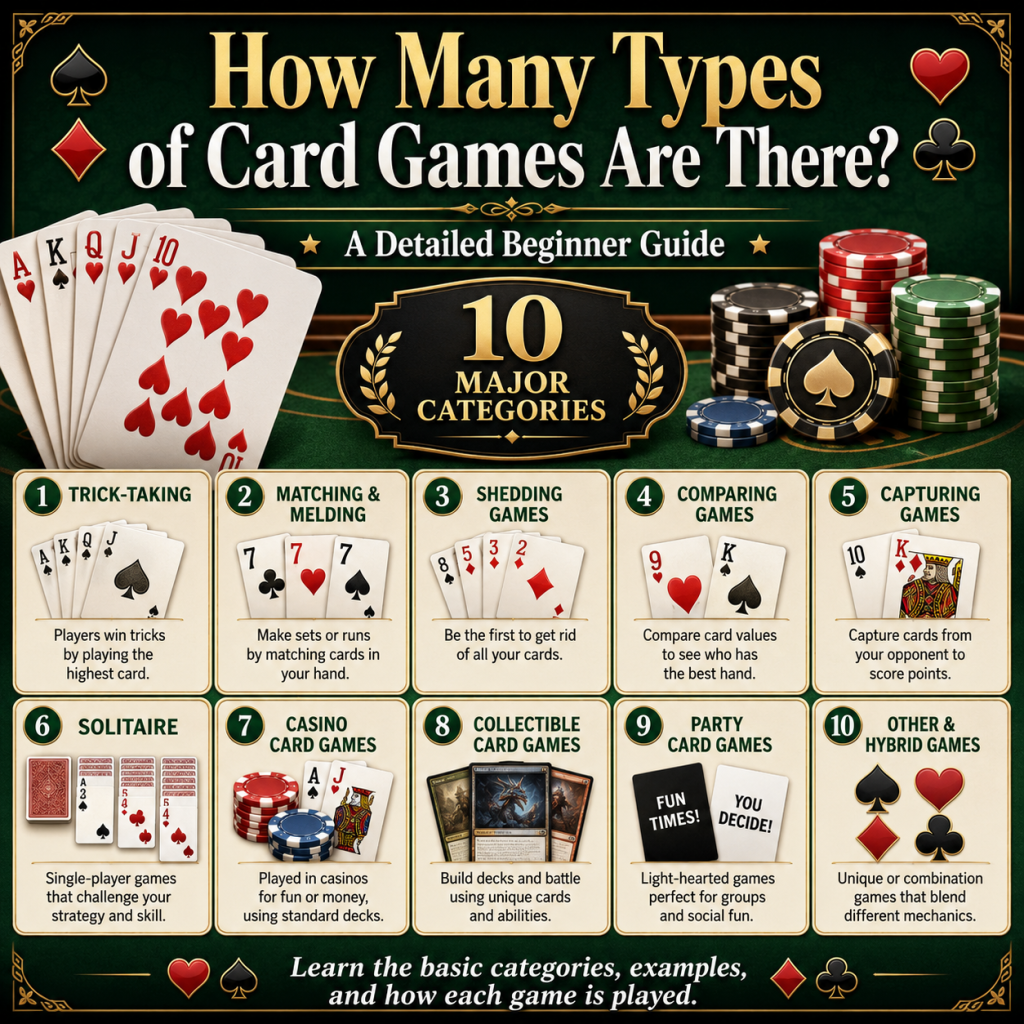
So, how many types of card games are there? A practical answer is that card games can be divided into at least 10 major categories, including trick-taking, matching, shedding, comparing, capturing, solitaire, banking, collectible, deck-building, and party games. Each category can then be divided into hundreds of regional styles and rule variations.
The number is not completely fixed because one game may belong to more than one category. Poker, for example, is a comparing game, a betting game, and a family of games with numerous variations. This overlap makes the world of playing cards surprisingly broad.
Understanding How Card Games Are Classified
Card games are usually classified according to their main objective and the actions players perform during a round. Some require players to collect matching sets, while others focus on winning tricks, discarding every card, or building the strongest possible hand.
The classification matters because it helps new players identify what kind of experience a game provides. A person who enjoys planning several moves ahead may prefer a strategy-heavy trick-taking game. Someone looking for a quick and casual activity may feel more comfortable with a shedding or matching game.
Because every category uses a different core mechanic, learning the basic categories also makes unfamiliar games easier to understand. Once a player recognizes the structure, the rules no longer feel completely new.
Main Types of Card Games at a Glance
| Category | Main Objective | Popular Examples | General Difficulty |
|---|---|---|---|
| Trick-taking | Win rounds or tricks | Bridge, Hearts, Spades | Medium to high |
| Matching and melding | Form sets or sequences | Rummy, Canasta, Gin Rummy | Easy to medium |
| Shedding | Discard all cards first | Uno, Crazy Eights, President | Easy |
| Comparing | Reveal the strongest card or hand | War, Poker, Baccarat | Easy to high |
| Capturing | Capture cards from the table | Go Fish, Scopa, Casino | Easy to medium |
| Solitaire | Complete an individual layout | Klondike, FreeCell, Spider | Easy to medium |
| Banking and casino | Compete against a dealer or bank | Blackjack, Baccarat | Easy to medium |
| Collectible | Build customized card collections | Pokémon, Magic: The Gathering | Medium to high |
| Deck-building | Improve a deck during play | Dominion, Star Realms | Medium |
| Party and social | Create interaction or deduction | Coup, Love Letter, Exploding Kittens | Easy |
1. Trick-Taking Card Games
Trick-taking is one of the oldest and most influential card game categories. During each round, every participant plays one card. The player who places the strongest valid card wins the trick and usually leads the next round.
Games such as Bridge, Spades, Hearts, Euchre, and Whist belong to this category. Some use partnerships, while others ask each player to compete independently.
Why Trick-Taking Games Feel Strategic
Players must pay attention to suits, previously played cards, and the likely cards remaining in their opponents’ hands. Because information is revealed gradually, careful observation often produces better decisions.
As a result, trick-taking games can feel difficult during the first few sessions. However, they become highly rewarding once players understand timing, card control, and partnership signals.
2. Matching and Melding Card Games
Matching games require players to collect cards with related values or suits. A group of matching cards is commonly called a set, while a sequence such as 5-6-7 of the same suit is known as a run.
Rummy, Gin Rummy, Canasta, and Mahjong-inspired card games are familiar examples. Their rules are generally approachable, making them suitable for family gatherings and casual game nights.
The appeal comes from balancing two decisions: keeping useful cards and discarding cards that may help an opponent. Because every discard reveals information, careless choices can directly improve another player’s hand.
3. Shedding Card Games
In shedding games, the main objective is simple: become the first player to discard every card. This direct goal makes the category particularly welcoming for beginners.
Popular examples include:
- Uno
- Crazy Eights
- President
- Mau-Mau
- Switch
Players usually match the previously played card by color, number, suit, or symbol. Special cards may reverse the direction, skip a turn, or force another participant to draw.
Shedding games tend to move quickly because every successful turn reduces the player’s hand. This creates an increasingly tense finish as several participants approach their final card.
4. Comparing and Showdown Games
Comparing games determine the winner by evaluating individual cards or completed hands. Some are extremely simple, while others involve deep probability, betting, and psychological decisions.
War is a straightforward example because the higher card wins each confrontation. Poker, by contrast, requires players to evaluate combinations such as pairs, straights, flushes, and full houses.
This category demonstrates why the question of how many types of card games has no single universal answer. Poker alone contains numerous forms, including Texas Hold’em, Omaha, Seven-Card Stud, and Five-Card Draw.
5. Capturing and Fishing Games
Capturing games allow players to collect cards from a shared area or from other participants. A capture is usually made by matching ranks, creating a total, or following a particular rule.
Go Fish is one of the simplest examples. Players request a rank from another participant and collect matching cards to form sets. Traditional games such as Scopa use more detailed capturing rules and reward careful planning.
Because visible cards influence every choice, these games develop observation and basic calculation skills. Missing a possible capture may allow the next player to gain a valuable advantage.
6. Solitaire and Patience Games
Solitaire games are designed primarily for one person. The player arranges cards according to a specific layout and attempts to complete a goal, usually by sorting cards into suits or ordered foundations.
Common forms include:
- Klondike
- Spider Solitaire
- FreeCell
- Pyramid
- Golf Solitaire
Solitaire remains popular because it does not require a group, special equipment, or a long setup. Some versions depend heavily on the initial deal, while others reward planning and the ability to uncover hidden cards in the correct order.
What Makes Solitaire Relaxing?
There is no pressure from opponents, so players can consider each move at their own pace. At the same time, limited moves create enough difficulty to keep the experience engaging rather than repetitive.
7. Banking and Casino-Style Games
Banking games place players against a dealer, house, or designated banker. The banker follows specific rules, while participants make decisions or predictions based on their cards.
Well-known examples include Blackjack, Baccarat, Dragon Tiger, and Red Dog. Blackjack gives players several decisions, including hit, stand, split, and double down. Baccarat is more streamlined because the drawing procedure is usually automatic.
The rules should be understood before playing because small variations can change how results are calculated. These games should always be approached as entertainment, especially when real money is involved.
8. Collectible and Trading Card Games
Collectible card games allow players to build personalized decks from a wider collection. Cards may represent characters, creatures, actions, resources, or special abilities.
Magic: The Gathering, Pokémon Trading Card Game, and Yu-Gi-Oh! are prominent examples. Two players using the same rules can still have completely different decks and strategies.
The customization creates strong replay value. However, because new cards and combinations expand the available options, the learning process can become more demanding than that of a standard deck game.
9. Deck-Building Card Games
Deck-building games differ from collectible games because players usually begin with similar basic decks. They acquire stronger cards during the match and gradually improve what their decks can do.
Dominion, Star Realms, and Ascension are familiar examples. Players must decide whether to gain resources, improve efficiency, defend themselves, or pursue victory points.
Poor purchases can slow a deck because weak cards continue appearing in later hands. Therefore, every addition has a cause-and-effect relationship with future turns.
10. Party and Social Card Games
Party card games focus on conversation, humor, bluffing, or social deduction rather than complex calculations. They are designed to create memorable interactions between players.
Examples include Coup, Love Letter, Exploding Kittens, The Mind, and Sushi Go! Some require players to hide their roles, while others encourage cooperation or light competition.
These games work well at social events because explanations are usually short and rounds do not take long. A player who loses early often has another opportunity within minutes.
How to Choose the Right Card Game Category
The best category depends on the group, available time, and preferred level of challenge.
Choose According to Group Size
For two players, Gin Rummy, Cribbage, or a trading card game can work well. Larger groups may enjoy Hearts, President, Uno, or a social deduction game.
Consider the Desired Playing Time
A shedding game may finish within 10 to 20 minutes, while Bridge or a strategic deck-building session can take considerably longer. Selecting the right duration prevents players from losing interest before the game ends.
Match the Game to Player Experience
Beginners usually respond well to games with:
- One clear objective
- Few special actions
- Short rounds
- Visible progress
- Limited score calculations
More experienced groups may prefer hidden information, partnerships, bidding, deck construction, or long-term strategy.
Practical Review: What the Main Categories Feel Like to Play
From a practical player’s perspective, shedding games offer the easiest entry point. The objective is immediately visible, and players can learn most actions while playing the first round. They are particularly effective when a group includes children, beginners, and experienced players.
Matching games provide a more relaxed rhythm. Players have enough time to examine their hands, build combinations, and adjust plans. This creates a satisfying balance between luck and decision-making.
Trick-taking games offer the deepest traditional experience, but they require more patience during the learning stage. At first, remembering the leading suit and card hierarchy can feel demanding. After several rounds, however, the strategic structure becomes clearer and more enjoyable.
Solitaire is the most practical choice for independent play. Meanwhile, collectible and deck-building games offer the strongest sense of progression. Their depth is appealing, although they require a greater investment of time to master.
Benefits of Learning Different Card Game Categories
Understanding several card game categories provides more than entertainment. Different mechanics exercise different abilities.
- Matching games encourage pattern recognition.
- Trick-taking games train memory and planning.
- Capturing games develop observation.
- Social games strengthen communication.
- Solitaire encourages patience and independent problem-solving.
- Deck-building games teach resource management.
Because card games create immediate consequences for each decision, players can quickly recognize which strategies were effective and which choices caused difficulties.
Frequently Asked Questions
1. How many types of card games are there?
There are at least 10 widely recognized categories, although the precise number depends on the classification system. Hundreds of individual games and regional variations exist within those categories.
2. What is the easiest type of card game for beginners?
Shedding and simple matching games are generally the easiest. Uno, Crazy Eights, Go Fish, and basic Rummy use clear objectives and can be learned quickly.
3. Which card games require the most strategy?
Bridge, Poker, collectible card games, and deck-building games can require significant strategy. They involve probability, long-term planning, hidden information, or complex interactions between cards.
4. Can one card game belong to multiple categories?
Yes. Poker can be classified as a comparing, betting, and combination-building game. Many modern games combine mechanics from several traditional categories.
5. What card games can be played with a standard 52-card deck?
A standard deck supports hundreds of games, including Rummy, Hearts, Spades, Poker, Solitaire, War, Go Fish, Crazy Eights, and President.
Conclusion
Card games can be organized into at least 10 major categories, but their true variety extends far beyond a simple number. Trick-taking games reward observation, matching games encourage combination building, shedding games offer fast entertainment, and collectible games provide long-term strategic depth. By understanding the purpose and structure of each category, players can choose a game that suits their group size, experience, and available time while discovering just how diverse a standard deck of cards can be.