Schafkopf is a classic German card game that has withstood the test of time, deeply embedded in Bavarian culture and widely enjoyed throughout Germany. Known for its strategic depth and complex rules, Schafkopf offers players the chance to demonstrate their skills through careful planning and teamwork.
Similar to other trick-taking games, Schafkopf revolves around winning rounds (or “tricks”) by using specific cards, with the ultimate goal of accumulating points while playing against other players or teams. While it’s often compared to games like Sheepshead (its American counterpart), Schafkopf is unique in its regional variations and strategic complexity.
Whether you’re looking to play casually with friends or dive deep into competitive Schafkopf tournaments, understanding the rules, strategies, and history of this iconic card game will enhance your experience.
How to Play Schafkopf: The Basics
Schafkopf is traditionally played with four players, though there are variations for different numbers. The game uses a 32-card German-suited deck (with suits such as Acorns (Eichel), Leaves (Gras), Hearts (Herz), and Bells (Schellen)) and is divided into rounds or “holes” in which players aim to win as many tricks as possible.
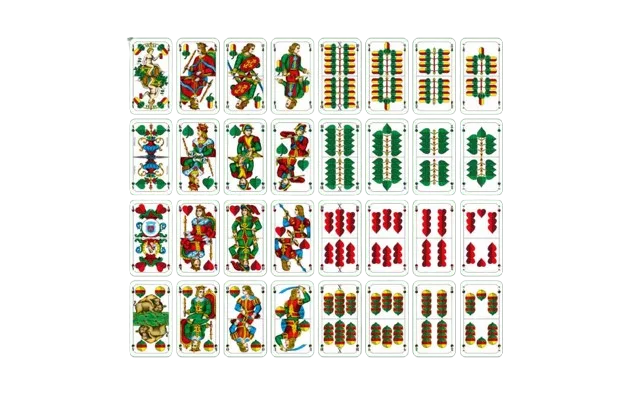
Card Values
- Aces (1 point)
- Kings (4 points)
- Obers (3 points)
- Unters (2 points)
- Number cards: The numbered cards (7-10) hold no point value.
Objective
The goal of Schafkopf is to be the player (or team) with the lowest total score after the designated number of rounds (usually 9 rounds). Each round consists of one trick-taking phase, where players must play cards in accordance with the rules of the game, using their strategic knowledge to control the outcome.
Game Setup and Deal
Players:
Schafkopf is played by 4 players, although variations for 2 to 3 players exist. Players are divided into two teams (or play solo, depending on the contract selected during the bidding phase).
Deck:
The game uses a 32-card deck (from a standard German-suited deck). The suits are Acorns, Leaves, Hearts, and Bells, and the deck consists of the following cards: 7, 8, 9, 10, Jack, Queen, King, Ace.
Objective:
The objective is to have the lowest score by the end of the game, with points assigned to each card in hand at the end of a round. Each card has specific point values (e.g., Aces are worth 1 point, Kings are worth 4 points, etc.). The team or individual with the fewest points wins.
Card Arrangement
- The game begins with each player receiving 8 cards (or 6 cards for variations). Cards are arranged in front of players as two rows: hand and foot.
- Players play with 6 cards at a time, though they also have additional cards, known as their “foot,” which they can access later in the round.
The Bidding Phase: Choosing a Contract
In Schafkopf, the game starts with a bidding phase where players declare their intentions regarding the game. During this phase, players choose one of the available contracts.
Types of Contracts
- Rufer (Caller) — The caller selects a secret partner by calling an Ace.
- Solo — The player plays alone against the other three players.
- Wenz — Only the Obers (Jacks) are trumps in this contract.
- Ramsch — A point-losing contract where the goal is to have the most cards in hand to lose points.
Once a contract is chosen, players continue the game based on the type of contract they agreed upon.
Playing a Round: Rules and Phases
1. Drawing Cards
Players begin each round by drawing a card from the stockpile or the discard pile. The card drawn can be swapped with any face-up card in their hand, and the game continues with the goal of lowering their points.
2. Trick-Taking Phase
A “trick” is a round in which all players contribute one card to the table. The highest card of the trump suit wins the trick. The players are then required to follow the suit of the first card played in the trick, if possible.
3. Discarding
After playing the round, each player discards one card into the discard pile. The round ends once all cards have been played, and each player’s remaining cards are scored.
Scoring in Schafkopf
After each round, the cards are scored as follows:
- Aces: 1 point each
- Kings: 4 points each
- Obers (Jacks): 3 points each
- Unters: 2 points each
- Number cards (7-10): 0 points each
Scoring Examples
- A King of Acorns would score 4 points.
- An Ace would score 1 point.
- Jokers (if used): 0 points.
Variations of Schafkopf
1. Bavarian Schafkopf
This version is the most widely played. It uses German-suited cards (as mentioned above) and is based on team play, with strategic bidding to outsmart opponents.
2. Palatinate Schafkopf
This variation uses French-suited cards (hearts, spades, diamonds, and clubs) and follows similar gameplay mechanics but includes different rules regarding trumps.
3. Doppelkopf
A different card game related to Schafkopf that’s often played with two decks. It’s a more competitive and team-oriented version of Schafkopf, where partners play opposite each other.
4. Sheepshead (American Schafkopf)
Sheepshead is the most well-known English version of Schafkopf. It uses a modified deck and simplified rules for easier play and is a more casual version than traditional Bavarian Schafkopf.
Schafkopf’s Cultural Significance
In Germany, Schafkopf is more than just a card game; it’s an institution. Widely played in Bavaria and Switzerland, Schafkopf brings people together in social settings, especially during holidays and gatherings. It has been featured in many German films and is commonly seen in local festivals and pubs.
Mastering Schafkopf
Schafkopf is an iconic and beloved card game that blends strategy, teamwork, and skill. Whether you’re playing it in a social setting or participating in tournaments, the game’s strategic depth and variations keep it exciting and rewarding. By understanding the rules, bidding phases, and scoring system, players can master the game and enjoy its cultural significance.
If you’re looking for a fun and challenging card game to play with friends or family, Schafkopf should definitely be on your radar!