If you’ve ever wished a card game could feel like a quick conversation—short sentences, sharp turns, and a lot of laughing interruptions—Pitty Pat is your kind of night. This small, speedy game is widely described as Belize’s national card game, built around one simple thrill: matching ranks, shedding cards, and racing to be the first player to run out.
It’s the kind of game that thrives anywhere people are close enough to tease each other—kitchen tables, verandas, travel nights, or a Jakarta hangout where you’ve got 10 minutes before someone says, “One more round.” And because pitty pat rules are easy to learn but endlessly “house-ruled,” it also becomes a living tradition: the same core idea, told in slightly different accents depending on who taught you.
Where Pitty Pat Comes From (and Why It Doesn’t Have One Inventor)
Unlike modern designer card games with a named creator and a release date, Pitty Pat is best understood as a folk game—a ruleset passed person-to-person and polished by repetition. That’s why it’s hard to pin down a single inventor. What we can say with confidence is that multiple rule references describe it as strongly associated with Belize, often calling it the country’s national card game.
Rule compendiums also place it near the family of rummy-like play. Pagat (a long-running card-game reference) notes Pitty Pat is “essentially a rummy game,” pointing to a mechanism reminiscent of Conquian—the old rummy ancestor where small hands and tight combinations matter.
In other words: it’s not about building a huge tableau. It’s about quick pattern recognition and clean exits.
What You Need to Play Pitty Pat
The classic setup is refreshingly minimal:
- Players: commonly 2 to 4 (some sources mention up to 5 in casual play)
- Deck: one standard 52-card deck, typically no jokers
- Goal: discard your cards by making matches—often framed as getting out by forming three pairs from a five-card hand
Setup: The 30-Second Start
Most commonly documented setup looks like this:
- Shuffle and choose a dealer.
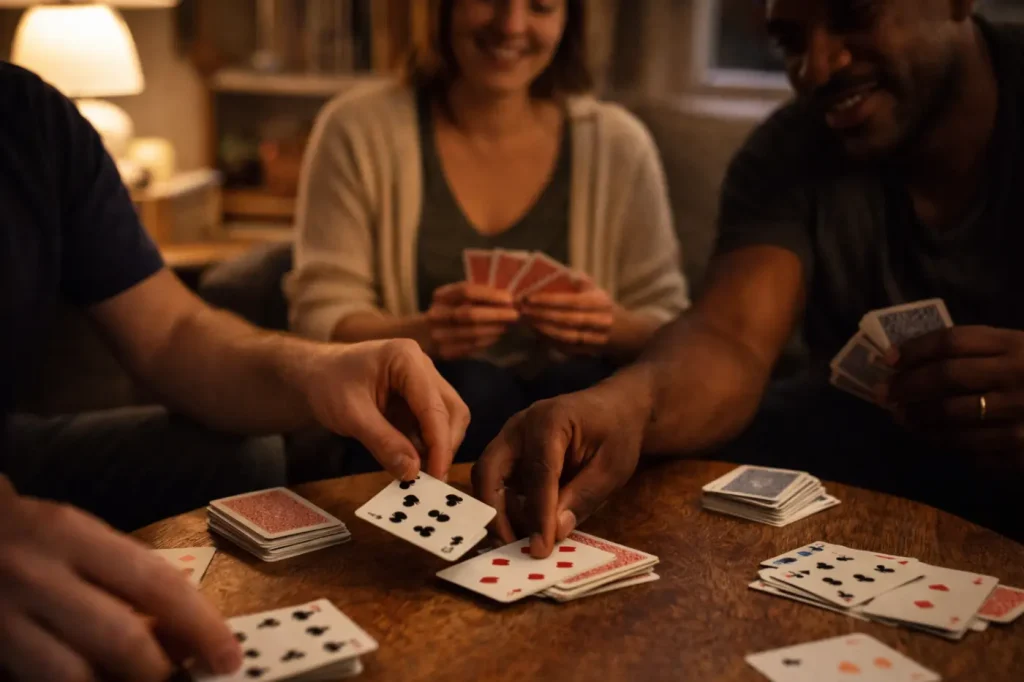
- Deal 5 cards to each player.
- Put the remaining deck face-down as the stock (draw pile).
- Flip the top card face-up to start the discard pile (often called the upcard).
That’s it. No score sheets. No phases. The game begins almost before someone finishes explaining it.
How to Play Pitty Pat: The Core Loop
If you’re searching how to play pitty pat card game, here’s the clean, practical version that matches multiple published rules:
Turn Order
Play usually starts with the player to the dealer’s left and continues clockwise.
On Your Turn, You Try to Match the Upcard
Look at the top card of the discard pile (the upcard). If you have a card of the same rank (example: any 7 matches a 7), you can play.
What You Do When You Have a Match
In many rulesets, when you can match the upcard, you:
- Discard your matching card, then discard one extra card from your hand.
- The second card you discarded becomes the new upcard for the next player to match.
This “match + choose the next upcard” is the soul of Pitty Pat. It’s where the personality lives: you’re not only getting rid of cards—you’re setting a problem for the next person.
What If You Don’t Have a Match?
If you can’t match the upcard, you typically:
- Draw the top card from the stock and place it on the discard pile (making it the new upcard).
- If you can match that new upcard, you may discard the match plus one extra card (as above).
- If you still can’t match after the draw, you pass.
That means luck can nudge the game—but your decisions still matter a lot because of the extra discard you choose.
Winning: Getting Out, Three Pairs, and the “Instant Win” Twist
Most descriptions agree on the big finish: the first player to run out of cards wins the hand.
But Pitty Pat also carries a traditional framing: you’re trying to get out by making three pairs from your starting five-card hand (pairs created through matching play as the hand evolves). This “three pairs” idea shows up explicitly in published rules and even in a digital adaptation description.
There’s also a fun little rule seen in some write-ups:
- If you were dealt a matching pair, you may be treated as having a built-in advantage—some versions say players with a pair can win once they discard their non-matching cards.
That’s one reason Pitty Pat feels so fast: it’s designed for short hands, quick wins, and immediate rematches.
What Happens When the Stock Runs Out?
Good rulesets don’t panic when the draw pile empties—they recycle.
A common approach:
- If the stock is depleted, shuffle the discard pile to form a new stock, then flip a new upcard.
That keeps the game flowing, especially with 3–4 players who can burn through the deck quickly.
Scoring (Or: Why Many People Don’t Bother)
Pitty Pat is often played as a single-hand winner game: you win the round, shuffle, deal again.
If you want a session structure, one rules reference suggests simple methods:
- Use chips/tokens and “pay” the winner each hand; players who run out of tokens drop out; last player with tokens wins overall.
- Or just count how many hands each person wins over a set time.
The real point isn’t arithmetic. It’s momentum.
Strategy: How to Win at Pitty Pat Without Overthinking It
Pitty Pat looks like pure matching—until you realize the second discard is a steering wheel.
Here are practical, non-fancy ways to play smarter:
1) Control the Next Upcard
When you match, you choose the next upcard by deciding what your “extra discard” will be. Pick ranks that:
- You hold multiples of (so you can match again soon), or
- You suspect others don’t have (based on what you’ve seen).
2) Watch What People “Feed” the Pile
Even if you never see anyone’s hand, the upcard trail tells a story. If Jacks keep appearing, someone is likely bleeding Jacks or forcing them. Use that information.
3) Don’t Dump Your Only Lifeline
If you’re holding a rank that has saved you multiple times (because the table keeps cycling near it), think twice before throwing it as the next upcard.
4) In Kid-Friendly Games, Use the “Open Pairs” Variant
One published variation suggests laying matched pairs down in front of you instead of always feeding the discard pile. This makes the game more readable and helps younger players understand what “matching” is doing.
Variations You’ll Hear in the Wild
Because Pitty Pat travels through people, not rulebooks, variations are normal—not mistakes.
Here are a few that show up in published references and common play:
- “Lay pairs down” (more rummy-like, more visible).
- Different player counts: some sources describe 2–5 players as workable.
- Deuces as wild: a digital version explicitly features deuces wild and still keeps the “three pairs from a five-card hand” identity.
And yes—people will argue about the “real” rules. That’s basically part of the game.
Modern/Digital Pitty Pat
Pitty Pat has been adapted into simple digital formats, including an iOS app that emphasizes the game’s speed and the “three pairs from five cards” win condition, with a twist: deuces are wild.
Digital versions tend to standardize what real life refuses to standardize—so they’re great for learning the core loop, even if your family table plays it differently.
5 Quick, Surprising Facts About Pitty Pat
- Multiple major rule references call it Belize’s national card game.
- The game is frequently taught with a five-card hand, making it unusually quick compared to most rummy relatives.
- Many descriptions frame the win as forming three pairs—a tiny target that creates big tension.
- If the stock runs out, rules commonly allow a discard reshuffle, so the game can keep going without stopping.
- Some playstyles openly lean into “table talk” and playful policing—because the rhythm is so fast that out-of-turn chaos is always one heartbeat away (a feature, not a bug).
Pitty Pat “Hand Game”: Is That the Same Thing?
Search engines sometimes mix terms like pitty pat hand game with clapping games (think pat-a-cake style). That’s a different tradition. In Cardanoir terms: same sound, different species.
This article is about Pitty Pat the card game—the Belize-linked matching-and-shedding game played with a standard deck.
Why This Tiny Game Sticks
Pitty Pat doesn’t ask you to be a strategist with a notebook. It asks you to pay attention—to the table, to the rhythm, to what people reveal without meaning to. The rules are light, but the social texture is rich.
And that might be the secret behind its reputation: a game doesn’t become a cultural staple because it’s complicated. It becomes a staple because it fits into real life. Pitty Pat fits into the gaps—between dinner and dessert, between arrivals and goodbyes, between “we should go” and “fine, one last hand.”
That’s not just a card game mechanic. That’s human design.