The Cambio or Kille card game is what happens when Golf-style low-scoring gameplay collides with memory, risk, and a single spicy decision: when to end the round. You’re not building big hands. You’re trying to quietly replace bad cards with better ones, remember what you’ve got, and call “Cambio!” at the exact moment everyone else is still a step behind.
If you’ve searched cambio rules or cambio card game rules also called Harlequin, Campio, Kambio or Kamfio, you’ve probably noticed a problem: people play it differently depending on family, school, and country. That’s not a bug—it’s the tradition. The version below is a clean, widely used baseline that matches the common “4-card grid / low score / call to end” style (closely related to Golf and commercial relatives like Cabo).
What Is the Goal in Cambio?
The goal is simple:
- End the round with the lowest total card value in front of you.
- You do that by swapping in lower cards, using “power cards” (in some versions), and choosing the right moment to call Cambio (ending the round).
Think of it as a low-score race where memory is your steering wheel.
Cambio vs Golf: Why People Mix Them Up
Cambio is often treated as a Golf-family variant—especially 4-card Golf, where players keep a 2×2 grid and swap cards to reduce score. Golf itself has many variants and a well-documented rules core: draw from stock or discard, swap into your grid, and try to finish with the lowest score.
That’s why the phrase golf card game rules shows up in Cambio searches: players are basically asking, “Is this the same kind of game?” The honest answer: it’s closely related, but Cambio often adds a sharper “end the round now” moment and, in some circles, special card abilities (power cards).
What You Need to Play Cambio
- Players: Usually 2–6 (the game scales well)
- Deck: One standard 52-card deck (some groups add jokers; optional)
- Table space: Each player needs room for a 2×2 grid.
Setup: The Classic 4-Card Grid
- Shuffle the deck.
- Deal four cards to each player, face down, arranged in a 2×2 grid.
- Put the remaining cards face down as the stock pile.
- Flip one card face up beside it to start the discard pile.
- Each player may peek at two of their four cards at the start (common rule), then turn them face down again.
Now the game is a mix of what you know, what you think you know, and what you can steal from the discard pile.
Card Values in Cambio (Common Scoring)
Scoring systems vary, but most Golf-style variants use something close to this:
- Number cards: face value (3–10 = 3–10)
- Jacks/Queens: often 10
- Kings: often 0
- Aces: often 1
And many versions include special tweaks (like 2 being negative in some Golf rulesets, or pairs in columns scoring zero in certain Golf variants).
Cardanoir tip: If you’re publishing this on your site, you can present a “default scoring” and then list “popular house scoring options,” because Golf-family games love house rules.
How to Play Cambio: Turn Flow (Baseline Rules)
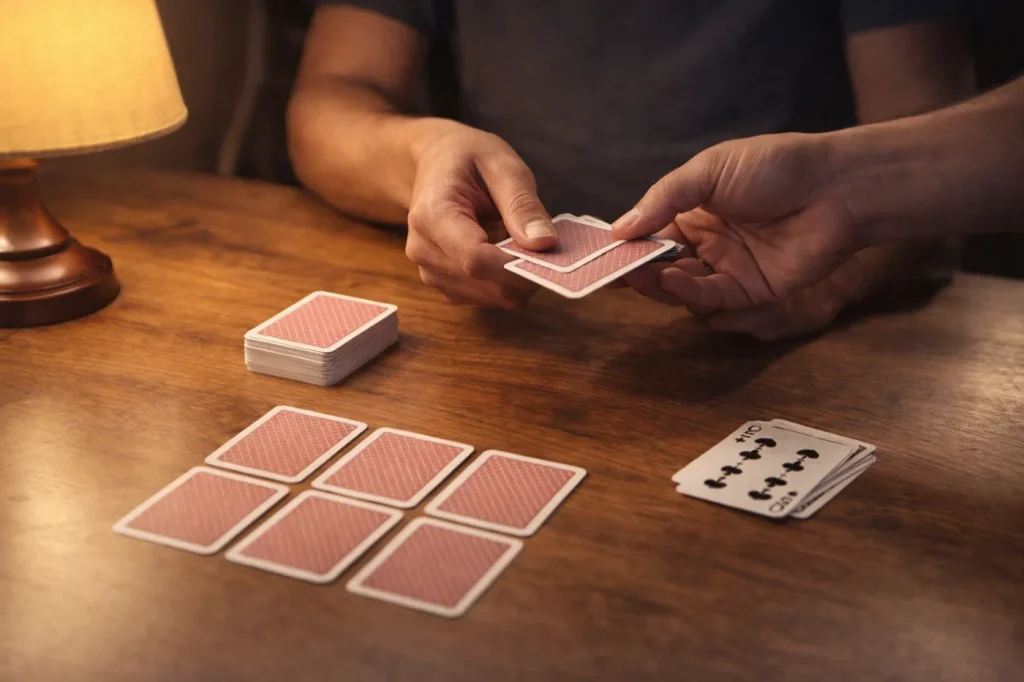
On your turn, you usually do this:
1) Draw a card
Choose one:
- Draw the top card from the stock, OR
- Take the top card from the discard pile.
2) Decide what to do with the drawn card
You have two main choices:
- Swap it with one of your four grid cards
- If you swap with a face-down card, you reveal that card as it leaves your grid (and it usually becomes the new top of the discard pile).
- Discard it (often allowed only if you drew from stock; discard-pile draws usually must be played in many Golf rulesets).
3) Optional: Use a “Power Card” ability (variant)
Some Cambio variants include power cards (especially the versions described as “Cambio/Pablo/Cactus” in the Golf family), where certain ranks let you peek or swap.
The “Cambio” Call: How Rounds End
The signature moment:
- If you believe your grid is low enough, you call “Cambio!” during your turn (exact timing varies by group).
- After that call, other players typically get one final turn (or finish the round depending on house rules), then everyone reveals their cards and scores the grid.
This “one last turn for everyone else” structure is common in the commercial cousin Cabo, and it fits Cambio-style play perfectly because it creates tension: calling early can backfire.
Popular “Power Cards” in Cambio-Style Play
Not every table uses powers—but when they do, the game becomes more tactical and more social.
A commonly documented family of “power card” effects includes:
- Look at one of your own cards
- Look at an opponent’s card
- Swap a card with an opponent
- Rearrange an opponent’s grid (rare / spicy rule)
The Golf (card game) variant section explicitly notes that “Cambio/Pablo/Cactus” versions can add power cards.
And a commercial rules PDF for Cabo shows structured special abilities tied to certain cards (a good example of how these powers are formalized in boxed versions).
Practical advice: If you’re writing rules for a broad audience, label this section clearly as a variant, not the universal rule.
Scoring a Round (and Winning the Game)
After the round ends:
- Everyone flips their four cards face up.
- Add values to get your score.
- Lowest score wins the round.
For a full game, groups typically play to:
- A target score (example: 50 or 100 total points), or
- A set number of rounds (“holes,” borrowing the Golf theme).
Strategy: How to Win Cambio More Often
Cambio feels like luck until you start playing it like information management.
1) The discard pile is a public diary
Every time someone discards, they reveal what they don’t want. That’s information. Watch which ranks get thrown away quickly—and which ranks never show.
2) Don’t “upgrade” blindly
Swapping a card you think is bad can be a trap. If you peeked early, trust your memory. If you didn’t—swap cautiously.
3) Use the stock draw for exploration
Taking from the discard pile is precise (you know what you’re getting). Drawing from stock is exploration. Great players alternate: secure improvements + careful fishing.
4) Call Cambio like a closer, not a gambler
Calling too early gives everyone else a final turn to improve. In many tables, the caller is penalized if they don’t end with the lowest score (a rule also seen in Golf “knocking” variants).
So: call when you have a real edge, not just a “pretty good feeling.”
5) Learn the “tempo”
If the discard pile is feeding low cards, the whole table’s scores are dropping—meaning you need a lower threshold before you call.
Variations You’ll See (and Why They’re All “Valid”)
Cambio is a traveler. Expect local dialects:
- Peek rules: peek at 2 cards, peek at 1, or no peek at all.
- End rules: caller ends immediately vs everyone gets one last turn.
- Grid size: classic 2×2 (4-card), but Golf also appears in 6-card and 9-card formats.
- Power cards: on or off.
When publishing rules, the best SEO move is to state:
- “Here is the standard baseline most people mean by Cambio.”
- “Here are common house variations you may encounter.”
That prevents bounce-back from readers who learned a slightly different version.
Origins: Where Did the Cambio Game Come From?
For this specific modern “Golf-family Cambio,” the cleanest credible answer is:
- It’s best treated as a variant name within the Golf family, and at least one major rules reference suggests the name cambio (“exchange”) points toward Spanish-language influence, noting it’s recorded among students in Spain and tied to Spanish variant names.
Important warning: “Cambio” is also used elsewhere as a name connected to an entirely different old Swedish game (Kille), so don’t mix the two when you’re writing SEO content.
For Cardanoir readers, the most accurate framing is:
Cambio (this version) is a folk-evolved Golf-style game whose rules spread socially, not through a single inventor credit.
5 Quick, Surprising Facts About Cambio
- Cambio is frequently listed as a Golf-family variant, alongside names like Pablo or Cactus.
- Some versions add “power cards” that let you peek or swap—turning a calm low-score game into a social mind game.
- The name cambio literally relates to “exchange,” which fits the game’s core action: swapping bad cards for better ones.
- A close commercial cousin (Cabo) formalizes the “call to end the round” mechanic and gives others a final turn—exactly the tension Cambio tables love.
- Golf itself spans multiple formats (4-card, 6-card, 9-card), which is why Cambio rules can look different depending on who taught you.
Why Cambio Works as a Social Game
Cambio is a quiet test of what humans do all day: manage partial information, improve a bad situation one move at a time, and decide when “good enough” is actually good enough.
You don’t win by seeing everything. You win by seeing just enough, remembering what matters, and choosing the moment to stop digging. And when someone calls Cambio too early—then watches the table flip over lower grids—everyone learns the same lesson, together, in under five minutes.
That’s why the cambio game lasts: it’s short, sharp, and endlessly replayable.