cardanoir.com – The belote card game is played in more French homes than any other, and it has one rule that breaks every instinct you brought with you: in the trump suit, the Jack is the strongest card in the deck, and the Nine is second.
Not the Ace. A Jack worth 20 points and a Nine worth 14, sitting above an Ace worth 11. Once that clicks, the rest of the belote card game rules fall into place quickly, because everything else follows the trick-taking logic you already know.
What the Belote Card Game Is
The belote card game is a trick-taking game for four players in two partnerships, sitting opposite their partner. In fact, it descends from the Dutch game Klaverjas and the wider Jass family, and it settled into its modern French form in the 1920s.
Naturally, a round lasts only eight tricks and a few minutes. Matches usually run to 501 or 1,000 points across many rounds, which is why you will see the same four people at a café table for two hours over what looks like a very short game.
The Deck and the Two Point Scales
First of all, you use a 32-card deck — a standard pack with the 2 through 6 removed, leaving 7 up to Ace in each suit.
Here is the part that matters. Card values change completely depending on whether the suit is trumps:
| Card | Trump suit | Other suits |
|---|---|---|
| Jack | 20 | 2 |
| Nine | 14 | 0 |
| Ace | 11 | 11 |
| Ten | 10 | 10 |
| King | 4 | 4 |
| Queen | 3 | 3 |
| Eight | 0 | 0 |
| Seven | 0 | 0 |
Of course, the ranking follows the values. In trumps the order runs J, 9, A, 10, K, Q, 8, 7. In every other suit it runs A, 10, K, Q, J, 9, 8, 7 — so the Ten sitting above the King is the second surprise waiting for new players.
The 32 cards hold 152 points. Add 10 for winning the final trick, called the dix de der, and every round contains exactly 162 points.
Belote Card Game Rules: Dealing and Bidding
- Deal five cards to each player, usually in batches of three then two.
- Turn one card face up in the middle. Its suit is the proposed trump.
- First round of bidding. Starting left of the dealer, each player may take that card as trumps or pass.
- Second round, if everyone passes. Now a player may name a different suit as trumps — any suit except the one that was turned up.
- If all pass twice, throw the hand in and redeal.
As a result, whoever takes becomes the taker, and their partnership commits to winning the round. The taker adds the face-up card to their hand, then the dealer completes every hand to eight cards.
The bidding decision comes down to one question, and experienced players state it bluntly: do not take unless you hold the Jack or the Nine of the proposed trump suit. Those two cards are 34 of the points you need, and taking without either hands the round to the other side.
Belote Card Game Rules: Playing the Tricks
In practice, play moves clockwise across eight tricks, and the obligations are stricter than most trick-taking games:
- Follow suit if you can.
- If you cannot follow suit, you must trump — you cannot simply discard.
- If trumps have already been played, you must beat the highest one if you are able to.
- Exception: if your partner is currently winning the trick, you may discard freely instead of trumping.
That last exception is the tactical heart of the belote card game. Recognising when your partner already owns the trick lets you save trumps instead of wasting them, and beginners burn through their strong cards precisely because they miss it.
Afterwards, the winner of each trick leads the next one, and the team taking the eighth trick collects the dix de der.
Belote and Rebelote
If you hold both the King and Queen of trumps, you score 20 bonus points. You claim them by saying “belote” as you play the first of the two and “rebelote” as you play the second.
Still, two details matter. You must announce it out loud as you play, or you lose it. And unlike every other bonus, Belote-Rebelote always counts for the team holding it, regardless of who wins the round.
Declarations Worth Points
Beyond the trump pair, sequences and sets score extra if you announce them during the first trick:
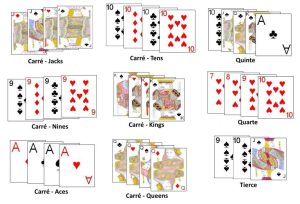
- Tierce — three cards in sequence in one suit: 20 points
- Quarte — four in sequence: 50 points
- Quinte — five in sequence: 100 points
- Four Jacks — 200 points
- Four Nines — 150 points
- Four Aces, Tens, Kings, or Queens — 100 points
Note that sequences run in the order A, K, Q, J, 10, 9, 8, 7 for declaration purposes, which is not the trump ranking. Only the team holding the single highest declaration scores anything, so a modest tierce can be worth nothing at all if the opponents hold a quarte.
Many groups now play with no declarations except Belote-Rebelote, which keeps every round at a clean 162 points and reduces the luck involved. Agree which version you are playing before the first deal.
Scoring a Belote Card Game Round
At the end of the round, each team totals the card points it captured, plus the dix de der, plus any declarations.
- Contract made: the taking side finishes ahead — in practice at least 82 of the 162 — and both teams keep what they scored.
- Dedans: the takers fall short, score nothing from tricks, and the defenders take all 162 points plus every declaration on the table.
- Capot: one side wins all eight tricks and adds a 90-point bonus, for 252 points.
Importantly, Belote-Rebelote survives a failed contract, so a team that goes dedans still keeps those 20 points.
Coinche: The Version Serious Players Use
Once a group knows the belote card game well, most graduate to Coinche, also called Belote Contrée. Instead of simply taking the upturned card, players bid a specific number of points they promise to score, and opponents may coincher — double the stakes — if they think the bid is impossible. The bidder’s side may then surcoincher to redouble.
In addition, Coinche adds two contract types worth knowing: sans atout, played with no trump suit at all, and tout atout, where every suit ranks like trumps. Both recalculate card values so the round still totals roughly the same points.
If Belote is France’s national game, Coinche is the one its tournaments run on.
Belote Card Game Tips That Win Rounds
- Count the trumps. There are only eight. Knowing who still holds the Jack and Nine decides the round.
- Lead trumps early when you took the contract. Drawing out the opposition frees your Aces and Tens to score.
- Watch for your partner winning. It is the only time you may keep a trump back.
- Do not chase the dix de der blindly. Ten points rarely justify wrecking your hand to get them.
- Remember the Ten. It beats the King in plain suits and carries ten points, so it is a target, not a spare card.
How to Start Playing
The belote card game needs nothing special to begin. Any standard deck works — pull out the 2s through 6s and you have a Belote pack. Admittedly, French decks are nicer to handle, but nothing about the rules requires one.
For example, play a few rounds without declarations at first, using only Belote-Rebelote. The bidding and the trumping obligations are enough to absorb in one session, and declarations can wait until the point scales feel automatic. Then move to Coinche once your table stops arguing about whether someone should have trumped.
For the full rule set, including regional variants and the two- and three-player versions, Pagat’s Belote page is the most thorough reference in English. Our card games around the world section covers other national traditions, and the Briscola guide is a good comparison — another Mediterranean trick-taking game, with far looser rules about what you may play.