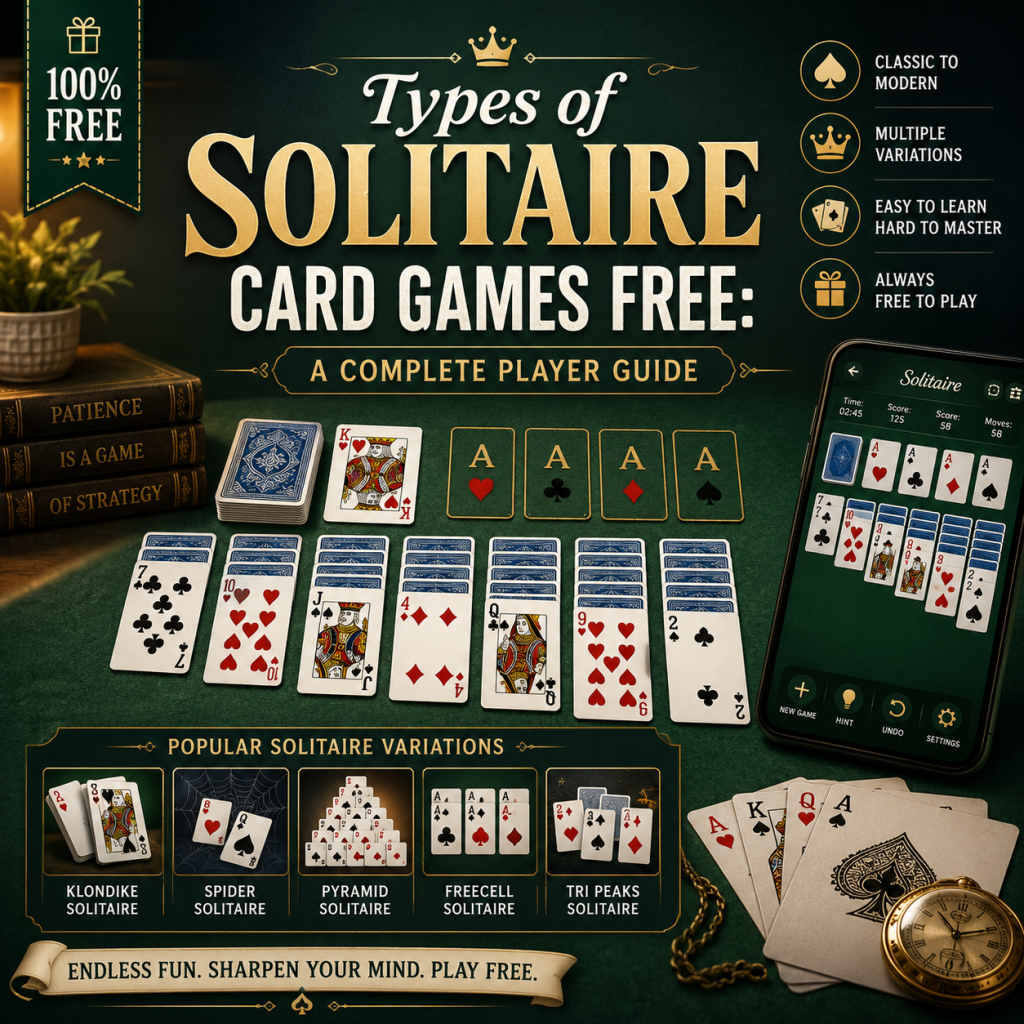
cardanoir.com – Solitaire may look like a simple card game, but its world is far larger than many players expect. Klondike is the version most people recognize, especially from classic computer systems, yet it represents only one branch of a broad family of single-player card games.
There are solitaire variations built around arranging complete sequences, matching cards by value, clearing unusual layouts, managing temporary storage spaces, or solving a puzzle with almost every card visible from the beginning. Some games take only a few minutes, while others require patience, memory, and careful planning across a much longer session.
Exploring types of solitaire card games free helps players find the right experience for their mood and ability. A beginner may enjoy the straightforward rhythm of TriPeaks, while a strategy-focused player may prefer FreeCell. Spider offers a satisfying challenge for players who enjoy building long sequences, whereas Pyramid turns solitaire into a numerical matching puzzle.
Digital versions have made these games easier to access. Players no longer need to shuffle, deal, or reorganize physical cards after every round. A new game can begin instantly, and useful features such as hints, undo, daily challenges, statistics, and automatic card movement can make the learning process more comfortable.
What Is a Solitaire Card Game?
Solitaire refers to a family of card games designed primarily for one player. The objective varies between versions, but most games ask the player to organize, remove, or transfer cards according to specific rules.
A typical solitaire layout may contain several important areas:
- Tableau: The main playing area where most cards are arranged.
- Foundation: The destination where completed card sequences are placed.
- Stock: A pile containing cards not yet introduced into play.
- Waste: The area where cards drawn from the stock are revealed.
- Free cells: Temporary spaces used to hold individual cards.
- Reserve: A separate group of cards that becomes available under certain conditions.
Not every version uses all these areas. FreeCell relies heavily on temporary cells, while TriPeaks focuses more on clearing exposed cards. Spider usually does not use traditional foundations in the same way as Klondike.
Why Free Solitaire Games Remain Popular
Free solitaire games continue to attract players because they are easy to start and require no opponents. There is no waiting for matchmaking, no pressure from teammates, and no need to coordinate schedules.
Players can open a game during:
- A short work break
- A commute
- A quiet evening
- A waiting period
- A moment of relaxation
- A longer puzzle session
Because each game can be played independently, solitaire fits naturally into different routines. The rules are usually simple enough to learn quickly, but the deeper strategies can keep experienced players interested.
The Balance Between Luck and Skill
Solitaire variations use different levels of randomness. Klondike contains hidden cards and depends partly on the order of the stock. FreeCell reveals almost every card from the beginning, so planning plays a much larger role.
This difference creates a clear cause-and-effect relationship. Because more information is visible in FreeCell, the player has greater control over the outcome. In Klondike, hidden information creates uncertainty, so even a reasonable strategy may be limited by an unfavorable deal.
Klondike Solitaire: The Familiar Classic
Klondike is the solitaire game most commonly associated with the word “solitaire.” It uses one standard 52-card deck and begins with seven tableau columns.
The first column contains one card, the second contains two, and the pattern continues until the seventh column contains seven cards. Only the top card of each column is face up.
The objective is to build four foundation piles, one for each suit, beginning with Ace and ending with King.
How Tableau Building Works
Cards in the tableau are usually arranged in descending order with alternating colors.
For example:
Black King
Red Queen
Black Jack
Red 10
Black 9
A face-up sequence may be moved together if it follows the correct pattern. Empty tableau spaces can generally be filled only by a King or a sequence beginning with a King.
Why Klondike Is Suitable for Beginners
Klondike introduces many fundamental solitaire ideas:
- Revealing hidden cards
- Building descending sequences
- Using foundations
- Managing the stock
- Creating empty columns
- Deciding when to move cards upward
The game is approachable, but it still requires judgment. Moving a card to the foundation immediately may look productive, yet that card might still be needed to support a tableau sequence.
The strongest move is not always the one that creates immediate progress. Sometimes the best move preserves future flexibility.
Spider Solitaire: Building Complete Sequences
Spider Solitaire usually uses two standard decks, giving the player a total of 104 cards. The goal is to construct complete sequences from King down to Ace.
When a full same-suit sequence is completed, it is removed from the tableau. The game ends when all eight sequences have been cleared.
Spider commonly offers three difficulty settings:
- One suit
- Two suits
- Four suits
One-Suit Spider for Learning the System
One-suit Spider is the easiest version because suit differences are removed. Players can focus on rank order and tableau management.
It teaches several useful habits:
- Open face-down cards early.
- Protect empty columns.
- Avoid dealing new rows too quickly.
- Build longer sequences whenever possible.
- Keep useful cards accessible.
Four-Suit Spider for Advanced Players
Four-suit Spider is substantially more difficult. Cards can be stacked in descending order regardless of suit, but a multi-card sequence can only be moved together when it is built in the same suit.
This rule creates long-term consequences. Because mixed-suit columns cannot move efficiently, careless stacking reduces the player’s options. As a result, the tableau may become crowded even when many legal moves initially appear available.
When to Deal a New Row
A new row should generally be dealt only after the current tableau has been improved as much as possible. Dealing too early can cover useful cards and break promising sequences.
Before dealing, check whether you can:
- Reveal another hidden card.
- Combine two partial sequences.
- Create an empty column.
- Move mixed suits apart.
- Complete a same-suit run.
FreeCell: Solitaire with Open Information
FreeCell is one of the most strategic solitaire games because almost every card is visible from the beginning.
The standard layout includes:
- Eight tableau columns
- Four free cells
- Four foundations
The foundations are built upward by suit from Ace to King. Tableau cards are arranged downward in alternating colors.
The Importance of Free Cells
Each free cell can temporarily hold one card. These spaces are useful, but filling all of them can quickly restrict movement.
The number of cards that can be moved as a sequence depends on the available empty free cells and tableau columns. Keeping even one space open can make a major difference.
Because temporary spaces create mobility, using them too early has a direct consequence: fewer options remain for reorganizing longer sequences later.
Practical FreeCell Strategy
Strong opening priorities include:
- Identify accessible Aces.
- Look for low cards trapped beneath larger ones.
- Create an empty tableau column.
- Keep at least one free cell available.
- Avoid moving cards to foundations without checking future needs.
- Plan several moves before committing.
Why FreeCell Feels Fair
FreeCell usually feels less dependent on luck because the player can inspect the full layout. Mistakes become easier to understand, and successful solutions feel more connected to planning.
This makes FreeCell especially rewarding for players who enjoy logical puzzles rather than hidden-card uncertainty.
Pyramid Solitaire: Matching Cards to Thirteen
Pyramid Solitaire arranges cards in a triangular layout. The goal is to remove cards by creating pairs that total 13.
Card values are generally:
| Card | Value |
|---|---|
| Ace | 1 |
| 2–10 | Face value |
| Jack | 11 |
| Queen | 12 |
| King | 13 |
Kings can be removed alone because they already equal 13.
Valid pairs include:
- Ace + Queen
- 2 + Jack
- 3 + 10
- 4 + 9
- 5 + 8
- 6 + 7
Exposed Cards Determine Every Move
Only cards that are not covered by another card can be selected. This means the player should not automatically remove the first available pair.
One pair may clear two cards but reveal nothing useful. Another pair may uncover an important card and open an entire section of the pyramid.
A Better Way to Choose Pairs
Before removing cards, consider:
- Which pair uncovers the most cards?
- Is one card needed for another blocked match?
- Are duplicate values creating a conflict?
- Can a stock card be saved for later?
- Will the move create a dead end?
Pyramid Solitaire rewards players who think beyond immediate removal.
TriPeaks Solitaire: Fast and Accessible
TriPeaks presents cards in three connected peaks. The player removes exposed cards that are one rank higher or lower than the current waste card.
For example, if the waste card is 8, either 7 or 9 can be selected. Suits and colors do not matter.
Why TriPeaks Is Easy to Learn
The basic rule can be explained in seconds, and long chains feel immediately satisfying. A player may clear several cards without drawing from the stock when the ranks connect properly.
This fast rhythm makes TriPeaks suitable for:
- Casual players
- Mobile gaming
- Short sessions
- Daily challenges
- Score-based play
Planning Longer Chains
A legal move is not automatically the best move. If both a 5 and a 7 are available from a 6, the player should check which choice creates the longer sequence.
For example:
6 → 7 → 8 → 9 → 10may be more valuable than:
6 → 5Planning one or two moves ahead helps preserve stock cards and improve the final score.
Golf Solitaire: Simple Rules with Tactical Decisions
Golf Solitaire usually contains seven columns of five face-up cards. The player removes cards that are one rank above or below the active waste card.
The objective is to clear the tableau before running out of stock cards.
Why It Is Called Golf Solitaire
Scoring is often based on the number of cards remaining. Like golf, a lower score is better.
The game appears simple, but careful sequencing matters. A long run can remove several cards without using additional stock cards.
Useful Golf Solitaire Tips
- Scan all exposed cards before moving.
- Prefer a path that creates multiple follow-up moves.
- Avoid breaking a long potential chain.
- Remember which ranks have already appeared.
- Use stock cards only when no tableau move remains.
Yukon Solitaire: A More Flexible Klondike
Yukon resembles Klondike but usually has no stock pile. More cards are face up from the beginning, and groups can be moved more freely.
A face-up card may be moved with all cards beneath it, even when the attached group is not perfectly ordered. However, the destination card must still follow the required alternating-color descending pattern.
Yukon Compared with Klondike
| Feature | Klondike | Yukon |
|---|---|---|
| Stock pile | Usually included | Usually absent |
| Hidden information | Higher | Lower |
| Group movement | Structured sequences | More flexible groups |
| Main challenge | Stock and hidden cards | Tableau planning |
| Difficulty | Easy to medium | Medium to hard |
Yukon is a good next step for players who understand Klondike and want more complex tableau management.
Forty Thieves: A Demanding Two-Deck Game
Forty Thieves uses two decks and begins with ten tableau columns containing four cards each. All 40 tableau cards are usually face up.
Cards are built downward by suit, and only one card can generally be moved at a time.
Why Forty Thieves Is Difficult
The rules create several restrictions:
- Same-suit building is required.
- Sequence movement is limited.
- The stock may allow only one pass.
- Empty columns are extremely valuable.
- Important low cards may remain blocked.
Because movement is limited, a seemingly harmless choice can create a long-term obstacle. Players should examine the tableau carefully before drawing from the stock.
Priority Moves in Forty Thieves
Focus on:
- Freeing Aces and low cards
- Creating empty columns
- Avoiding unnecessary stock draws
- Keeping related suits accessible
- Moving cards to foundations when safe
Scorpion Solitaire: Flexible but Unforgiving
Scorpion combines elements of Spider and Yukon. Players aim to build complete same-suit sequences from King to Ace.
Groups of face-up cards can often be moved even when the internal sequence is mixed, provided the top moved card fits its destination.
This freedom can be helpful, but it can also produce tangled columns. A poor move may bury a critical card beneath a long, unusable group.
Who Will Enjoy Scorpion?
Scorpion is well suited to players who enjoy:
- Open tableau information
- Larger card movements
- Same-suit sequence goals
- Long-term planning
- Difficult recovery decisions
Accordion Solitaire: A Distinctive Patience Game
Accordion Solitaire deals cards into a line. A pile can typically be moved onto another pile when their top cards share the same rank or suit and are either:
- One position apart
- Three positions apart
The objective is to compress all cards into a single pile.
Why Accordion Is So Challenging
Every move changes the distance between the remaining piles. A match that looks useful now may remove a connection needed later.
Accordion requires careful positional thinking rather than traditional tableau building. It is one of the most unusual and difficult solitaire variations.
Comparison of Popular Free Solitaire Variations
| Game | Difficulty | Main Mechanic | Best For |
|---|---|---|---|
| Klondike | Easy–medium | Alternating tableau sequences | Classic players |
| Spider, one suit | Easy | Descending sequences | Beginners |
| Spider, four suits | Hard | Same-suit sequence management | Advanced players |
| FreeCell | Medium | Open-information planning | Strategy fans |
| Pyramid | Medium | Pairs totaling 13 | Number-puzzle fans |
| TriPeaks | Easy | One rank higher or lower | Casual sessions |
| Golf | Easy–medium | Sequence clearing | Fast play |
| Yukon | Medium–hard | Flexible tableau movement | Klondike fans |
| Forty Thieves | Hard | Same-suit restricted movement | Experienced players |
| Accordion | Very hard | Positional pile matching | Puzzle enthusiasts |
How to Choose the Right Solitaire Game
The best choice depends on what kind of experience you want.
Choose Klondike for a familiar balance of luck and strategy. Pick FreeCell when you want a logical challenge with visible information. Spider is ideal for players who enjoy building long card sequences, while TriPeaks and Golf are better for short, relaxed sessions.
A simple selection guide:
- For complete beginners: TriPeaks or one-suit Spider
- For classic gameplay: Klondike
- For strategic control: FreeCell
- For number matching: Pyramid
- For a serious challenge: Four-suit Spider or Forty Thieves
- For unusual rules: Accordion
- For Klondike-style complexity: Yukon
General Tips for Playing Free Solitaire Games
Different solitaire games require different tactics, but several principles work across many variations.
Reveal Hidden Cards Early
Hidden cards reduce available information and movement. Opening them usually creates more options.
Protect Empty Spaces
Empty columns and free cells are powerful. Do not fill them unless the move creates meaningful progress.
Compare Every Available Move
The first legal move may not be the strongest. Look for the move that opens cards, creates space, or supports a longer sequence.
Avoid Automatic Foundation Moves
Moving a card to the foundation can be useful, but it may remove a card needed for tableau building. Check the layout first.
Use Undo as a Learning Tool
Undo can reveal why a move failed. Try another path and compare the consequences instead of using it only to erase mistakes.
Realistic Review of Free Solitaire Variations
After playing several versions, Klondike remains the most comfortable entry point. Its rules are familiar, the layout is easy to read, and the balance between hidden cards and planning keeps each deal interesting.
FreeCell provides the most satisfying sense of control. Because the cards are visible, a successful solution feels earned. The four temporary cells create flexibility, but they also tempt players to use space too quickly.
Spider offers the strongest long-session experience. One-suit mode is relaxing, while four-suit mode can become genuinely demanding. Completing a same-suit King-to-Ace sequence feels rewarding because it usually requires several earlier decisions to work together.
TriPeaks is the easiest to enjoy casually. It moves quickly and creates frequent streaks, although the stock can occasionally determine whether the final cards are reachable.
Pyramid stands out because it feels more like a numerical puzzle than a traditional building game. The most interesting decisions come from choosing which available pair will reveal the best future cards.
Overall, the variety is the main strength of free solitaire. Players can switch from a calm five-minute game to a deep strategic challenge without leaving the same card-game family.
Benefits of Playing Solitaire
Solitaire can provide more than simple entertainment. It may help players practice:
- Concentration
- Pattern recognition
- Short-term planning
- Patience
- Decision-making
- Visual organization
- Learning from mistakes
It also offers a quiet activity without social pressure. The player can pause, restart, or experiment at their own pace.
FAQ About Types of Solitaire Card Games Free
1. What is the easiest free solitaire game?
TriPeaks, Golf, one-suit Spider, and basic Klondike are among the easiest versions for new players.
2. Which solitaire game requires the most strategy?
FreeCell relies heavily on planning because almost all cards are visible. Four-suit Spider and Forty Thieves also demand strong long-term thinking.
3. Can every solitaire deal be won?
No. Some variations contain deals that are impossible or extremely difficult, particularly games with hidden cards and limited stock access.
4. What is the difference between Klondike and Spider?
Klondike uses one deck and builds four suit foundations. Spider usually uses two decks and focuses on completing full King-to-Ace sequences.
5. Where can solitaire card games be played for free?
Free solitaire games are available through browser-based gaming websites, mobile applications, computer game collections, and downloadable card-game packages.
Conclusion
Exploring types of solitaire card games free reveals a surprisingly diverse collection of card puzzles. Klondike offers familiar classic play, Spider rewards sequence building, FreeCell emphasizes planning, Pyramid uses numerical matching, and TriPeaks provides quick casual entertainment. More demanding variations such as Yukon, Forty Thieves, Scorpion, and Accordion give experienced players additional challenges. Each game creates a different balance of luck, information, and strategy, allowing players to choose a format that fits their available time and preferred difficulty. With simple access, varied rules, and strong replay value, free solitaire remains one of the most flexible ways to enjoy a deck of cards.