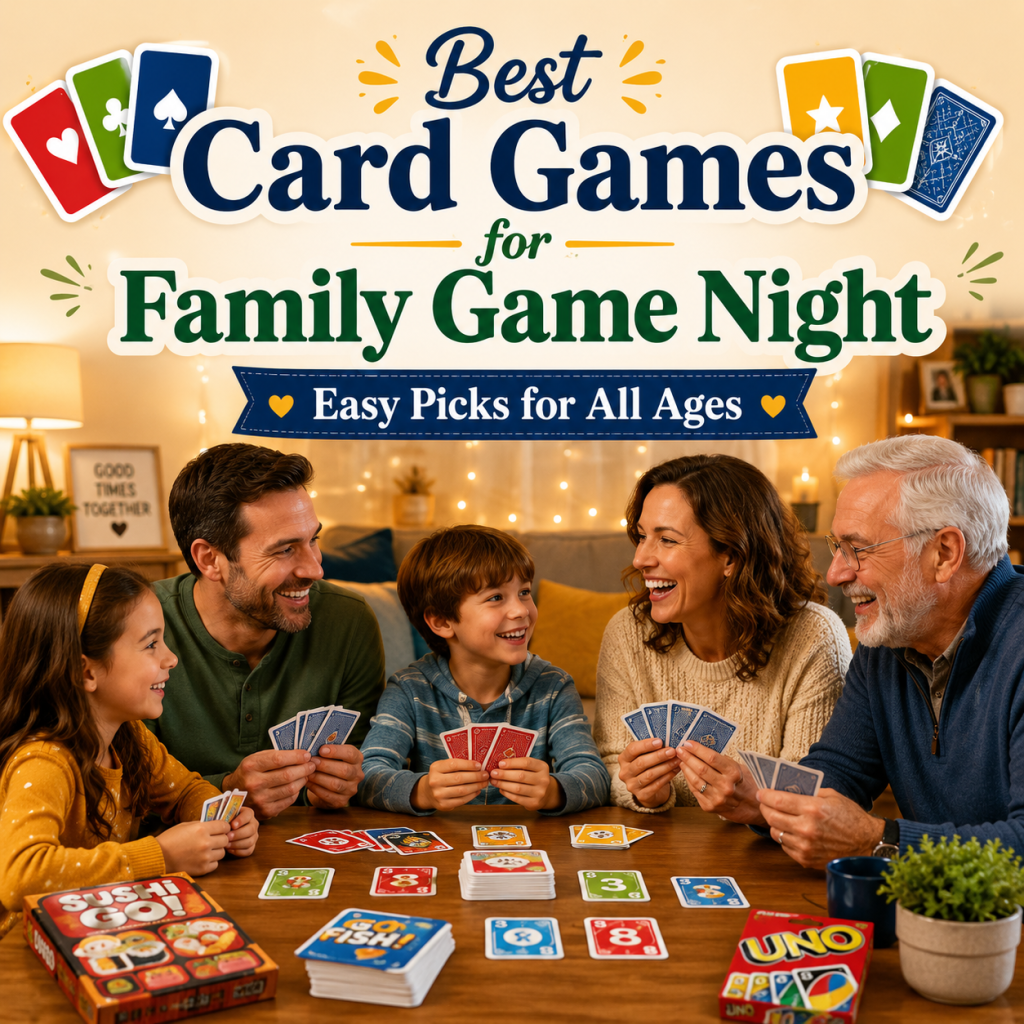
A family game night sounds simple: gather everyone around the table, bring out a game, and enjoy an evening without screens or complicated plans. In reality, choosing the right game can be surprisingly difficult. One person may prefer strategy, another may want something fast, while younger players can quickly lose interest when the rules become too complicated.
That is why card games are often the easiest solution. They are generally affordable, portable, quick to prepare, and flexible enough for different age groups. The best card games for family game night do more than fill time. They encourage conversation, create friendly competition, and give family members a reason to laugh together.
The right game can turn an ordinary evening into a memory people continue talking about long after the cards have been packed away.
Why Card Games Work So Well for Families
Card games are especially suitable for families because they remove many of the barriers found in larger tabletop games. There is usually no complicated board to assemble, no long list of pieces to organize, and no need to spend an hour understanding the basic rules.
Most family card games can be explained in a few minutes. As a result, players can begin enjoying the game before anyone becomes bored or frustrated.
There is also a clear cause-and-effect relationship between simple rules and better participation. When the rules are easy to understand, younger players feel more confident. When younger players participate comfortably, adults are less likely to spend the entire evening correcting mistakes. This creates a more relaxed atmosphere for everyone.
Benefits of Playing Card Games Together
Regular family game nights can provide several practical benefits:
- They encourage face-to-face communication.
- They help children practice patience and turn-taking.
- They create opportunities for friendly competition.
- They improve simple decision-making skills.
- They offer entertainment without requiring a television or phone.
- They help family members build shared traditions.
A game does not need to be educational to provide value. Even a silly matching game can teach players to observe carefully, control their reactions, and handle both winning and losing.
How to Choose the Right Family Card Game
Before buying or selecting a game, consider the people who will actually be sitting at the table. A highly strategic game may be excellent for teenagers and adults but exhausting for a seven-year-old. Meanwhile, a game designed only for small children may not hold an adult’s attention for very long.
The strongest choices usually offer simple rules with enough variety to remain interesting.
Check the Recommended Age
The age printed on the box is a useful starting point, but it should not be treated as an absolute rule. Some children understand patterns and numbers earlier than expected, while others prefer games that rely less on reading.
For mixed-age groups, look for games that allow younger players to participate without giving experienced adults an overwhelming advantage.
Consider the Playing Time
A game lasting between 10 and 30 minutes is usually ideal for a casual family evening. Shorter rounds allow players to switch games, take breaks, or play a rematch.
Long games can still be enjoyable, but they may become tiring when someone is eliminated early or when younger players begin losing focus.
Match the Game to Your Family’s Personality
Some families enjoy thoughtful strategy. Others prefer loud reactions, quick decisions, and ridiculous mistakes. Choosing a game that matches the group’s natural energy can make a major difference.
A quiet family may enjoy Sushi Go! or Skyjo, while an energetic group may have more fun with Taco Cat Goat Cheese Pizza or Happy Salmon.
Quick Comparison of the Best Family Card Games
| Card Game | Recommended Age | Players | Average Time | Best For |
|---|---|---|---|---|
| UNO | 7+ | 2–10 | 15–30 minutes | Classic family competition |
| Sushi Go! | 8+ | 2–5 | 15 minutes | Light strategy |
| Exploding Kittens | 7+ | 2–5 | 15 minutes | Humor and surprises |
| Taco Cat Goat Cheese Pizza | 8+ | 2–8 | 10–15 minutes | Fast reactions |
| Monopoly Deal | 8+ | 2–5 | 15–25 minutes | Quick strategy |
| Phase 10 | 7+ | 2–6 | 30–60 minutes | Longer family sessions |
| Skyjo | 8+ | 2–8 | 20–30 minutes | Numbers and risk |
| Sleeping Queens | 8+ | 2–5 | 15–20 minutes | Younger families |
| The Mind | 8+ | 2–4 | 20 minutes | Cooperative play |
| Go Fish | 4+ | 2–6 | 10–20 minutes | Young children |
1. UNO: The Reliable Family Classic
UNO remains one of the most recognizable family card games because almost anyone can understand it. Players match cards by number or color while using action cards to skip turns, reverse direction, or force opponents to draw additional cards.
The rules are simple, but the experience can become surprisingly competitive. A player who appears certain to win can suddenly be forced to draw several cards.
That unpredictability keeps the game interesting across repeated rounds.
Why UNO Is Still Worth Playing
UNO works particularly well when the family includes both children and adults. Younger players can focus on matching colors and numbers, while older players can think about when to save or use action cards.
One realistic issue is that families often develop their own rules. Disagreements may arise over whether Draw Two cards can be stacked or whether a Wild Draw Four can be challenged. Establishing the rules before the first round prevents arguments later.
Review impression: UNO is not the most innovative card game available, but it remains one of the safest choices. It is quick to teach, easy to replace, and entertaining enough for casual gatherings.
2. Sushi Go!: Simple Strategy with Charming Artwork
Sushi Go! is a card-drafting game in which players collect combinations of sushi dishes. Everyone selects one card from their hand and passes the remaining cards to the next player.
Because the hands continue moving, players must decide whether to complete their own combinations or take a card that another player may need.
The result is a game that feels strategic without becoming overly serious.
What Makes Sushi Go! Family-Friendly?
The artwork is colorful, the rounds are short, and the scoring combinations become easy to recognize after one practice round. Younger players may need help calculating scores at first, but the actual decisions are straightforward.
Review impression: Sushi Go! feels calm at the beginning, but tension increases when a valuable card disappears just before reaching you. It is an excellent option for families who want meaningful choices without complicated rules.
3. Exploding Kittens: Silly, Fast, and Unpredictable
Exploding Kittens combines simple card play with absurd illustrations and sudden surprises. Players draw cards until someone reveals an Exploding Kitten. Unless that player has a Defuse card, they are eliminated.
Other cards allow players to skip turns, look at upcoming cards, shuffle the deck, or force another player to act.
Because danger remains hidden inside the deck, every draw creates suspense.
Who Will Enjoy It Most?
This game is ideal for families that enjoy humor and do not mind a little chaos. It may be less suitable for players who dislike elimination, although most rounds are short enough that eliminated players do not wait very long.
Review impression: The first few turns can feel harmless, but the atmosphere changes once the deck becomes smaller. Players start watching every move and wondering whether someone has secretly placed an Exploding Kitten on top.
4. Taco Cat Goat Cheese Pizza: Best for High-Energy Groups
Taco Cat Goat Cheese Pizza is a reaction game built around five repeated words. Players place cards in the center while saying the words in sequence. When the spoken word matches the card, everyone races to slap the pile.
The last person to react collects the cards.
It sounds easy, but the combination of speaking, watching, and reacting causes hilarious mistakes.
Why It Creates So Much Laughter
Players often slap the pile at the wrong time or hesitate when a match appears. These mistakes create a natural chain reaction: one player moves too early, other players follow automatically, and suddenly everyone is laughing over a completely avoidable error.
This is one of the best choices for a lively family gathering, although it may become noisy.
Review impression: The game is more physical than strategic, but that is exactly its strength. It quickly breaks awkward silence and gets everyone involved.
5. Monopoly Deal: A Faster Alternative to the Board Game
Monopoly Deal transforms the familiar property-trading concept into a compact card game. Players collect property sets, charge rent, use action cards, and attempt to complete three full sets before their opponents.
Unlike the traditional Monopoly board game, a round usually ends within 15 to 25 minutes.
That shorter playing time prevents the frustration commonly associated with a game that continues for several hours.
Strategy Without a Complicated Setup
Players must decide whether to save useful cards, build property sets, or attack an opponent’s collection. The game includes enough strategy for adults while remaining understandable for older children.
Review impression: Monopoly Deal can feel unfair when a valuable property is stolen at the last moment, but the quick pace makes losing easier to accept. Most players immediately want another round.
6. Phase 10: Best for Families Who Want a Longer Game
Phase 10 is based on completing specific combinations, such as sets of matching numbers, runs, or cards of the same color. Players must finish each phase in order before moving to the next one.
The concept is easy, but completing all ten phases may take time.
This creates both the game’s greatest strength and its main weakness. Families looking for a longer evening activity may enjoy the gradual progression. Families with impatient players may find it too slow.
A Helpful House Rule
Consider limiting the game to five phases during shorter sessions. This keeps the central experience while reducing the overall playing time.
Review impression: Phase 10 creates satisfying moments when a difficult combination finally comes together. However, falling several phases behind can feel discouraging, especially for younger players.
7. Skyjo: Easy Numbers with Meaningful Decisions
Skyjo challenges players to finish with the lowest score. Each person has a grid of hidden and visible number cards. During a turn, players decide whether to keep a drawn card or exchange it with one already in their grid.
The rules are approachable, but every decision involves risk. A hidden card may contain a low number, or it may reveal something that damages the entire round.
Why Skyjo Works Across Different Ages
The game uses basic numbers rather than long text instructions. This makes it accessible to players who can compare values but may not enjoy reading-heavy games.
Review impression: Skyjo starts quietly and gradually becomes competitive. Revealing a high-value hidden card near the end can completely change the result, which keeps players emotionally invested until scoring is complete.
8. Sleeping Queens: A Strong Choice for Younger Players
Sleeping Queens combines simple arithmetic, memory, and playful characters. Players attempt to awaken queens using kings while using knights, dragons, potions, and wands to affect other players.
The fantasy theme gives the game personality without making the rules difficult.
Children can enjoy the characters while adults remain engaged through the light tactical decisions.
Review impression: Sleeping Queens is more interesting than many games marketed toward children. The rounds move quickly, and the special cards create enough interaction to prevent the experience from becoming repetitive.
9. The Mind: A Cooperative Game Without Talking
The Mind asks players to place numbered cards in ascending order without discussing the numbers in their hands. There is no turn order. Players must watch one another, judge the passing time, and place a card when the moment feels right.
This unusual idea creates a cooperative experience that feels completely different from traditional card games.
Communication Without Words
The lack of verbal communication forces everyone to pay closer attention. When the group succeeds, it feels like a shared achievement. When it fails, the mistake often produces laughter rather than blame.
Review impression: Some players understand The Mind immediately, while others initially wonder whether it is even a game. After a successful sequence, however, the appeal becomes much clearer.
10. Go Fish: The Best Starting Point for Small Children
Go Fish remains one of the easiest card games for all ages, particularly for young children who are learning how to take turns and recognize matching values.
Players ask one another for specific cards. When the requested player does not have the card, the asking player must draw from the deck.
The game is basic, but that simplicity is useful. Children can focus on participating instead of remembering several special rules.
How to Make Go Fish More Engaging
Adults can encourage children to remember which cards have already been requested. This adds a gentle memory challenge without changing the core rules.
Review impression: Adults may not choose Go Fish for an evening with friends, but it is dependable for introducing preschool and early elementary-aged children to card games.
Additional Family Card Games Worth Trying
Beyond the main recommendations, several other games deserve consideration:
- Spot It! for visual recognition and quick reactions.
- Happy Salmon for movement and energetic group play.
- Old Maid for young children and traditional gameplay.
- Love Letter for older children who enjoy deduction.
- Five Crowns for families that enjoy rummy-style games.
- Skip-Bo for number sequencing and relaxed competition.
- Rat-a-Tat Cat for memory and simple mathematics.
Keeping several different games available makes it easier to match the evening’s mood. A family may want a thoughtful game one week and something completely ridiculous the next.
How to Make Family Game Night More Enjoyable
Even the best game can become unpleasant when the atmosphere is too competitive. The goal should be to create an evening people want to repeat.
Set Up the Space Before Everyone Arrives
Clear the table, prepare drinks, and place snacks away from the main playing area. Sticky fingers and card decks rarely work well together.
Explain Only the Essential Rules
Avoid reading the entire rulebook aloud. Explain what players need to know for the first turn, then introduce smaller details when they become relevant.
A long explanation causes boredom. Boredom causes players to stop paying attention. When the game begins, those players become confused, forcing the rules to be explained again.
Let Younger Players Make Their Own Decisions
Helping children is useful, but controlling every decision removes their sense of participation. Offer simple choices instead of telling them exactly which card to play.
Keep Competition Friendly
Celebrate clever moves, even when they are made by an opponent. Avoid embarrassing players for mistakes, and do not allow one person’s frustration to control the evening.
End While People Are Still Having Fun
It is better to finish after three enjoyable rounds than to continue until everyone becomes tired. Ending at the right moment makes players more excited about the next family game night.
Common Mistakes to Avoid
Choosing a good game is only part of creating a successful evening. Families should also avoid several common mistakes:
- Selecting a game that takes too long for the youngest player.
- Introducing several complicated games in one evening.
- Allowing unclear house rules to create arguments.
- Forcing uninterested family members to continue playing.
- Treating every round as a serious competition.
- Letting eliminated players wait too long without participating.
When a game does not work for the group, changing it is not a failure. Different families naturally enjoy different types of entertainment.
Frequently Asked Questions
1. What are the best card games for family game night?
UNO, Sushi Go!, Monopoly Deal, Skyjo, Exploding Kittens, and Taco Cat Goat Cheese Pizza are strong choices. The best option depends on the players’ ages, preferred level of strategy, and available playing time.
2. Which family card game is easiest to learn?
UNO and Go Fish are among the easiest games to teach. Both use familiar matching mechanics and can be explained within a few minutes.
3. What card games are suitable for children and adults?
Sushi Go!, Skyjo, Sleeping Queens, UNO, and Monopoly Deal offer accessible rules while still giving adults meaningful decisions.
4. How long should a family game night last?
A family game night can last between 45 minutes and two hours. Several short games are often more enjoyable than one long game, especially when younger children are involved.
5. How can I stop family card games from becoming too competitive?
Set expectations before playing, keep the rules consistent, praise clever decisions, and remind everyone that the purpose is shared entertainment. Switching to a cooperative game such as The Mind can also reduce direct competition.
Conclusion
Finding the best card games for family game night is less about choosing the most popular box and more about understanding the people around the table. UNO provides familiar competition, Sushi Go! introduces gentle strategy, Taco Cat Goat Cheese Pizza creates instant laughter, and games such as The Mind encourage families to cooperate in unusual ways. Because simple rules lead to faster participation, and faster participation creates more interaction, a carefully chosen card game can transform an ordinary evening into meaningful time together. Start with one accessible game, keep the mood relaxed, and allow your family’s favorite traditions to develop naturally from one round to the next.