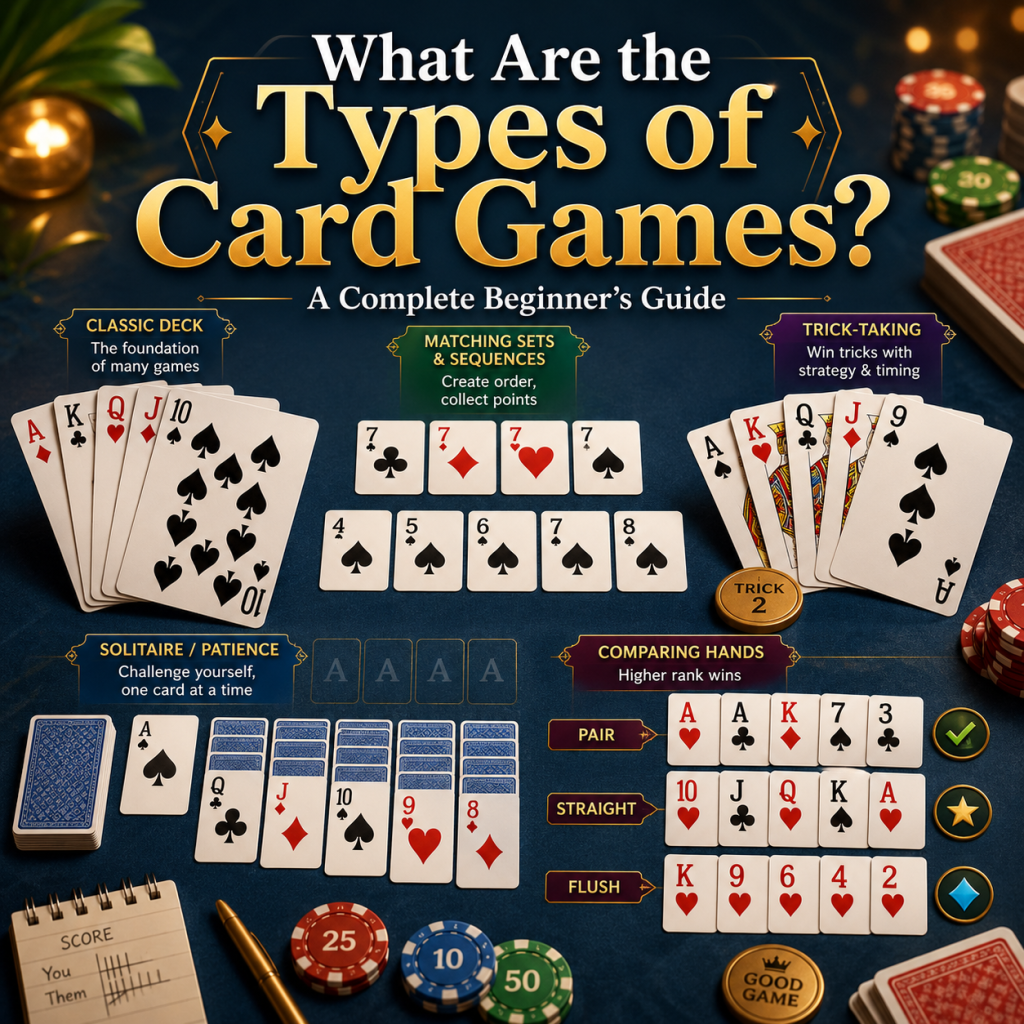
cardanoir.com – Card games have entertained people for centuries, yet not every card game follows the same structure. Some games reward careful planning, others depend heavily on memory, and many combine strategy / luck / social interaction in ways that make every round feel different.
This variety often leads new players to ask: what are the types of card games, and how can one category be distinguished from another?
The answer is broader than simply dividing games into “easy” and “difficult.” Card games are generally classified by their main objective, the way cards are played, how points are collected, and how players interact with one another. A game may involve capturing tricks, forming combinations, discarding cards, comparing hand values, building a deck, or completing a specific pattern.
Understanding these categories makes it easier to choose a game that matches your group, available playing time, experience level, and preferred style of competition.
Why Card Games Are Divided into Different Categories
Card games are grouped into categories because they use different systems to determine progress and victory. In one game, the winner may be the player who collects the most valuable cards. In another, winning means becoming the first person to empty a hand.
The objective directly affects the player’s decisions. Because trick-taking games revolve around winning individual rounds, players must pay attention to suits and previously played cards. By contrast, shedding games encourage players to remove cards quickly, so speed and hand management become more important.
This cause-and-effect relationship is what gives every category its own identity:
- Different objectives create different strategies.
- Different card values create different levels of risk.
- Different player counts change the social experience.
- Different rule systems affect the length of a game.
Some card games are ideal for quiet two-player competition, while others become more entertaining with a large group. There is no universally superior category because each one offers a different kind of experience.
Quick Overview of the Main Card Game Categories
The following table summarizes several major card game categories and their defining characteristics.
| Card Game Type | Main Objective | Common Skills | Popular Examples |
|---|---|---|---|
| Trick-taking games | Win individual tricks or rounds | Memory, timing, prediction | Bridge, Hearts, Spades |
| Matching games | Create matching sets or sequences | Observation, planning | Rummy, Go Fish |
| Shedding games | Discard all cards before opponents | Hand management, timing | Crazy Eights, UNO |
| Comparing games | Hold the strongest hand or value | Probability, decision-making | Poker, Baccarat |
| Solitaire games | Complete an objective alone | Patience, organization | Klondike, Spider Solitaire |
| Collectible card games | Build and use a customized deck | Deck building, strategy | Pokémon, Magic: The Gathering |
| Banking games | Compete against a dealer or bank | Risk evaluation, probability | Blackjack, Baccarat |
| Party card games | Complete humorous or social challenges | Creativity, communication | Apples to Apples |
| Fishing games | Capture cards from a shared area | Memory, calculation | Cassino, Scopa |
| Combat card games | Defeat opposing cards or characters | Tactical planning | War, Top Trumps |
Several games may overlap between categories. Poker, for example, is primarily a comparing game, but certain variants also include betting and strategic bluffing. Rummy is considered a matching game, although players also discard unwanted cards throughout each round.
1. Trick-Taking Card Games
Trick-taking games are among the oldest and most structured types of card games. A “trick” is a single round in which every player places one card on the table. The winner of that trick is determined by the rank, suit, or trump rules of the game.
Popular trick-taking games include:
- Bridge
- Hearts
- Spades
- Euchre
- Whist
- Pinochle
How Trick-Taking Games Work
One player normally leads by playing a card. The other players must then follow the same suit when possible. Depending on the rules, the highest card in the leading suit or the highest trump card wins the trick.
Players must observe which cards have already been played. When a high-value card disappears from the deck, lower cards may become safer or more powerful later.
Why Memory Matters
Memory is especially useful in trick-taking games because the number of available cards decreases after every round. A player who remembers which suits have been exhausted can make more accurate decisions.
For example, if an opponent no longer has cards from the leading suit, that player may be able to use a trump card. As a result, leading the wrong suit can unintentionally give the opponent an advantage.
2. Matching and Melding Card Games
Matching games require players to arrange cards into specific combinations. These combinations may be sets of equal ranks or sequences from the same suit.
Rummy is one of the best-known examples. Players commonly try to create:
- A set such as three Kings
- A sequence such as 5, 6, and 7 of Hearts
- A longer run containing several consecutive cards
Popular Matching Card Games
Common examples include:
- Rummy
- Gin Rummy
- Canasta
- Go Fish
- Old Maid
- Mahjong-inspired card games
Matching games are usually easy to understand because players can clearly see the combinations they need. However, stronger play requires more than waiting for the correct card.
A player may need to decide whether to keep a nearly completed sequence or abandon it to pursue a safer set. Holding too many incomplete combinations causes the hand to become difficult to manage. Therefore, good organization often leads to better results.
3. Shedding Card Games
The main objective of a shedding game is simple: get rid of every card in your hand before anyone else.
This category is popular among families and casual groups because the basic goal can be explained within minutes. Even so, special cards and changing directions can make the game unpredictable.
Popular shedding games include:
- UNO
- Crazy Eights
- President
- Switch
- Mau-Mau
- Taki
What Makes Shedding Games Exciting?
Shedding games usually allow a player to place a card that matches the current suit, number, symbol, or color. Special cards may reverse the direction of play, force an opponent to draw additional cards, or skip someone’s turn.
Because these actions directly affect other players, shedding games often create lively social interaction. A player who appears close to winning may suddenly receive several extra cards, which changes the entire round.
The rules are accessible, but timing remains important. Using a powerful action card too early may leave the player without protection near the end of the game.
4. Comparing Card Games
Comparing games determine the winner by evaluating the strength or numerical value of each player’s hand. In many cases, players receive cards and compare their final combinations after several decisions have been made.
Well-known examples include:
- Poker
- Teen Patti
- Baccarat
- Three Card Brag
- Casino War
- High Card
Hand Strength and Probability
In poker-style games, card combinations have a specific ranking. A pair usually defeats a high card, while stronger combinations such as a straight, flush, or full house defeat lower-ranking hands.
These games often involve hidden information. Because players cannot see every opposing card, they must make decisions based on probability, betting behavior, and available community cards.
The Role of Bluffing
Bluffing appears in some comparing games, particularly poker. It allows a player with a weak hand to represent a stronger position.
However, bluffing is not equally important in every comparing game. Baccarat, for example, uses fixed drawing rules and does not rely on players representing the strength of their cards. This difference shows why games within the same broad category can still produce very different experiences.
5. Solitaire and Patience Card Games
Solitaire games are designed primarily for one player. Instead of defeating an opponent, the player tries to organize the deck according to a specific arrangement.
Popular solitaire variations include:
- Klondike
- Spider Solitaire
- FreeCell
- Pyramid
- TriPeaks
- Yukon
Why Solitaire Remains Popular
Solitaire provides a calm and flexible experience. It does not require a group, a dealer, or complicated preparation. A standard deck is often enough.
The player usually moves cards between columns while trying to reveal hidden cards and build ordered foundations. Since one incorrect decision can block future moves, the game rewards patience and forward planning.
Some solitaire deals are easier than others. In games such as FreeCell, most layouts can be solved when the cards are moved carefully. In other variants, the original shuffle may significantly limit the player’s options.
6. Collectible and Trading Card Games
Collectible card games allow players to construct personalized decks from a larger collection of available cards. Each card may represent a character, creature, spell, item, location, or special ability.
Popular examples include:
- Magic: The Gathering
- Pokémon Trading Card Game
- Yu-Gi-Oh!
- Digimon Card Game
- Disney Lorcana
- Flesh and Blood
Deck Building as Part of the Game
Unlike traditional games that give every player cards from the same standard deck, collectible games begin before the match starts. Players must select cards that work well together.
A balanced deck may include:
- Main attackers
- Defensive cards
- Resource cards
- Support abilities
- Cards that counter specific strategies
A player who fills a deck with powerful but expensive cards may struggle to make early moves. As a result, balance and consistency are often more valuable than raw card strength.
Physical Versus Digital Card Collections
Many collectible games are available in both physical and digital formats. Physical cards offer face-to-face interaction and tangible collections, while digital versions can automate complex rules and make matchmaking faster.
The best format depends on whether a player values local community events, convenient online play, physical collecting, or quick access to different opponents.
7. Banking and Casino-Style Card Games
Banking games involve players competing against a dealer, house, or designated bank rather than directly against every other participant.
Examples include:
- Blackjack
- Baccarat
- Pontoon
- Red Dog
- Casino War
How Banking Games Differ from Other Categories
In blackjack, each player tries to build a hand closer to 21 than the dealer without exceeding that number. The decisions include whether to hit, stand, double down, or split a pair.
Baccarat works differently. Hands are labeled Player and Banker, and additional cards are normally drawn according to fixed rules.
These games are easy to begin because the central objectives are clear. However, understanding card values and available decisions helps players follow the game more confidently.
They can also be played recreationally with chips, points, or no money at all. The card mechanics do not require real-money wagering.
8. Fishing Card Games
Fishing games involve capturing cards from a shared layout on the table. Players generally take cards by matching ranks, combining numerical values, or using special capture rules.
Popular fishing games include:
- Scopa
- Cassino
- Go-Stop
- Basra
- Seep
Capturing Cards from the Table
In a basic fishing system, a player places one card from the hand and uses it to capture matching cards from the table. Some games allow multiple table cards to be captured when their combined value matches the card played.
This structure creates an interesting balance between immediate rewards and future risks. Capturing a small group now may leave a valuable card available for an opponent. Therefore, players must consider not only what they can take, but also what remains behind.
9. Combat and Battle Card Games
Combat card games present direct conflicts between cards. A card with a higher value, stronger statistic, or special ability defeats another card.
The classic game War is the simplest example. Each player reveals a card, and the higher card wins the round. More advanced combat games add health points, abilities, resources, and tactical positioning.
Examples include:
- War
- Top Trumps
- Superfight
- Character battle card games
- Deck-building combat games
These games appeal to players who enjoy immediate competition. The outcome of each exchange is usually easy to understand, making the format suitable for children and beginners. More complex versions can offer deep tactical choices.
10. Party and Social Card Games
Party card games focus on communication, humor, creativity, or group reactions rather than traditional card ranking.
Examples include:
- Apples to Apples
- Cards Against Humanity
- Dixit
- Exploding Kittens
- Sushi Go!
- What Do You Meme?
Why Party Card Games Work Well in Groups
These games often use cards as prompts. Players may complete a sentence, choose the funniest response, explain an image, or predict which option another person will select.
The social context matters as much as the official rules. A response that works well with one group may not be as effective with another because humor and shared experiences influence the result.
Party games are generally best for casual gatherings because they encourage conversation and reduce the pressure of highly technical competition.
Traditional Playing Cards Versus Specialty Card Decks
Not every card game uses the familiar 52-card deck. Traditional playing cards normally include four suits:
- Hearts
- Diamonds
- Clubs
- Spades
Each suit contains numbered cards and face cards. This structure supports hundreds of games because the cards can be sorted by rank, suit, color, or numerical value.
Specialty decks are designed for a particular game. UNO uses colors and action symbols, while collectible games use cards with unique text and abilities.
A standard deck provides versatility / portability / familiarity. A specialty deck provides more distinctive mechanics and visual identity. Neither format is automatically better; the choice depends on the intended experience.
How to Choose the Right Type of Card Game
Choosing a card game becomes easier when several practical factors are considered.
1. Consider the Number of Players
Some games are designed for two players, while others become more enjoyable with four or more.
- For one player: Solitaire or FreeCell
- For two players: Gin Rummy, War, or Cribbage
- For four players: Bridge, Hearts, or Spades
- For large groups: UNO or party card games
2. Decide How Much Time Is Available
A quick game may last less than 15 minutes. Strategic collectible games and tournament-style sessions may take considerably longer.
For a short break, choose a simple shedding or matching game. For a dedicated game night, a deeper trick-taking or deck-building game may provide more satisfying decisions.
3. Match the Difficulty to the Group
Beginners usually enjoy games with visible objectives and limited exceptions. Experienced players may prefer hidden information, advanced card interactions, or long-term planning.
Introducing an overly complicated game can cause players to lose interest before they understand the main strategy. Starting with a simpler game creates confidence, which makes it easier to explore more complex categories later.
4. Choose Between Luck and Strategy
Nearly every card game contains some degree of luck because shuffled cards are unpredictable. The amount of player control, however, varies considerably.
War relies heavily on the order of the deck. Bridge gives players more opportunities to use communication, memory, and strategic planning. Rummy sits somewhere between these extremes because players depend on drawn cards but still decide which combinations to build.
Practical Review of the Most Accessible Card Game Types
From a practical playing perspective, shedding games are the easiest category for mixed groups. Their objectives are direct, rounds move quickly, and special cards keep the experience lively. They work particularly well when children, beginners, and experienced players share the same table.
Matching games offer a slightly more thoughtful experience without becoming intimidating. Rummy is a strong choice for players who enjoy organizing cards and planning several moves ahead.
Trick-taking games provide the greatest sense of partnership and structured competition, but they usually require a longer explanation. New players must understand the leading suit, trump rules, and scoring system before they can make confident decisions.
Collectible card games offer the deepest customization. However, they can demand more preparation because players need to learn card effects and construct balanced decks.
Solitaire remains the most convenient option for individual play. It can be started almost anywhere and does not depend on another player’s schedule.
Overall, the most suitable category depends on the desired atmosphere. For a relaxed family evening, choose a shedding or matching game. For serious strategy, consider trick-taking or collectible games. For quiet individual play, solitaire is difficult to beat.
Common Mistakes New Card Players Make
New players often focus only on the cards currently in their hands. This can cause them to miss important information on the table.
Common mistakes include:
- Forgetting which cards have already been played
- Using powerful cards too early
- Holding incomplete combinations for too long
- Ignoring an opponent who is close to winning
- Failing to read special card instructions
- Choosing a game that is too complex for the group
- Changing house rules during the middle of a round
Clear rules prevent confusion. Before beginning, players should agree on scoring, special actions, winning conditions, and any local variations.
Frequently Asked Questions
1. What are the main types of card games?
The main types include trick-taking, matching, shedding, comparing, solitaire, collectible, banking, fishing, combat, and party card games. Each category is defined by its main objective and style of play.
2. What is the easiest type of card game for beginners?
Shedding and matching games are generally the easiest for beginners. Games such as UNO, Crazy Eights, Go Fish, and basic Rummy have clear objectives and can be learned quickly.
3. Is poker a comparing card game?
Yes. Poker is primarily a comparing card game because the winner is commonly determined by the strength of a card combination. It also includes strategic betting, probability, and bluffing.
4. Can card games be played without gambling?
Yes. Most card games can be played for points, tokens, friendly competition, or entertainment without real money. Even traditional casino-style games can be enjoyed recreationally.
5. What card game is best for improving strategy?
Bridge, Rummy, Poker, and collectible card games can help develop strategic thinking. They encourage players to evaluate probabilities, remember previous actions, plan combinations, and anticipate opponents.
Conclusion
Understanding what are the types of card games reveals how diverse the world of playing cards really is. Trick-taking games emphasize timing and memory, matching games reward organization, shedding games create fast social competition, and solitaire offers a flexible individual challenge. Collectible, fishing, combat, banking, and party games add even more variety through deck construction, card capturing, direct battles, hand comparison, and creative interaction. By considering player count, available time, difficulty, and the preferred balance between luck and strategy, anyone can find a card game category that feels enjoyable, accessible, and worth playing again.