cardanoir.com – Card games have remained popular for generations because they are easy to set up, flexible enough for different group sizes, and capable of creating memorable moments without requiring expensive equipment. A single deck can support quiet two-player matches, competitive tournaments, casual family gatherings, or lively adult game nights.
The best types of card games for adults are not limited to complicated strategy games. Some focus on communication, observation, bluffing, speed, humor, or teamwork. This variety makes card games suitable for different personalities and situations.
A group of close friends may enjoy a fast party game filled with jokes, while another group may prefer a thoughtful game in which every move affects the final result. The atmosphere changes because the game structure changes. As a result, choosing the right category is often more important than simply choosing the most popular title.
This guide explores the major categories of adult card games, explains how they work, and helps you select a game that matches your group, available time, and preferred level of competition.
Why Card Games Remain Popular Among Adults
Modern entertainment offers countless digital options, yet physical card games continue to attract adult players. One reason is their simplicity. Players can sit around a table, learn a few basic rules, and begin playing without creating accounts, downloading software, or preparing complicated equipment.
Card games also encourage direct interaction. Players watch facial expressions, react to unexpected decisions, and communicate throughout the session. That personal element creates a different experience from playing alone on a screen.
Other reasons for their lasting popularity include:
- Most card games are portable and easy to store.
- Many games work well with small or large groups.
- Rules can often be adjusted for different skill levels.
- A single session can last from ten minutes to several hours.
- Card games encourage conversation and friendly competition.
- Players can choose between luck-based and strategy-focused formats.
The social experience is especially important. When players laugh, negotiate, bluff, or celebrate a close victory, the cards become a tool for building interaction rather than the entire focus of the evening.
Main Types of Card Games for Adults
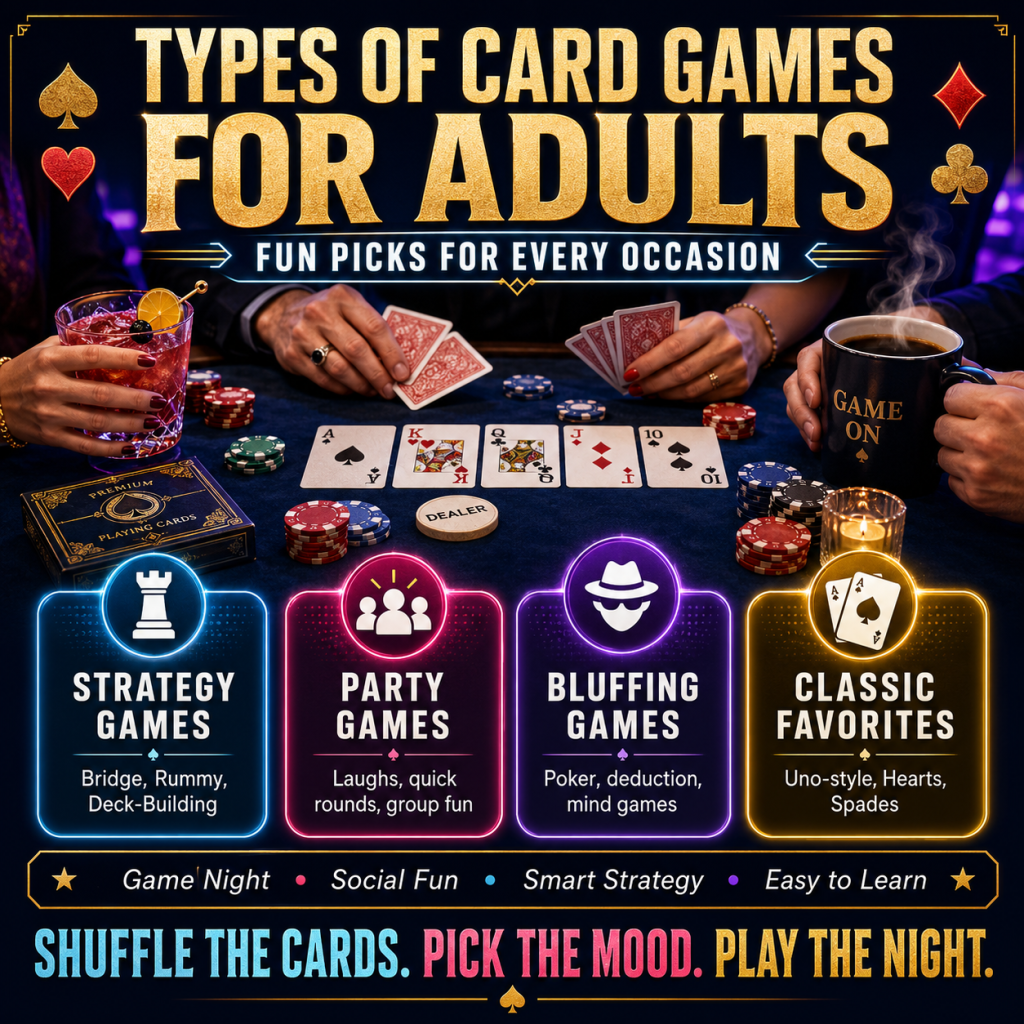
Adult card games can be divided into several broad categories. Each category creates a different pace and style of play.
| Card Game Category | Main Skill | Typical Group Size | General Atmosphere |
|---|---|---|---|
| Trick-taking games | Planning and card management | 3–6 players | Strategic and competitive |
| Matching games | Observation and timing | 2–8 players | Casual and accessible |
| Bluffing games | Deception and psychology | 3–10 players | Social and unpredictable |
| Party card games | Humor and communication | 4–12 players | Loud and relaxed |
| Deck-building games | Long-term strategy | 2–5 players | Tactical and focused |
| Cooperative games | Teamwork and discussion | 2–6 players | Collaborative |
| Shedding games | Speed and hand management | 2–8 players | Fast and energetic |
| Casino-style games | Probability and risk assessment | 2 or more | Competitive |
Understanding these categories makes it easier to avoid choosing a game that does not fit the group. A deeply strategic game may frustrate players who want quick entertainment, while an extremely simple party game may disappoint people looking for a serious challenge.
1. Trick-Taking Card Games
Trick-taking games are among the most traditional card game formats. Each player usually contributes one card to a round, commonly called a trick. The winner of that trick is determined by suit, rank, or a special trump rule.
Popular examples include:
- Bridge
- Hearts
- Spades
- Euchre
- Whist
Why Adults Enjoy Trick-Taking Games
These games reward careful observation. Players must remember which cards have already been played and predict what their opponents may still hold.
The rules may appear straightforward, but the strategic depth develops over time. A beginner can participate after learning the basic structure, while an experienced player can study partnerships, probabilities, and advanced tactics.
Best Situation for Trick-Taking Games
Trick-taking games are ideal for groups that meet regularly. Repeated play improves the experience because players gradually understand each other’s habits and strategies.
They are less suitable for a loud party where participants frequently leave the table. Missing one round or forgetting previously played cards can significantly affect the outcome.
2. Matching and Set-Collection Games
Matching games ask players to collect cards with similar numbers, symbols, colors, or categories. These games are usually easy to teach and work well with mixed-experience groups.
Common examples include:
- Rummy
- Gin Rummy
- Go Fish
- Phase-style games
- Set-collection party games
The main goal may involve forming pairs, sequences, or complete sets before the other players.
A Relaxed but Competitive Format
Matching games are often described as casual, but they still involve meaningful decisions. Players may need to choose between completing a small set immediately or waiting for a more valuable combination.
That choice creates tension. Waiting can lead to a stronger hand, but it also gives opponents more time to finish first. Because of this cause-and-effect relationship, even a simple matching game can remain engaging across multiple rounds.
3. Bluffing and Deduction Card Games
Bluffing games depend on incomplete information. Players may hide their cards, make claims about what they possess, or attempt to identify someone who is being dishonest.
Examples include:
- Cheat or I Doubt It
- Coup
- The Resistance-style card games
- Social deduction games
- Hidden-role card games
These games create excitement because players are not judged only by the strength of their cards. Their confidence, timing, and communication can be equally important.
Reading People Becomes Part of the Game
A player with a weak hand may still succeed by appearing confident. Meanwhile, a player with an excellent position can lose by acting too nervous.
This psychological layer makes bluffing games particularly enjoyable for adults who like conversation and social interaction. However, the group should understand that deception is part of the game, not a personal attack.
Good table manners matter. Competitive energy is enjoyable, but arguments can appear when players take a bluff too seriously.
4. Party Card Games
Party card games are designed to produce conversation, laughter, and unexpected responses. They generally prioritize entertainment over complex strategy.
Typical formats include:
- Word association
- Sentence completion
- Caption creation
- Quick challenges
- Opinion-based prompts
- Voting and comparison
These games are among the most popular card games for parties because new players can usually join without studying a long rulebook.
What Makes a Party Card Game Successful?
A strong party game should have:
- Simple rules that can be explained quickly.
- Short turns that prevent long waiting periods.
- Flexible player limits.
- Prompts that match the group’s comfort level.
- Enough variety to avoid repetitive rounds.
The group itself heavily influences the result. The same game may feel hilarious among close friends but awkward among coworkers who barely know one another.
For that reason, check the theme and maturity level before playing. Some adult party games contain explicit humor, while others remain light and suitable for broader gatherings.
5. Shedding Card Games
In shedding games, players try to get rid of every card in their hand before anyone else. The format creates a clear objective and often produces a quick pace.
Examples include:
- Crazy Eights
- Uno-style games
- President
- Switch
- Mau-Mau
Fast Rules and Immediate Tension
Shedding games are accessible because progress is visible. When a player has only one card remaining, everyone knows that the round may end soon.
That visible progress affects decision-making. Opponents may use special cards to delay the leading player, change the active suit, or reverse the direction of play.
These games are excellent for casual evenings because one round rarely requires a large time commitment. Players can stop after a few rounds or continue for an entire evening.
6. Strategy and Deck-Building Games
Deck-building games begin with players holding small, relatively weak decks. Throughout the match, they acquire new cards and gradually develop a more powerful collection.
Examples of gameplay concepts include:
- Buying stronger action cards
- Building resource combinations
- Creating card synergies
- Removing weaker cards
- Adjusting strategy to counter opponents
Why Deck-Building Feels Rewarding
Players can see their strategy develop during the session. A deck that feels limited at the beginning may become highly efficient after several carefully planned choices.
However, every purchase has a consequence. Choosing an expensive card may provide long-term power, but it can slow down short-term progress. Buying too many different card types can also make the deck inconsistent.
This category suits adults who enjoy tactical planning and do not mind spending time learning card interactions.
Who Should Avoid Deck-Building Games?
Players seeking immediate action may find the early rounds too slow. These games work best when everyone is willing to understand the mechanics and remain involved until the end.
7. Cooperative Card Games
Cooperative games place all players on the same team. Instead of competing against each other, the group works against a scenario, timer, enemy deck, or escalating challenge.
Common objectives include:
- Surviving a series of events
- Solving a mystery
- Completing shared missions
- Protecting a location
- Managing limited resources
Teamwork Changes the Atmosphere
Cooperative games reduce direct rivalry, making them appealing to groups that prefer problem-solving over competition. Players discuss options and combine their card abilities to reach a shared goal.
Still, cooperation introduces another challenge: one experienced player may attempt to control every decision. This is sometimes called the quarterbacking problem.
A healthier approach allows each player to explain their own options before the group chooses a strategy. This makes participation feel balanced and prevents the game from becoming a solo puzzle controlled by one person.
8. Two-Player Card Games
Not every adult game night requires a large group. Many games are designed specifically for two players and offer a more focused experience.
Popular options include:
- Gin Rummy
- Cribbage
- Speed
- Traditional War
- Competitive deck-building games
- Duel-style strategy games
Two-player games usually move quickly because there is little downtime. Every action directly affects the opponent, creating a personal and tactical match.
These games work well for couples, roommates, travel partners, or friends looking for a quiet activity.
9. Casino-Style Card Games
Casino-style games use probability, risk management, and betting structures. Familiar examples include poker, blackjack, baccarat, and similar formats.
They can also be played recreationally without real money by using chips, points, or score sheets.
Strategy, Probability, and Risk
Poker combines card strength with bluffing and observation. Blackjack focuses more heavily on probability and decision-making based on visible information.
When real money is involved, the atmosphere changes because each decision carries a financial consequence. For a casual adult game night, using points or inexpensive tokens can preserve the strategic experience without adding financial pressure.
Set clear limits / rules before beginning, especially when players have different expectations.
How to Choose the Best Adult Card Game
The best game depends on the people at the table rather than its popularity.
Consider these questions:
- How many players will participate?
- How much time is available?
- Does the group prefer strategy or casual entertainment?
- Are all players comfortable with mature humor?
- Should the game be cooperative or competitive?
- Are beginners joining experienced players?
- Does the group want one long match or several short rounds?
A party of eight people may enjoy a social bluffing game, while two experienced players may prefer a tactical duel. Matching the game to the occasion prevents boredom and reduces the chance of someone feeling excluded.
Practical Tips for Hosting an Adult Card Game Night
A successful game night requires more than placing a deck on the table. Small preparations can improve the entire session.
- Choose one main game and keep a simpler backup available.
- Explain the objective before describing every detailed rule.
- Play a practice round when the mechanics are unfamiliar.
- Use enough lighting for players to read cards comfortably.
- Keep drinks away from valuable cards and game components.
- Set a reasonable finishing time for longer games.
- Avoid eliminating players too early whenever possible.
- Rotate the first player between rounds.
It also helps to know the group. Some players enjoy serious competition, while others mainly want conversation. A flexible host can adjust scoring, shorten rounds, or change games when the energy begins to drop.
A Realistic Review of an Adult Card Game Night
A realistic adult card game night rarely runs exactly as planned. The first game may take longer to explain, one player may arrive late, and another may misunderstand a rule. However, the evening often becomes more enjoyable after everyone completes one practice round.
Fast shedding games usually generate immediate engagement because the objective is obvious. Party games create the most laughter, although their success depends heavily on the personalities in the room. Strategy games provide deeper satisfaction, but players may become impatient if they were expecting a relaxed social evening.
The most consistently successful format is often a combination: begin with a simple game, move to a strategic or bluffing game once everyone is comfortable, and finish with something fast. This progression works because the group’s energy changes throughout the night.
The cards themselves matter, but the pacing of the evening matters just as much.
Frequently Asked Questions
1. What are the best types of card games for adults?
The best categories include trick-taking, matching, bluffing, party, shedding, cooperative, and deck-building games. The right choice depends on group size, available time, and preferred difficulty.
2. What card games are good for an adult party?
Simple party games, social deduction games, bluffing games, and fast shedding games work well because they support larger groups and require minimal preparation.
3. Are there adult card games without explicit content?
Yes. The word adult can simply refer to strategic depth or target age. Many adult card games contain no explicit language and focus on planning, teamwork, or social interaction.
4. What card games work best for two adults?
Gin Rummy, Cribbage, Speed, duel-style deck-building games, and other two-player strategy games are strong options because they offer quick turns and direct competition.
5. How long should an adult card game night last?
A casual game night usually works well at two to four hours. Short games can be played in several rounds, while complex strategy games may require the full session.
Conclusion
The wide variety of types of card games for adults makes it possible to create the right experience for almost any gathering. Trick-taking and deck-building games reward careful strategy, bluffing games test confidence and observation, party games encourage laughter, and cooperative games turn the table into a shared challenge. The most enjoyable choice is not always the most complex or popular game; it is the one that matches the group’s mood, time, and level of experience. With clear rules, comfortable pacing, and the right mix of competition and conversation, a simple deck of cards can turn an ordinary evening into a memorable game night.