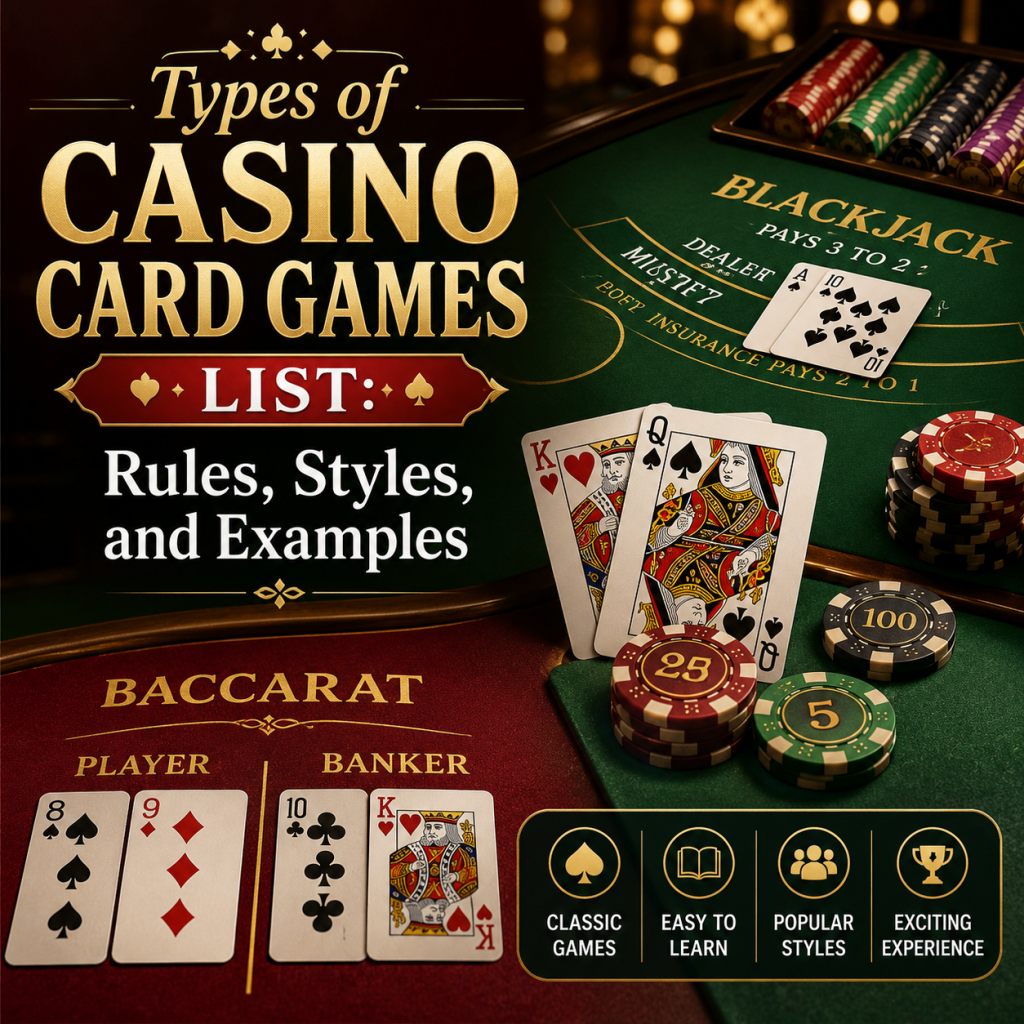
cardanoir.com – Casino card games come in many formats, ranging from straightforward comparing games to strategic poker variations involving several betting rounds. Although most of them use standard playing cards, their objectives, rules, pace, and decision-making requirements can be completely different.
A complete types of casino card games list usually includes blackjack, baccarat, poker, casino hold’em, three-card poker, pai gow poker, red dog, Caribbean stud, and several regional games. Some require players to compete against the dealer, while others create competition between players at the same table.
Understanding these differences is useful because a game that looks simple may involve several strategic decisions. Meanwhile, another game with an elaborate table layout may depend mostly on fixed rules and card comparison.
This guide explains the main categories, popular examples, basic objectives, and playing characteristics of casino card games without assuming that every version follows identical rules.
What Is a Casino Card Game?
A casino card game is a table game that uses playing cards as its primary equipment. It is normally managed by a dealer or automated system and follows a fixed set of rules established by the casino or game provider.
Most casino card games fall into one of three structures:
- Player versus dealer
- Player versus player
- Fixed-outcome card comparison
In player-versus-dealer games, the casino is directly involved in the result. Blackjack and baccarat are the most familiar examples.
In player-versus-player formats, the casino generally organizes the table and collects a fee rather than competing with participants. Traditional poker rooms usually use this system.
Fixed-outcome comparison games require players to choose an available position before cards are revealed. The result is determined by comparing hands under established rules.
Why Casino Card Games Feel Different from One Another
Two games may use the same 52-card deck but create completely different experiences.
Blackjack asks players to decide whether to draw another card. Baccarat usually applies automatic drawing rules. Poker requires players to evaluate opponents and betting behavior, while Caribbean stud mainly focuses on comparing one hand against the dealer.
The main differences come from:
- the number of cards dealt;
- whether cards are visible;
- how winning hands are ranked;
- whether drawing decisions are available;
- the number of betting rounds;
- the dealer’s role;
- the level of player interaction.
Quick Types of Casino Card Games List
The following table compares several well-known casino card games.
| Casino Card Game | Main Objective | Typical Opponent | Decision Level | General Pace |
|---|---|---|---|---|
| Blackjack | Reach a stronger total than the dealer without exceeding 21 | Dealer | Medium/High | Fast |
| Baccarat | Predict which hand finishes closest to nine | Fixed hands | Low | Fast |
| Texas Hold’em Poker | Build the strongest five-card hand or force folds | Other players | High | Medium |
| Three-Card Poker | Make a stronger three-card hand than the dealer | Dealer | Medium | Fast |
| Caribbean Stud | Beat the dealer with a five-card poker hand | Dealer | Medium | Medium |
| Casino Hold’em | Build a stronger Texas Hold’em-style hand than the dealer | Dealer | Medium | Medium |
| Pai Gow Poker | Create two hands that both compete with the dealer | Dealer | High | Slow |
| Red Dog | Predict whether a third card falls between two card values | Dealer/table | Low | Very fast |
| Let It Ride | Form a strong poker hand while deciding whether to keep wagers active | Pay table | Medium | Medium |
| Ultimate Texas Hold’em | Beat the dealer using community cards and timed wagering choices | Dealer | High | Medium |
Rules and payouts can differ between casinos, jurisdictions, and online platforms. The table describes the general structure rather than every possible variation.
1. Blackjack
Blackjack is one of the most recognized casino card games. Its central objective is to finish with a card total closer to 21 than the dealer without going over that number.
Basic Blackjack Card Values
- Number cards use their printed value.
- Kings, queens, and jacks count as ten.
- An ace may count as one or eleven.
- A two-card total of 21 using an ace and a ten-value card is called a blackjack.
Players normally begin with two cards. Depending on the hand, they may be able to:
- Hit to receive another card.
- Stand to keep the current total.
- Double down by increasing the initial wager and taking one additional card.
- Split a matching pair into two separate hands.
- Surrender in versions that permit it.
What Makes Blackjack Different?
Blackjack provides more direct decisions than many other dealer games. The player is not simply waiting for cards to be revealed.
Every choice creates a cause-and-effect relationship. Taking another card may improve a weak total, but it can also push the hand above 21. Standing avoids that immediate risk, but it may leave the dealer with an easier target to beat.
Editorial Review of Blackjack
Blackjack is suitable for people who prefer fast rounds but still want meaningful choices. The rules are not difficult to understand, yet the game remains engaging because the correct decision depends on both the player’s cards and the dealer’s visible card.
It feels more interactive than baccarat, although it requires greater attention.
2. Baccarat
Baccarat is a comparing game built around two positions known as the Player hand and the Banker hand. Participants predict which side will finish closer to nine or whether the result will be a tie.
The names do not necessarily represent the actual participant and casino dealer. They are simply the two hands used in each round.
How Baccarat Totals Work
Cards from two through nine use their printed value. Tens and face cards count as zero, while aces count as one.
If a total exceeds nine, only the final digit is used.
For example:
- Seven plus two equals nine.
- Seven plus eight equals fifteen, which becomes five.
- Nine plus six equals fifteen, which also becomes five.
Additional cards are normally dealt according to fixed rules. This means players usually do not decide whether either hand should draw.
Why Baccarat Is Easy to Follow
Once the value system is understood, baccarat moves quickly. The dealer handles the drawing procedure, and participants mainly choose among Player, Banker, or Tie.
Because decisions are limited, the game is less demanding than blackjack or poker.
Editorial Review of Baccarat
Baccarat has a formal appearance, but the underlying structure is relatively simple. It works well for players who prefer observing outcomes instead of making several decisions during each hand.
Its biggest learning curve is understanding why card totals use only the last digit.
3. Texas Hold’em Poker
Texas Hold’em is a community-card poker game in which each participant receives two private cards. Five community cards are then dealt face up across several stages.
The objective is to create the strongest five-card poker hand using any combination of private and community cards, or to win because all opponents fold.
Main Stages of Texas Hold’em
- Pre-flop: Each participant receives two private cards.
- Flop: Three community cards are revealed.
- Turn: A fourth community card is added.
- River: The fifth community card is revealed.
- Showdown: Remaining players compare hands.
Texas Hold’em includes multiple betting rounds, which means a participant may win without showing the strongest cards if every opponent folds.
Why Poker Requires More Strategy
Poker involves incomplete information. Players know their own cards and the community cards, but they do not know what opponents are holding.
Decisions may depend on:
- hand strength;
- table position;
- bet size;
- opponent behavior;
- possible draws;
- available chips;
- previous actions.
Editorial Review of Texas Hold’em
Texas Hold’em offers the deepest player interaction on this list. It rewards patience, observation, and decision-making across several rounds.
However, it is less suitable for someone looking for quick, isolated hands because each decision can influence future actions.
4. Three-Card Poker
Three-card poker is a compact casino game that uses simplified poker rankings. Players and the dealer each receive three cards.
A participant may usually place an ante wager and then decide whether to fold or continue.
Typical Three-Card Hand Rankings
Common rankings from strongest to weakest are:
- Straight flush
- Three of a kind
- Straight
- Flush
- Pair
- High card
Because only three cards are used, the ranking order differs from traditional five-card poker. A straight may rank above a flush because of the relative frequency of each combination.
Why Three-Card Poker Moves Quickly
There are fewer cards, fewer betting decisions, and no community-card stages. The result can therefore be resolved faster than Texas Hold’em or Caribbean stud.
Editorial Review of Three-Card Poker
This is a practical introduction to poker-style hand comparison without the complexity of a full poker table.
The game provides a simple continue-or-fold decision while preserving the excitement of checking a completed hand.
5. Caribbean Stud Poker
Caribbean stud uses five-card poker rankings but places the participant against the dealer rather than other players.
Each side receives five cards. The player can generally view their own hand and one exposed dealer card before deciding whether to fold or continue.
General Structure
- Place an initial ante.
- Receive five cards.
- Review the hand and the dealer’s exposed card.
- Fold or place an additional wager.
- The dealer reveals the complete hand.
- Hands are compared if the dealer meets the required qualification standard.
Some versions offer an optional progressive jackpot wager tied to specific rare hands.
What Makes Caribbean Stud Unique?
Unlike traditional poker, there is no bluffing against other players. Decisions are based on the strength of the player’s hand and the dealer’s exposed card.
Editorial Review of Caribbean Stud
Caribbean stud feels slower and more deliberate than three-card poker. It provides the familiarity of five-card rankings without the social pressure of a competitive poker room.
Its structure is straightforward, although the dealer qualification rule adds an extra layer to the result.
6. Casino Hold’em
Casino hold’em adapts the community-card structure of Texas Hold’em into a player-versus-dealer game.
The player and dealer receive private cards before community cards are placed on the table. Both sides use the available cards to create their best five-card hand.
Typical Round Sequence
- The player places an ante.
- Two private cards are dealt.
- Three community cards are revealed.
- The player folds or continues.
- Two final community cards are dealt.
- The player’s hand is compared with the dealer’s.
Casino Hold’em vs Texas Hold’em
The two games share community cards, but the experience is different.
In Texas Hold’em, players compete against one another and can use betting behavior strategically. In casino hold’em, the opponent is the dealer, and there is no need to read several other participants.
Editorial Review of Casino Hold’em
Casino hold’em is a reasonable choice for people who enjoy community-card poker but prefer a simpler table structure.
It removes bluffing and complex multiplayer betting, making the outcome more focused on completed hand strength.
7. Pai Gow Poker
Pai gow poker is played with a standard deck plus a joker in many versions. Each participant receives seven cards and divides them into two separate hands:
- a five-card high hand;
- a two-card low hand.
Both hands are compared with the dealer’s corresponding hands.
How a Round Is Won
To win the full round, the player generally needs both hands to defeat the dealer’s hands.
If one hand wins and the other loses, the result is usually a push. If both player hands lose, the dealer wins.
The five-card hand must rank higher than the two-card hand.
Why Setting the Hands Matters
A seven-card holding may contain several possible arrangements. Placing too much strength in the high hand can leave the low hand vulnerable. Strengthening the low hand may weaken the main hand.
Cause: the cards must be divided into two valid groups.
Effect: players must think about balance rather than simply creating the strongest possible five-card combination.
Editorial Review of Pai Gow Poker
Pai gow poker is slower and more analytical than most casino card games. Pushes occur frequently because both hands must be won.
It appeals to players who enjoy organizing cards and comparing multiple outcomes within a single round.
8. Ultimate Texas Hold’em
Ultimate Texas Hold’em is another dealer-based adaptation of community-card poker. The player competes against the dealer but can place a play wager at different stages.
The earlier a player commits, the larger the permitted wager may be. Waiting provides more information but can reduce the available wager size.
Decision Timing Creates Tension
A participant may choose to act:
- before community cards are revealed;
- after the flop;
- after all community cards are visible.
Acting early involves uncertainty but may allow a larger play wager. Waiting provides clarity but limits flexibility.
Editorial Review of Ultimate Texas Hold’em
Ultimate Texas Hold’em is one of the more strategic dealer games because timing matters.
It combines recognizable poker hands with a decision structure that rewards understanding when to commit and when to wait.
9. Let It Ride
Let It Ride is based on five-card poker hands. Players begin with three cards, while two community cards are gradually revealed.
The initial action is divided across several wagers. At designated moments, a player may remove part of the wager or “let it ride.”
Main Objective
Unlike dealer-comparison games, the final hand is normally evaluated against a pay table.
The player is therefore trying to complete a qualifying poker combination rather than defeat the dealer’s hand.
Why the Decision Feels Different
The question is not whether another card should be drawn. Instead, the player decides whether the current hand is strong enough to keep all wagers active.
Editorial Review of Let It Ride
Let It Ride has a relaxed pace and does not require direct competition. Its appeal comes from watching a partial hand develop through community cards.
The decision process is easy to understand, but patience is important because many hands do not form high-ranking combinations.
10. Red Dog
Red Dog is a fast comparing game involving two initial cards. A third card is then drawn, and the result depends on whether its rank falls between the first two card values.
For example, if the first cards are four and nine, ranks five through eight fall between them.
Spread and Payout Structure
The numerical distance between the two opening cards is called the spread.
A narrower spread usually offers a higher payout because fewer card ranks can produce a winning result.
If the initial cards are consecutive, the round may be treated as a push. Matching initial cards may trigger a special procedure depending on the version.
Editorial Review of Red Dog
Red Dog is among the easiest casino card games to follow. It is fast and almost entirely focused on card comparison.
The game offers less decision-making than blackjack, poker, or pai gow, but its simplicity is the main attraction.
Main Categories of Casino Card Games
The games above can be organized into broader groups.
Comparing Games
These games determine results by comparing hands or card values.
Examples include:
- baccarat;
- red dog;
- war-style casino games.
Twenty-One Games
These revolve around reaching a target total without exceeding it.
The main example is blackjack, although regional variations may use different drawing or payout rules.
Poker-Based Dealer Games
These use poker rankings but place the participant against the dealer.
Examples include:
- three-card poker;
- Caribbean stud;
- casino hold’em;
- ultimate Texas Hold’em;
- pai gow poker.
Player-Versus-Player Poker
These games involve participants competing against one another.
Examples include:
- Texas Hold’em;
- Omaha;
- seven-card stud;
- five-card draw.
Why Categories Matter
Understanding the category makes it easier to predict the general playing experience.
A comparing game will usually be faster. Poker-based games require hand-ranking knowledge. Player-versus-player formats demand more observation and long-term decision-making.
How to Choose a Casino Card Game
The most suitable choice depends on how much interaction, strategy, and complexity a person prefers.
Choose Blackjack for Direct Decisions
Blackjack works well when the player wants fast rounds with decisions that affect the hand.
Choose Baccarat for Simple Outcomes
Baccarat is easier for someone who prefers choosing a position and allowing fixed rules to determine the result.
Choose Poker for Deeper Competition
Texas Hold’em and Omaha provide more strategic depth, especially for players interested in reading opponents and managing decisions across several rounds.
Choose Three-Card Poker for Quick Poker Hands
Three-card poker provides recognizable hand rankings without long betting sequences.
Choose Pai Gow for a Slower Pace
Pai gow poker suits players who prefer arranging cards carefully and experiencing more split outcomes or pushes.
Practical Review of Casino Card Game Types
From an editorial perspective, blackjack offers the strongest balance between accessibility and decision-making. The basic objective can be learned quickly, but each hand still asks the player to evaluate the current total.
Baccarat is the easiest major table game to follow once the unusual card totals are understood. It provides speed without requiring several decisions.
Texas Hold’em is the deepest game on the list. It involves cards, position, betting, probability, and opponent behavior. That depth also means it requires more time to learn.
Three-card poker is one of the most beginner-friendly poker-based games because the round is compact. Caribbean stud feels more traditional because it uses five-card hands, while ultimate Texas Hold’em offers more complex wagering decisions.
Pai gow poker is the best fit for players who enjoy organizing cards and comparing two hands. Red Dog is the simplest choice for quick card-value comparison.
Overall, no single game is ideal for every situation. The better choice depends on whether the player values speed, simplicity, strategic control, social competition, or poker-style hand building.
Important Rule Differences to Check
Before joining any version, review the table rules because small variations can change the structure significantly.
Important details include:
- the number of decks;
- dealer drawing rules;
- dealer qualification requirements;
- available side wagers;
- poker hand rankings;
- joker usage;
- payout tables;
- surrender or splitting options;
- minimum and maximum wagers.
A familiar game name does not guarantee identical rules in every venue.
Frequently Asked Questions
1. What are the most popular casino card games?
The most widely recognized casino card games include blackjack, baccarat, Texas Hold’em, three-card poker, Caribbean stud, casino hold’em, pai gow poker, and ultimate Texas Hold’em.
2. Which casino card game is easiest to learn?
Baccarat and Red Dog are among the easiest because players make relatively few decisions. Three-card poker is also straightforward once the short hand-ranking list is understood.
3. Which casino card game requires the most strategy?
Player-versus-player poker games such as Texas Hold’em generally require the greatest strategic depth. Blackjack and ultimate Texas Hold’em also involve several meaningful decisions.
4. Is casino hold’em the same as Texas Hold’em?
No. Both use private cards and community cards, but casino hold’em places the participant against the dealer. Traditional Texas Hold’em involves competition among players.
5. Why do casino card game rules vary?
Casinos, jurisdictions, and game providers may use different dealer rules, payout schedules, side wagers, deck numbers, and qualification requirements. Players should check the specific table rules before a round begins.
Conclusion
This types of casino card games list demonstrates how varied card-based table games can be. Blackjack focuses on reaching 21 through direct decisions, baccarat uses automatic drawing rules and simple hand comparison, while Texas Hold’em creates deeper competition between players. Three-card poker, Caribbean stud, casino hold’em, and ultimate Texas Hold’em adapt poker rankings into dealer-based formats, whereas pai gow poker challenges players to balance two separate hands. By understanding each game’s objective, pace, opponent structure, and decision level, readers can more easily identify which casino card game format matches their preferred playing style.