cardanoir.com – Card games have remained popular for generations because they are simple to prepare, easy to carry, and flexible enough to entertain almost any group. A single deck of cards can be used for quiet solo games, competitive two-player matches, family activities, or strategic tournaments involving several participants.
However, not every card game follows the same structure. Some games require players to collect matching cards, while others focus on winning tricks, building combinations, discarding cards, or comparing card values. Understanding the different types of card games and how to play them can help beginners choose a game that matches their preferred level of difficulty, pace, and strategy.
Whether you enjoy careful planning, quick decisions, teamwork, or simple luck-based entertainment, there is almost certainly a card game that suits your style.
Understanding the Main Types of Card Games
Card games are generally classified according to their main objective and playing mechanism. Two games may use the same standard 52-card deck but feel completely different because their rules require players to make different decisions.
For example, in a trick-taking game, players attempt to win individual rounds by playing strong cards. In a matching game, the goal may be to create pairs or sets. In a shedding game, the winner is usually the first player to get rid of every card in their hand.
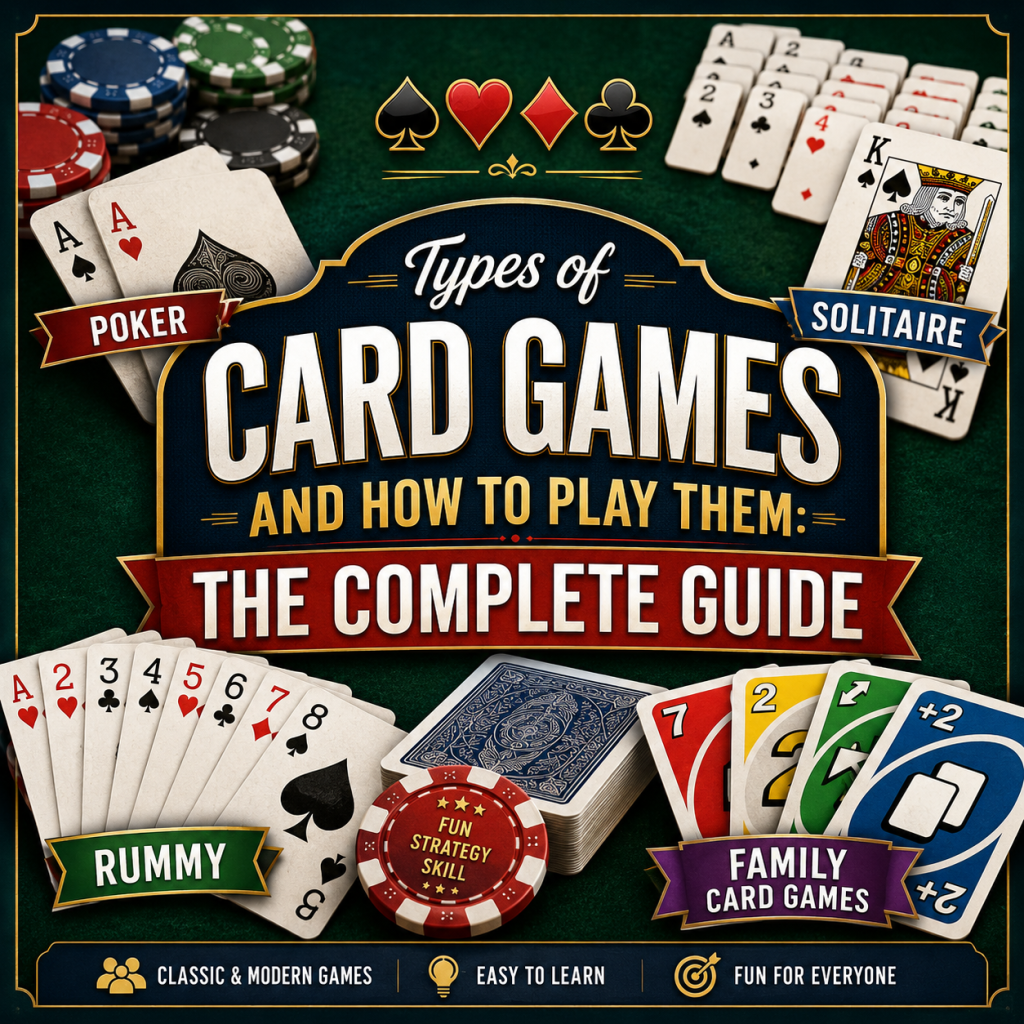
The most common card game categories include:
- Trick-taking games
- Matching and collecting games
- Shedding games
- Draw-and-discard games
- Comparing games
- Fishing and capturing games
- Solitaire games
- Poker-style combination games
- Collectible and trading card games
Each category offers a different balance of luck/strategy, making card games suitable for children, casual players, and experienced competitors.
Quick Comparison of Popular Card Game Categories
| Card Game Type | Main Objective | Common Examples | Typical Players | Difficulty |
|---|---|---|---|---|
| Trick-taking | Win rounds or tricks | Hearts, Spades, Bridge | 3–4 | Medium |
| Matching | Collect matching cards | Go Fish, Old Maid | 2–6 | Easy |
| Shedding | Discard all cards first | Crazy Eights, Uno | 2–8 | Easy |
| Draw-and-discard | Build valid combinations | Rummy, Gin Rummy | 2–6 | Medium |
| Comparing | Reveal the highest-value card | War, Baccarat | 2 or more | Easy |
| Fishing | Capture cards from the table | Casino, Scopa | 2–4 | Medium |
| Solitaire | Complete a layout alone | Klondike, Spider | 1 | Medium |
| Poker-style | Build the strongest hand | Five-Card Draw, Texas Hold’em | 2–10 | Medium/Hard |
The table provides a quick overview, but learning how each category works will make it easier to choose the right game.
1. Trick-Taking Card Games
Trick-taking games are among the oldest and most strategic forms of card entertainment. A trick is one round in which every player places one card on the table. The player who plays the strongest valid card wins that trick.
How Trick-Taking Games Work
Most trick-taking games follow this basic structure:
- The dealer distributes an equal number of cards.
- One player leads by placing a card face up.
- The remaining players play one card each.
- Players may be required to follow the suit that was led.
- The strongest card wins the trick.
- The winner of the trick usually leads the next round.
Some games include a trump suit, which can defeat cards from other suits regardless of their numerical value.
Popular Trick-Taking Games
Spades
Spades is normally played by four people divided into two teams. Before the round begins, each player predicts how many tricks they expect to win.
Spades are always the trump suit. However, players usually cannot lead with a spade until the suit has been “broken” by being played on another trick.
Teams earn points by meeting their combined bid. Poor predictions can lead to penalties, meaning players must balance confidence with realistic hand evaluation.
Hearts
Hearts has a different objective because players generally want to avoid collecting tricks containing penalty cards.
Each heart is worth one penalty point, while the queen of spades is worth 13 points. The player with the lowest score at the end of the game wins.
This reversed objective creates an interesting cause-and-effect relationship: winning too many tricks can place a player in danger because those tricks may contain penalty cards.
2. Matching and Collecting Card Games
Matching games are often recommended for children and beginners because the rules are easy to understand. Players usually search for pairs, sets, or groups of cards with the same rank.
How to Play Go Fish
Go Fish is commonly played by two to six people.
The basic steps are:
- Each player receives a small hand of cards.
- The remaining cards are placed face down as the draw pile.
- A player asks another participant for a specific rank.
- The player making the request must already hold at least one card of that rank.
- If the opponent has matching cards, they must hand them over.
- If not, the opponent says, “Go fish.”
- The requesting player draws one card from the pile.
- A complete set of four matching ranks is placed face up.
The winner is the player who collects the most complete sets.
Why Matching Games Are Beginner-Friendly
Matching games help new players understand basic card values without forcing them to memorize complex scoring systems. Because players repeatedly ask for and collect ranks, the game naturally develops memory and observation skills.
If a player remembers which ranks opponents have requested, they can make more informed decisions later. Better observation therefore leads to better card requests and a higher chance of completing sets.
3. Shedding Card Games
The objective of a shedding game is simple: be the first player to discard every card in your hand.
These games are usually fast, social, and easy to replay. They are especially suitable for family gatherings or casual game nights.
How to Play Crazy Eights
Crazy Eights can be played using a standard 52-card deck.
To begin:
- Each player receives five or seven cards.
- One card is placed face up to start the discard pile.
- The remaining cards form the draw pile.
During a turn, a player must place a card that matches either the rank or suit of the top discard.
For example, if the top card is the seven of hearts, the next player may play:
- any heart;
- any seven; or
- an eight.
Eights are wild cards. A player who uses an eight may choose the suit that must be played next.
The first participant to discard all cards wins the round.
Practical Strategy for Shedding Games
Players should not always use wild cards immediately. Keeping a wild card for later can provide an escape when no ordinary card can be played.
However, holding special cards for too long also carries a risk. If another participant unexpectedly finishes first, unused high-value cards may increase the losing player’s penalty score.
4. Draw-and-Discard Games
Draw-and-discard games require players to improve their hands by taking new cards and removing unwanted ones. The main objective is usually to create valid groups known as sets and runs.
A set contains cards of the same rank, such as three queens. A run contains consecutive cards of the same suit, such as the four, five, and six of clubs.
How to Play Basic Rummy
A simple game of Rummy can be played with two to six players.
Each turn follows two main actions:
- Draw one card from the stock pile or discard pile.
- Discard one card from the hand.
Players attempt to form:
- three or four cards of the same rank;
- three or more consecutive cards of the same suit; or
- a combination of sets and runs.
The round ends when one player successfully arranges their cards into valid combinations and discards their final unused card.
Why Rummy Requires Planning
Rummy may appear simple, but every discard provides information. When a player repeatedly collects diamonds, opponents may suspect that the player is building a diamond run.
As a result, discarding a useful diamond could help that opponent complete a combination. Careless discarding therefore gives opponents more opportunities, while deliberate card selection limits their progress.
5. Comparing Card Games
Comparing games determine the winner by evaluating card values. They generally involve fewer strategic choices, making them ideal for players who prefer quick and straightforward rules.
How to Play War
War is usually played by two people.
The deck is shuffled and divided equally. Both players reveal the top card of their pile at the same time. The higher card wins, and the winner collects both cards.
When both cards have the same rank, a “war” occurs:
- Each player places several cards face down.
- Each player reveals another card.
- The higher revealed card wins all cards involved.
The game continues until one player controls the entire deck or until players agree to stop after a set period.
What Makes War Entertaining?
War involves very little decision-making, but the uncertainty creates suspense. A player may appear close to losing and then win several valuable wars in a row.
It is best viewed as a casual game of chance rather than a deep strategy game.
6. Fishing and Capturing Card Games
Fishing games involve capturing cards from a shared layout on the table. Players may capture cards by matching ranks, combining values, or following special game-specific rules.
How Capturing Games Usually Work
A typical capturing game begins with several cards placed face up in the center. On each turn, a player uses one card from their hand to capture one or more table cards.
For example, a player might capture:
- a card with the same value;
- several cards whose values equal the played card; or
- a special combination defined by the rules.
These games require players to evaluate both immediate gains and future opportunities.
Capturing a strong card too early may leave the table open for an opponent. Waiting may create a larger opportunity, but it also gives another player the chance to capture first.
7. Solitaire Card Games
Solitaire is a category designed primarily for one player. The goal is usually to organize the entire deck according to suit, rank, or a specific layout.
How to Play Klondike Solitaire
Klondike is the version commonly associated with computer solitaire.
The game begins with seven tableau columns:
- The first column contains one card.
- The second contains two cards.
- The pattern continues until the seventh column contains seven cards.
- Only the top card of each column is face up.
Players build tableau sequences in descending order while alternating colors. For example, a black eight may be placed on a red nine.
The final objective is to move every card into four foundation piles, arranged by suit from ace to king.
Key Solitaire Strategy
Whenever possible, players should prioritize moves that reveal hidden cards. Revealing a face-down card creates new options and may release an important ace or low card.
Moving cards without uncovering anything may look productive, but it can simply rearrange the same problem. Therefore, progress in Solitaire depends not only on building sequences but also on increasing access to hidden information.
8. Poker-Style Card Games
Poker-style games are based on building and comparing card combinations. Although many people associate poker with betting, the underlying game can also be played casually using chips, points, or no money at all.
Standard Poker Hand Rankings
From strongest to weakest, common poker hands are:
- Royal Flush
- Straight Flush
- Four of a Kind
- Full House
- Flush
- Straight
- Three of a Kind
- Two Pair
- One Pair
- High Card
Learning these rankings is essential because the strongest valid combination wins the showdown.
How to Play Five-Card Draw
Each player receives five private cards. After reviewing their hand, players may discard unwanted cards and receive replacements.
Once the draw is complete, all remaining players reveal their hands. The strongest poker combination wins.
The strategic challenge comes from deciding which cards to keep. A player holding one pair may keep the pair and replace three cards in the hope of improving to three of a kind, two pair, or a full house.
9. Collectible and Trading Card Games
Collectible card games use specially designed decks rather than ordinary playing cards. Players usually build personalized decks containing characters, abilities, resources, and action cards.
Common features include:
- deck construction;
- resource management;
- character or creature cards;
- attack and defense values;
- unique card abilities;
- turn-based competition.
The exact rules differ between products, but most trading card games reward players who build decks with cards that work well together.
A deck filled only with powerful cards may perform poorly if those cards require too many resources. Good deck construction therefore depends on balance, consistency, and synergy rather than raw strength alone.
How to Choose the Right Card Game
The best card game depends on the number of players, available time, experience level, and preferred style of play.
Choose Based on Player Count
For one player, Solitaire is the most obvious option. Two players may enjoy War, Gin Rummy, or simple capturing games. Groups of four can explore Spades, Hearts, Bridge, or team-based games.
Choose Based on Difficulty
Beginners may prefer:
- Go Fish;
- War;
- Crazy Eights;
- Old Maid; or
- basic Rummy.
More experienced players may enjoy:
- Bridge;
- Spades;
- Gin Rummy;
- Poker-style games; or
- strategic trading card games.
Choose Based on Playing Time
A quick game of War or Crazy Eights may finish within several minutes. Bridge, tournament poker, and advanced trading card games can require significantly more time.
Choosing a game that matches the available time prevents players from rushing or abandoning a round before it is complete.
Practical Review of the Most Enjoyable Card Game Types
From a practical player’s perspective, shedding games offer the easiest balance between simplicity and entertainment. New participants can understand the objective quickly, but wild cards and changing suits still create surprising moments.
Rummy is a better choice for players who enjoy planning. It encourages attention, memory, and careful hand management without becoming overly complicated.
Trick-taking games are the most rewarding for groups that play regularly. The first session may feel confusing because players must follow suits, count cards, and understand trump rules. Once everyone becomes familiar with the structure, however, teamwork and prediction add significant depth.
Solitaire remains useful when no playing partner is available. It is relaxing, portable, and challenging enough to encourage repeated attempts.
Overall, there is no single category that suits every situation. A family gathering may benefit from a fast shedding game, while a competitive group may prefer Spades, Rummy, or Poker.
Basic Tips for Learning Any Card Game
Learning a new card game becomes easier when players use a simple process:
- Understand the objective first. Know exactly how the winner is determined.
- Learn the turn sequence. Identify what each player must do during a turn.
- Review special cards. Check whether certain ranks or suits have unique powers.
- Play an open practice round. Allow everyone to show their cards while learning.
- Discuss unclear situations. Agree on house rules before the competitive game begins.
- Start without scoring pressure. Focus on understanding the structure.
- Add strategy gradually. Learn advanced tactics after mastering the basic rules.
A practice round is particularly helpful because reading rules does not always explain how decisions feel during actual play. Once players see the sequence in action, the rules become easier to remember.
Frequently Asked Questions
1. What are the main types of card games?
The main categories include trick-taking, matching, shedding, draw-and-discard, comparing, fishing, Solitaire, Poker-style, and collectible card games. Each category is defined by its main objective and playing mechanism.
2. What is the easiest card game for beginners?
War, Go Fish, and Crazy Eights are among the easiest choices. Their objectives are clear, turns are simple, and players do not need to memorize complicated scoring systems.
3. Which card games require the most strategy?
Bridge, Spades, Gin Rummy, Poker, and collectible card games usually require more strategy. Players must consider probability, card memory, opponent behavior, and long-term planning.
4. Can card games be played without gambling?
Yes. Most card games can be played purely for entertainment. Poker-style games can use points, buttons, tokens, or ordinary chips without involving money.
5. How many cards are in a standard playing deck?
A standard deck contains 52 cards divided into four suits: hearts, diamonds, clubs, and spades. Each suit contains 13 ranks, from ace through king. Some decks also include one or more jokers.
Conclusion
Understanding the different types of card games and how to play them opens the door to countless forms of entertainment using either a standard deck or specially designed cards. Beginners can start with simple matching, comparing, or shedding games, while experienced players may prefer the deeper planning found in Rummy, Spades, Bridge, Poker, or collectible card games. Each category offers a different combination of luck, memory, communication, and strategy, so the best choice depends on the number of players, available time, and desired level of challenge. By learning the objective, turn sequence, scoring system, and special rules of each game, anyone can confidently join the table and enjoy one of the world’s most adaptable forms of social entertainment.