cardanoir.com – The question “how many types of bridge card games are there?” sounds simple, but the answer becomes more interesting once you explore how bridge is played at home, in clubs, and in formal competitions.
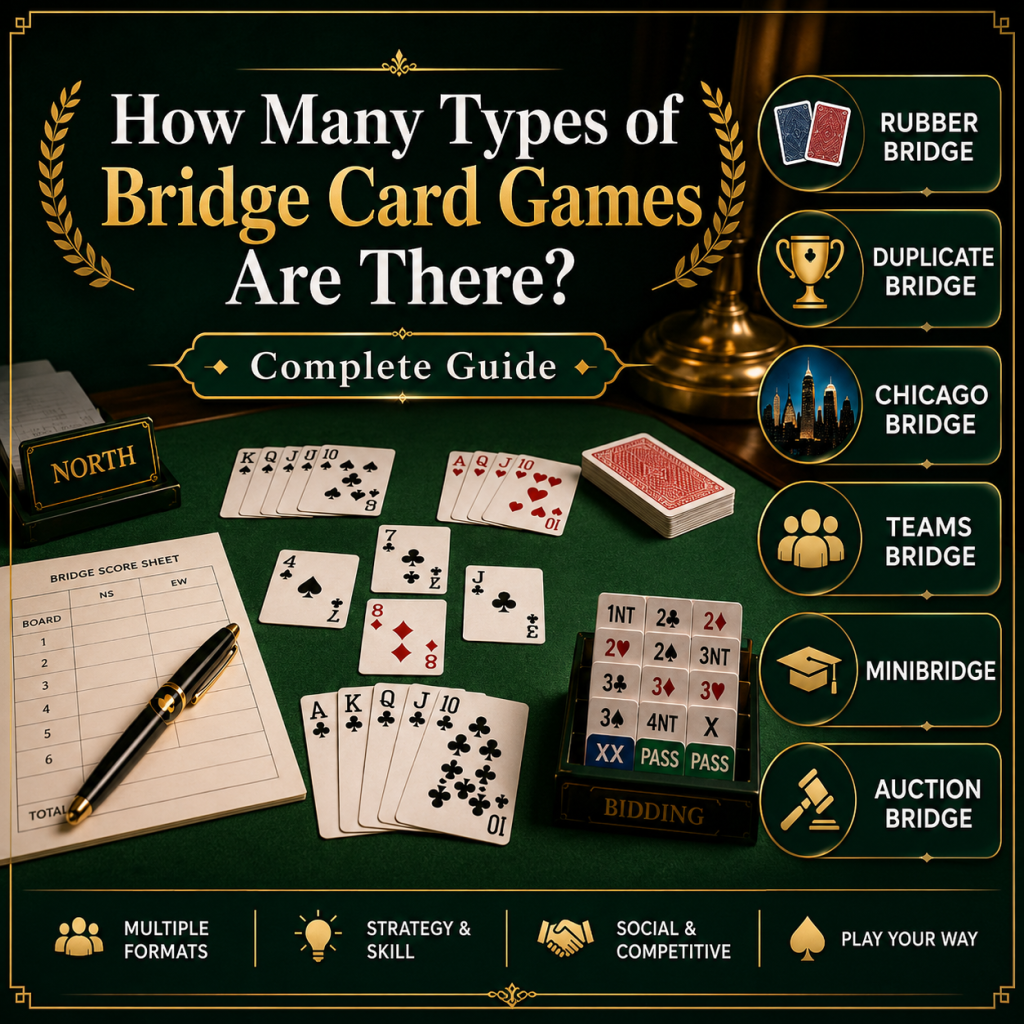
The clearest answer is that there are three main modern formats of bridge card games: Rubber Bridge, Duplicate Bridge, and Chicago Bridge. However, when historical versions, teaching formats, partnership structures, and tournament variations are included, players may encounter at least eight widely recognized types or formats of bridge.
These versions share the same basic foundation, but they do not always feel like the same game. Some are designed for relaxed social play, while others focus on competitive accuracy. Certain formats can be completed in less than an hour, whereas others may continue until one partnership reaches a specific scoring target.
Bridge itself is normally played with a standard 52-card deck divided equally among four players. The players form two partnerships, use bidding to describe their hands, and attempt to complete a declared contract during card play. Duplicate contract bridge is the principal competitive form because multiple players or teams can play identical hands under comparable conditions.
What Is a Bridge Card Game?
Bridge is a partnership-based trick-taking card game. Four players sit around a table, with partners facing each other. Each person receives 13 cards, meaning the entire deck is distributed before play begins.
A standard deal contains two major stages:
- The auction or bidding phase
- The card-playing phase
During the auction, players use bids to exchange limited information about the strength and distribution of their cards. The auction establishes the final contract, including the required number of tricks and whether a suit will become trump. The American Contract Bridge League describes bidding as the language of bridge because it allows partners to communicate through an agreed system.
After the auction, one player becomes the declarer. Declarer attempts to complete the contract with help from the exposed hand of their partner, known as the dummy. The opposing partnership becomes the defenders and tries to prevent the contract from succeeding.
This structure creates a clear cause-and-effect relationship. Accurate bidding leads to a realistic contract, while overly ambitious bidding can place the partnership in a contract it cannot complete. Likewise, careful card play can rescue a difficult contract, whereas one poorly timed card may give the defenders a decisive trick.
How Many Types of Bridge Card Games Are There?
There are three principal formats commonly associated with modern social and competitive bridge:
- Rubber Bridge
- Duplicate Bridge
- Chicago or Four-Deal Bridge
A broader classification may also include Contract Bridge as the modern rules framework, Duplicate Pairs, Teams Bridge, Minibridge, and Auction Bridge. Under this wider definition, players can identify at least eight important bridge types and formats.
| Bridge Type or Format | Typical Players | Main Characteristic | Best For |
|---|---|---|---|
| Contract Bridge | 4 | Bidding determines a contract | Learning modern bridge |
| Rubber Bridge | 4 | First partnership to win two games wins the rubber | Social home games |
| Duplicate Bridge | 4 or more | Identical deals are compared across tables | Clubs and tournaments |
| Chicago Bridge | 4 | A session lasts four completed deals | Short social sessions |
| Duplicate Pairs | Multiple pairs | Scores are compared using matchpoints | Pair competitions |
| Teams Bridge | Usually 8 or more | Two partnerships represent one team | Team tournaments |
| Minibridge | Usually 4 | Simplified contract selection without full bidding | Complete beginners |
| Auction Bridge | Usually 4 | Historical predecessor to modern contract bridge | History and classic variants |
The distinction matters because some names refer to complete scoring systems, while others refer to tournament structures. For example, Duplicate Pairs and Teams Bridge both use the principles of Duplicate Bridge, but they reward different strategic decisions.
1. Contract Bridge
Contract Bridge is the modern foundation from which the most familiar bridge formats are built. The word contract refers to the commitment made during the auction.
A bid contains a number and a denomination. For example, a bid of 4 Hearts promises that the partnership will win ten tricks with hearts as trump. Six tricks are treated as the base, so the number four represents four additional tricks.
The final contract determines:
- Which partnership attacks;
- Which player becomes declarer;
- How many tricks must be won;
- Whether a trump suit is used;
- How the result will be scored;
- What penalties apply if the contract fails.
Why Contract Bridge Feels Strategically Deep
The cards alone do not decide the outcome. Players must evaluate high-card strength, suit length, distribution, partner responses, and the likely position of missing cards.
As a result, a strong hand can still produce a poor score when the partnership chooses the wrong contract. Meanwhile, an average hand may generate an excellent result when both partners communicate accurately and play efficiently.
This balance between bidding and card play is one reason bridge remains engaging over repeated sessions. The same cards can produce different contracts and different outcomes depending on the decisions made at the table.
2. Rubber Bridge
Rubber Bridge is one of the best-known formats for casual games at home. A rubber is normally won by the first partnership to win two games.
Contract trick points are recorded below the scoring line. When a partnership accumulates enough trick points to complete a game, it becomes vulnerable. Vulnerability increases potential bonuses but also increases penalties when a contract fails.
What Makes Rubber Bridge Different?
Rubber Bridge follows a continuous scoring structure. Points earned during one deal can influence the importance of the next deal. A partnership that has already won one game is closer to winning the rubber, so later bidding decisions may become more aggressive or defensive.
For example, a partnership may accept a slightly risky game contract because completing it would finish the rubber and earn a valuable bonus. However, that decision also creates a consequence: if the contract fails while vulnerable, the penalty can be expensive.
Strengths of Rubber Bridge
- Suitable for home and social play;
- Does not require duplicate boards;
- Creates a continuing story across several deals;
- Rewards both bidding judgment and card play;
- Easy to organize with four players and one deck.
Limitations of Rubber Bridge
The distribution of the cards can influence the result more heavily than it does in Duplicate Bridge. One partnership may receive several strong hands in succession, while the opponents spend much of the session defending.
Skill still matters, but the random deal has a visible effect. This is precisely why Duplicate Bridge became attractive to competitive players: it allows different partnerships to be measured while playing the same cards.
3. Duplicate Bridge
Duplicate Bridge is the leading competitive form of bridge. Instead of shuffling the cards after every table finishes, the original deal is preserved in a numbered board and played again by other partnerships.
The North, East, South, and West hands remain in separate pockets. When the board moves to another table, new players face the same distribution.
The result is not judged only by whether a partnership makes or defeats a contract. It is judged by how well that partnership performs compared with others holding the same cards. ACBL identifies duplicate contract bridge as the main competitive form because competitors play identical hands under similar conditions.
Why Duplicate Bridge Reduces the Effect of Luck
Imagine that North-South receives a weak collection of cards. At one table, they lose 200 points. At another table, a different North-South pair loses only 100 points with the same cards.
Neither pair records a positive score, but the second pair has achieved the better competitive result. They may have defended more carefully, avoided an unnecessary double, or stopped the opponents from reaching a more valuable contract.
Because identical deals are compared, the quality of the cards becomes less important than the way each partnership handles them.
Duplicate Bridge Scoring
Two common methods are:
- Matchpoints, often used in pairs events;
- International Matchpoints or IMPs, commonly used in team events.
Under matchpoint scoring, each result is compared with other results on the same board. A player receives more matchpoints for beating a greater number of comparable scores. Under IMP scoring, the difference between two scores is converted through an official IMP scale.
This difference changes strategy. In matchpoints, an extra overtrick may be extremely valuable because it can move a pair above many competitors. In IMP games, making a safe contract is often more important than risking the entire contract to chase one additional trick.
4. Chicago Bridge or Four-Deal Bridge
Chicago Bridge, also known as Four-Deal Bridge, is a shortened form of Rubber Bridge. Instead of continuing until one partnership wins two games, a Chicago session consists of four completed deals.
The official ACBL Laws of Rubber Bridge describe Four-Deal Bridge as a form of Rubber Bridge suited to clubs and home play. Its fixed structure avoids lengthy rubbers, and a four-deal round typically takes about 20 minutes.
How Chicago Bridge Works
The dealer rotates after each deal, and vulnerability follows a predetermined schedule:
- On the first deal, neither side is vulnerable.
- On the second and third deals, one side is vulnerable.
- On the fourth deal, both sides are vulnerable.
The scoring is completed after the four deals. Because the number of deals is fixed, players can estimate how long a session will last.
Why Chicago Bridge Is Popular for Short Sessions
Rubber Bridge can continue for an unpredictable amount of time. Chicago solves that problem by creating a clear stopping point.
This produces a practical cause-and-effect benefit: a fixed number of deals creates predictable playing time. It is therefore easier to rotate players, organize several tables, or enjoy bridge during a limited evening schedule.
5. Duplicate Pairs
Duplicate Pairs is a competition in which players remain with the same partner throughout a session. Each pair plays a series of boards against different opponents.
North-South results are usually compared with other North-South results, while East-West results are compared with other East-West results. Matchpoint scoring rewards a pair according to how many comparable scores it beats or ties.
Strategic Character of Pairs Play
Small differences matter greatly in pairs competition. Consider two partnerships that both play a contract of 3 No Trump:
- Pair A makes nine tricks;
- Pair B makes ten tricks.
Both partnerships complete the contract, but Pair B may receive a much better matchpoint result because of the additional trick.
This encourages players to search for efficient contracts, protect overtricks, and avoid conceding unnecessary tricks on defense. However, excessive greed can backfire. A player who risks the contract to gain one extra trick may turn a good score into a bottom result.
6. Teams Bridge
In Teams Bridge, one team is usually represented by two partnerships. One partnership sits North-South at one table, while its teammates sit East-West at another table.
Both tables play the same deals, but the opposing directions are reversed. The two results are compared, and the point difference is commonly converted into IMPs. The World Bridge Federation defines IMP scoring as a system in which the point difference between compared scores on each board is converted through an established scale.
Why Team Strategy Is Different
Large score swings matter more than small differences. Suppose one pair safely bids and makes a vulnerable game, while the teammates defeat the same game at the other table. That combination can produce a substantial gain.
By contrast, gaining one extra overtrick may provide only a minor advantage.
For this reason, successful team players often prioritize:
- Reaching sound game and slam contracts;
- Avoiding unnecessary doubled penalties;
- Protecting the contract before chasing overtricks;
- Defending carefully against high-value contracts;
- Maintaining a consistent partnership system.
Teams Bridge feels more conservative than matchpoint pairs, but it can become highly dramatic when game, slam, and doubled contracts are involved.
7. Minibridge
Minibridge is a simplified version created to introduce new players to bridge without requiring them to learn a complete bidding system immediately.
Players still learn how to sort a hand, count high-card points, identify the declaring side, select a contract, use the dummy, and play tricks. The English Bridge Union recommends Minibridge as a route into full bridge because beginners can become comfortable with hand evaluation, scoring, and card play before studying the auction.
Why Minibridge Works for Beginners
Traditional bridge can feel overwhelming because a newcomer must learn two complex subjects at once:
- How to bid;
- How to play the cards.
Minibridge removes much of the auction complexity. As a result, beginners can focus on following suit, establishing winners, using trump effectively, and planning the order of play.
Once those skills feel natural, bidding becomes easier to understand because the player already knows what the eventual contract is trying to achieve.
Basic Skills Learned Through Minibridge
- Counting high-card points;
- Recognizing balanced and unbalanced hands;
- Understanding declarer and defender roles;
- Planning how many tricks can be won;
- Using entries between declarer and dummy;
- Learning when to draw trump;
- Recording and comparing scores.
The standard Minibridge learning process includes dealing 13 cards to each player, counting points, identifying the declaring side, choosing a contract, and then playing the hand.
8. Auction Bridge
Auction Bridge is an older form that helped shape modern Contract Bridge. It belongs to the historical development of bridge and introduced competitive bidding before Contract Bridge became dominant.
The key difference lies in scoring emphasis. Contract Bridge rewards players for bidding and completing the declared level, which makes accurate contract selection especially important. Auction Bridge placed greater scoring emphasis on tricks actually won.
Historical ACBL material places Auction Bridge between the earlier Bridge Whist period and the rise of Contract Bridge, noting that Contract Bridge eventually replaced Auction Bridge as the more popular form.
Auction Bridge is no longer the standard choice for most clubs, but it remains valuable for anyone interested in how bridge bidding and scoring evolved.
Main Differences Between Rubber, Duplicate, and Chicago Bridge
Rubber, Duplicate, and Chicago use the same general language of contracts and tricks, but they create noticeably different experiences.
| Feature | Rubber Bridge | Duplicate Bridge | Chicago Bridge |
| Main Goal | Win two games and the rubber | Outperform others with identical cards | Earn the best score over four deals |
| Session Length | Variable | Based on scheduled boards | Fixed at four deals |
| Effect of Card Distribution | Relatively noticeable | Reduced through comparison | Relatively noticeable |
| Typical Setting | Home or social group | Club or tournament | Home, party, or club |
| Common Scoring | Rubber scoring | Matchpoints or IMPs | Four-deal scoring |
| Best Quality | Ongoing social competition | Fair skill comparison | Fast and predictable play |
Rubber Bridge creates the strongest sense of a continuing match. Duplicate Bridge provides the clearest comparison of skill. Chicago Bridge offers the most convenient balance between traditional scoring and a manageable session length.
Which Type of Bridge Is Best for Beginners?
The best starting format depends on how much experience a player already has with trick-taking games.
A practical learning path is:
- Start with Minibridge to learn tricks, trump, declarer play, and defense.
- Move to Chicago Bridge to experience short contract-based sessions.
- Play Rubber Bridge to understand games, vulnerability, and continuing scores.
- Try Duplicate Pairs after becoming comfortable with bidding.
- Explore Teams Bridge once partnership agreements become consistent.
Minibridge is the easiest entry point because it separates card-play skills from complicated bidding. Chicago is useful next because the four-deal structure prevents an early session from becoming too long.
Duplicate Bridge may feel demanding at first, but it becomes highly rewarding once players understand that a weak hand is not automatically a bad result. The real goal is to manage the cards better than other players facing the same situation.
Practical Review of the Main Bridge Formats
From a practical playing perspective, Rubber Bridge creates the warmest social atmosphere. The continuing score gives every deal context, and the game works well when four friends want an unhurried evening. Its main weakness is that one partnership may receive stronger cards repeatedly.
Chicago Bridge feels more organized. Four deals are enough to produce meaningful competition without requiring a long commitment. It is especially convenient when several people are waiting to rotate into the game.
Duplicate Bridge provides the most satisfying test of consistent skill. A poor card distribution cannot be treated as an excuse because other partnerships must handle the same problem. The format also gives players a useful way to review decisions after the session.
Duplicate Pairs feels sharp and detail-oriented because every trick may affect the ranking. Teams Bridge feels broader and more strategic because large swings matter more than tiny improvements.
For complete beginners, Minibridge offers the smoothest first experience. It allows people to enjoy the logic of card play before introducing bidding conventions, alerts, responses, and competitive auctions.
Common Mistakes When Identifying Bridge Game Types
One common mistake is assuming that every bridge-related term describes a completely separate game.
For example:
- Matchpoints are a scoring method;
- IMPs are another scoring method;
- Duplicate Pairs is a competition format;
- Teams Bridge is a team structure;
- Standard American and Acol are bidding systems;
- Online bridge is a playing medium.
These terms may change the experience, but they do not always create an entirely new card game.
Another mistake is treating Contract Bridge and Duplicate Bridge as exact synonyms. Contract Bridge is the broader modern game framework. Duplicate Bridge applies that framework in a format where deals are preserved and compared across players or teams.
Understanding these categories prevents confusion and makes it easier to choose the right rules, scoring sheets, lessons, or online tables.
How to Choose the Right Bridge Variation
The ideal choice depends on the number of available players, the amount of time, and the desired level of competition.
Choose by Playing Time
- Choose Chicago Bridge for a short and predictable session.
- Choose Rubber Bridge when time is flexible.
- Choose Duplicate Bridge for an organized club session.
Choose by Experience Level
- Choose Minibridge for complete beginners.
- Choose Rubber or Chicago for developing social players.
- Choose Duplicate Pairs for experienced partnerships.
- Choose Teams Bridge for strategic competition.
Choose by Playing Goal
- For learning: Minibridge
- For social enjoyment: Rubber Bridge
- For quick play: Chicago Bridge
- For objective comparison: Duplicate Bridge
- For team competition: Teams Bridge
- For historical interest: Auction Bridge
Selecting the appropriate format improves the experience because the rules match the players’ expectations. A casual group may find a formal duplicate movement unnecessary, while competitive players may find random Rubber Bridge deals less satisfying.
FAQ About Types of Bridge Card Games
1. How many types of bridge card games are there?
There are three main modern formats commonly played: Rubber Bridge, Duplicate Bridge, and Chicago Bridge. A broader classification that includes Contract Bridge, tournament structures, teaching versions, and historical forms contains at least eight important types or formats.
2. What is the most popular type of bridge?
Contract Bridge is the modern foundation of the game, while Duplicate Bridge is the principal competitive format used in many clubs and tournaments. Rubber Bridge remains a popular option for informal home play.
3. What is the difference between Rubber Bridge and Duplicate Bridge?
Rubber Bridge uses a continuing score until one partnership wins two games. Duplicate Bridge preserves the same card distributions for several tables and compares the results achieved by different partnerships.
4. Is Chicago Bridge the same as Rubber Bridge?
Chicago follows many Rubber Bridge principles, but a session is limited to four completed deals. Vulnerability follows a predetermined schedule, making the playing time more predictable.
5. Which bridge card game is easiest to learn?
Minibridge is generally the easiest starting point because it teaches card play, tricks, scoring, declarer strategy, and defense before requiring players to study a complete bidding system.
Conclusion
The most useful answer to “how many types of bridge card games are there?” is that bridge has three main modern formats—Rubber Bridge, Duplicate Bridge, and Chicago Bridge—along with several important competitive, educational, and historical variations. Rubber Bridge is ideal for relaxed social sessions, Chicago offers a faster four-deal structure, and Duplicate Bridge provides the strongest comparison of skill by letting different players handle identical cards. Minibridge gives beginners an accessible starting point, while Duplicate Pairs and Teams Bridge add deeper competitive strategy. Understanding these differences makes it easier to choose a bridge format that matches the players, available time, and desired level of challenge.