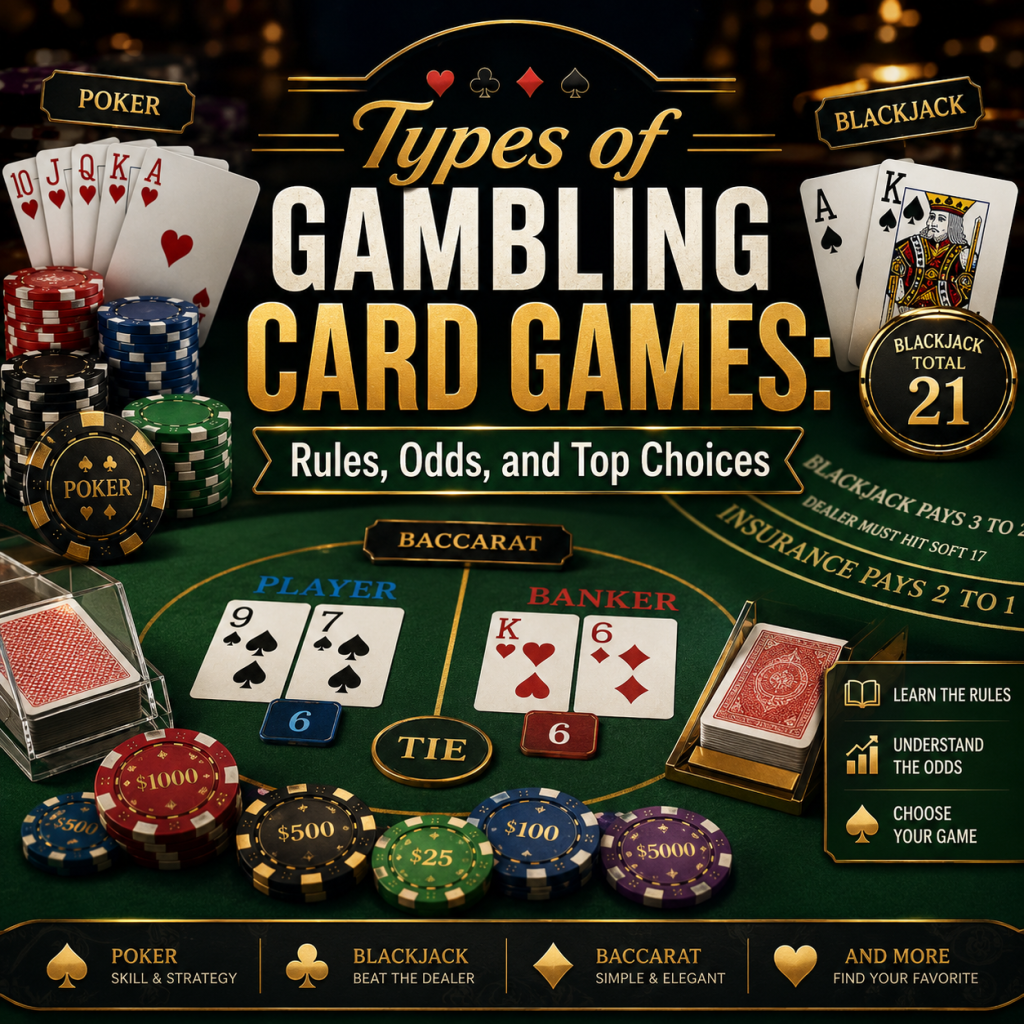
cardanoir.com – Card games have been connected with gambling for hundreds of years because they combine simple equipment with strategy, probability, psychology, and unpredictable outcomes. A standard deck can produce dozens of different games, ranging from slow and calculated poker sessions to fast casino rounds such as baccarat and blackjack.
Understanding the different types of gambling card games is important because every game offers a different playing experience. Some depend heavily on decision-making, while others are controlled mainly by chance. Certain games involve competing against a casino dealer, whereas others require players to compete against one another.
This difference has a direct effect on how the game is played. A player who enjoys strategy may feel comfortable at a poker or blackjack table. On the other hand, someone who prefers straightforward betting may be more interested in baccarat, three-card poker, or casino war.
This comprehensive guide explores the most popular gambling card games, their basic rules, their strategic depth, and the reasons they continue to attract players around the world.
What Are Gambling Card Games?
Gambling card games are games in which cards determine all or part of the final result, while players place something of value on a possible outcome. That value is normally money, casino chips, tournament entries, or agreed stakes between participants.
Most gambling card games fall into one of three categories:
- Player-versus-player games, such as poker.
- Player-versus-dealer games, such as blackjack.
- Outcome-based casino games, such as baccarat or red dog.
The structure matters because it determines where the house advantage comes from. In blackjack, for example, the casino gains an advantage because the player must act before the dealer. In poker, the casino usually does not compete directly with players. Instead, it collects a fee known as the rake or charges tournament entry fees.
Skill-Based and Chance-Based Card Games
Not every card game requires the same level of knowledge. Some games allow players to influence long-term results through strategic decisions, while others provide very limited control.
| Card Game | Main Opponent | Skill Level | Typical Pace | Main Objective |
|---|---|---|---|---|
| Texas Hold’em | Other players | High | Moderate | Build the strongest hand or force folds |
| Blackjack | Casino dealer | Medium to high | Fast | Reach 21 or beat the dealer |
| Baccarat | Predetermined hands | Low | Fast | Predict the winning hand |
| Three-Card Poker | Casino dealer | Medium | Fast | Form a stronger three-card hand |
| Casino War | Casino dealer | Low | Very fast | Draw a higher card |
| Caribbean Stud | Casino dealer | Medium | Moderate | Beat the dealer’s poker hand |
| Pai Gow Poker | Casino dealer | Medium | Slow | Win two separate hands |
| Red Dog | Casino dealer | Low | Fast | Predict whether a card falls between two cards |
This variation is one reason gambling card games remain popular. Players can select a format that matches their preferred level of complexity, speed, and involvement.
Poker: The Most Strategic Gambling Card Game
Poker is one of the best-known gambling card games in the world. Unlike many casino games, poker usually places players against one another rather than against the house.
The objective is to win the pot, which contains all bets made during a hand. A player can win by showing the strongest hand at the end or by convincing every opponent to fold before the final comparison.
Texas Hold’em
Texas Hold’em is currently the most recognizable poker variation. Each player receives two private cards, while five community cards are gradually placed in the middle of the table.
Players create their strongest five-card combination from the seven cards available to them.
A standard hand contains four betting stages:
- Pre-flop: Players receive two private cards.
- Flop: Three community cards are revealed.
- Turn: A fourth community card is added.
- River: The fifth and final community card is revealed.
Texas Hold’em rewards patience, position, hand selection, mathematical awareness, and the ability to read betting patterns. Because decisions continue across multiple betting rounds, a single mistake can cause a player to lose more chips than necessary.
Why Texas Hold’em Remains Popular
Texas Hold’em offers simple starting rules but considerable strategic depth. A beginner can understand the objective within a few minutes, yet mastering the game can take years.
It is also widely used in tournaments because increasing blinds create pressure and prevent players from waiting indefinitely for premium cards.
Omaha Poker
Omaha resembles Texas Hold’em, but each player receives four private cards instead of two. Players must use exactly two private cards and exactly three community cards to form a final hand.
Because more starting cards are available, strong combinations appear more frequently. Flushes, straights, and full houses are therefore more common than in Texas Hold’em.
The additional possibilities can cause players to overestimate weaker hands. For example, two pair may appear strong in Hold’em but may be vulnerable in an active Omaha pot.
Seven-Card Stud
Seven-Card Stud was one of the dominant poker games before Texas Hold’em became internationally popular. It does not use community cards.
Each player receives seven cards throughout the hand, but only the strongest five-card combination counts. Some cards are dealt face down, while others remain visible to opponents.
Because exposed cards provide useful information, memory plays a major role. Players who remember folded cards can estimate whether specific straights, flushes, or pairs are still possible.
Blackjack: A Balance Between Strategy and Probability
Blackjack is among the most popular casino card games because its rules are relatively simple and player decisions can influence the outcome.
The goal is to create a hand closer to 21 than the dealer’s hand without exceeding 21. Number cards keep their printed values, face cards count as 10, and an ace can count as either 1 or 11.
A player can usually choose to:
- Hit: Take another card.
- Stand: Keep the current total.
- Double down: Double the original wager and receive one additional card.
- Split: Separate two equal-value cards into two hands.
- Surrender: Give up the hand and recover part of the initial stake, where permitted.
How Blackjack Strategy Changes the Game
Blackjack differs from purely chance-based games because every decision affects the mathematical expectation of the hand. Hitting a hard 16 against a dealer’s 10 may feel risky, but standing can be even less favorable under standard rules.
Basic blackjack strategy uses the player’s total and the dealer’s visible card to identify the mathematically preferred action. As a result, disciplined decisions can reduce unnecessary losses caused by intuition or emotion.
The cause-and-effect relationship is clear: when players ignore basic strategy, the house advantage generally increases because more decisions are made against probability.
Common Blackjack Variations
Different casinos may offer variations such as:
- European Blackjack
- Atlantic City Blackjack
- Spanish 21
- Blackjack Switch
- Pontoon
- Double Exposure Blackjack
Rules involving dealer behavior, doubling, splitting, payouts, and deck numbers can change the mathematical balance. A natural blackjack paying 3:2, for instance, is normally more favorable than a table offering a 6:5 payout.
Baccarat: Simple Rules and Fast Results
Baccarat is often presented as a premium casino game, but its basic structure is easier to understand than poker or blackjack.
Two hands are dealt:
- The Player hand
- The Banker hand
Participants do not control how the cards are drawn. Instead, they predict whether the Player hand, Banker hand, or a Tie will win.
Cards from 2 to 9 keep their numerical values. Tens and face cards count as zero, while aces count as one. Only the final digit of the total matters. For example, a hand containing 7 and 8 totals 15, but its baccarat value is 5.
Why the Banker Bet Is Frequently Discussed
The Banker hand usually has a slightly stronger mathematical position because of the drawing rules. Casinos commonly charge a commission on winning Banker bets to compensate for this advantage.
This does not mean the Banker hand wins every round. It means that across a very large number of rounds, the betting option generally performs differently from the Player and Tie options.
The Tie bet may offer an attractive payout, but the lower frequency of tied results usually creates greater risk. Therefore, a high payout should not automatically be interpreted as a better betting opportunity.
Three-Card Poker: Fast Poker Against the Dealer
Three-card poker combines familiar poker hand rankings with the speed of a casino table game. Each participant receives three cards and competes against the dealer rather than against other players.
The game commonly includes an Ante wager and an optional Pair Plus wager.
After viewing the cards, the player can either:
- Fold and lose the Ante, or
- Make a Play wager to continue against the dealer
Because only three cards are used, the hand rankings differ slightly from traditional five-card poker. A straight usually ranks above a flush because there are fewer possible straights than flushes in a three-card format.
Pair Plus and Side Bets
The Pair Plus wager pays according to the value of the player’s cards, regardless of the dealer’s result. A pair, flush, straight, three of a kind, or straight flush can produce a payout.
Side bets add excitement because they create additional winning possibilities. However, they can also have different mathematical characteristics from the main game. This means players should understand the paytable rather than focusing only on the largest advertised prize.
Caribbean Stud Poker
Caribbean Stud Poker uses five-card poker hands but removes bluffing and player-versus-player competition. Every participant tries to beat the dealer.
Players place an Ante before receiving five cards. The dealer also receives five cards, with one card exposed. After inspecting the hand and the dealer’s visible card, the player chooses to fold or raise.
The dealer must normally qualify with a minimum hand. When the dealer does not qualify, the Ante may pay while the raise is returned.
This qualification rule creates an unusual situation: a strong player hand does not always produce the same payout because the dealer’s hand also affects the settlement.
Progressive Jackpot Feature
Many Caribbean Stud tables include an optional progressive jackpot. Players contribute a separate amount for a chance to win a large prize with rare hands such as a royal flush.
The growing jackpot can make the table more visually appealing. However, the jackpot wager is separate from the main Ante and raise structure, so it should be evaluated as an additional bet rather than part of the core game.
Pai Gow Poker: A Slower Game With Two Hands
Pai Gow Poker uses a standard 52-card deck plus a joker. Each player receives seven cards and must divide them into:
- A five-card high hand
- A two-card low hand
The five-card hand must rank higher than the two-card hand. Both hands are then compared with the dealer’s corresponding hands.
To win the round, the player normally needs to win both comparisons. Winning one and losing one produces a push in many versions.
Why Pai Gow Poker Appeals to Patient Players
Pai Gow Poker often produces more tied rounds than faster casino games. Because many rounds end in a push, a player’s bankroll may move more gradually.
This slower pace can be attractive to players who prefer longer sessions and fewer rapid decisions. The trade-off is that Pai Gow Poker may feel less exciting to those who want frequent and immediate results.
Casino War: One of the Simplest Card Games
Casino War is based on the familiar childhood card game. The player and dealer each receive one card, and the higher card wins.
When both cards have equal values, the player may be allowed to surrender or go to war by placing an additional wager.
The simplicity of Casino War makes it accessible to beginners. There are no complicated hand rankings, community cards, or strategic betting rounds.
However, simple rules do not mean the game lacks risk. Because decisions are limited, players have little ability to change the mathematical outcome of each round.
Red Dog: Betting on the Spread
Red Dog is a lesser-known casino card game in which two cards are dealt face up. The player bets on whether a third card will fall numerically between the first two.
For example, if the first cards are 4 and 10, the third card must be 5, 6, 7, 8, or 9 to win.
The number of ranks between the first two cards is known as the spread. A smaller spread normally results in a larger payout because fewer cards can produce a winning result.
When the initial cards are consecutive, the hand may push. When they form a pair, special rules may apply, such as drawing a third card and awarding a bonus for three of a kind.
Andar Bahar and Teen Patti
Some popular card games for gambling developed outside traditional Western casinos. Andar Bahar and Teen Patti are especially well known in South Asian gaming culture.
Andar Bahar
Andar Bahar is a straightforward game using a single deck. A central card is dealt, followed by alternating cards to the Andar and Bahar sides.
The game ends when a card matching the rank of the central card appears. Players predict which side will receive the matching card.
The game requires almost no complex decision-making, making it attractive to players who prefer rapid rounds and easy-to-follow results.
Teen Patti
Teen Patti is sometimes compared to three-card poker. Players receive three cards and bet against one another.
Hands may include:
- Trail or three of a kind
- Pure sequence
- Sequence
- Color or flush
- Pair
- High card
Betting behavior and confidence can be as important as the cards themselves. Since players may continue without revealing their cards, psychology and risk tolerance influence the outcome.
How to Choose Between Different Gambling Card Games
Selecting a card game should depend on the experience a player wants rather than simply choosing the game with the largest possible payout.
Consider these factors:
- Level of strategy: Poker and blackjack provide more meaningful decisions.
- Playing speed: Baccarat and Casino War usually move quickly.
- Competition format: Poker involves other players, while most casino games involve a dealer.
- Rule complexity: Andar Bahar and Casino War are easier to learn than Omaha or Pai Gow Poker.
- Bankroll movement: Faster games can produce more wagers within a shorter period.
- Social interaction: Poker tables generally create more conversation and player interaction.
- Payout structure: Main bets and side bets can have very different paytables.
A player who chooses a fast game without considering the pace may place more wagers than expected. As a result, the total amount at risk can increase even when each individual wager appears small.
Practical Review of the Most Popular Card Games
From a gameplay perspective, Texas Hold’em offers the deepest experience because every hand combines cards, position, stack size, betting history, and opponent behavior. It is ideal for players who enjoy long-term improvement, although the learning curve is considerably higher than most casino table games.
Blackjack provides the best balance between accessibility and decision-making. New players can understand the objective immediately, while experienced players can study basic strategy, table rules, and probability.
Baccarat is the most convenient choice for players who prefer to focus on selecting an outcome rather than making decisions after the cards are dealt. The experience is smooth and fast, although it offers less strategic control.
Three-card poker feels more dynamic than baccarat but remains easier than traditional poker. Its compact format makes it suitable for shorter sessions. Pai Gow Poker is almost the opposite: it is slower, more structured, and appealing to players who enjoy arranging hands carefully.
Casino War is easy to understand but may feel repetitive over a long session. Caribbean Stud offers familiar poker rankings, though the absence of bluffing means it does not provide the same psychological competition as Texas Hold’em.
Overall, the best gambling card game depends on whether a player values strategy, speed, simplicity, social interaction, or slower bankroll movement.
Important Terms Used in Gambling Card Games
House Edge
The house edge represents the casino’s mathematical advantage over time. It does not predict the result of an individual round.
Ante
An Ante is an initial wager required before cards are dealt. It is common in poker and poker-based casino games.
Rake
A rake is the fee collected by a poker room from cash-game pots or tournament entries.
Push
A push occurs when neither side wins. The original wager is normally returned.
Side Bet
A side bet is an optional wager placed in addition to the main game. It often offers larger payouts for less frequent outcomes.
Frequently Asked Questions
1. What are the most popular types of gambling card games?
The most popular types include Texas Hold’em, blackjack, baccarat, three-card poker, Caribbean Stud Poker, Pai Gow Poker, Omaha, and Casino War. Their popularity varies according to region, casino availability, and player preference.
2. Which gambling card game requires the most skill?
Poker generally requires the most overall skill because players must manage probabilities, betting sizes, position, psychology, and long-term strategy. Blackjack also involves meaningful strategic decisions, but players compete against fixed dealer rules rather than changing human opponents.
3. What is the easiest casino card game to learn?
Casino War and baccarat are among the easiest casino card games to understand. Casino War simply compares two cards, while baccarat requires players to predict whether the Player, Banker, or Tie hand will win.
4. Is blackjack more strategic than baccarat?
Yes. Blackjack allows players to hit, stand, split, double down, and sometimes surrender. Baccarat drawing rules are automatic, so players mainly decide where and how much to bet.
5. What is the difference between poker and casino poker games?
Traditional poker places players against one another and includes betting, folding, and bluffing. Casino poker games such as Caribbean Stud or three-card poker place each player against the dealer and use fixed table rules.
Conclusion
The many types of gambling card games offer experiences ranging from highly strategic poker tournaments to quick and simple baccarat or Casino War rounds. Texas Hold’em and Omaha reward patience and decision-making, blackjack combines probability with practical strategy, while baccarat, Andar Bahar, and Red Dog focus more heavily on predetermined card outcomes. Understanding the rules, pace, opponents, hand rankings, and payout structures helps players identify which format matches their preferences. Whether the priority is deep strategy, social competition, fast gameplay, or straightforward betting, gambling card games remain popular because one deck of cards can create an enormous variety of challenges and experiences.