cardanoir.com – The world of types of patience card games is much wider than many people realize. Most players know Klondike, the classic solitaire game often associated with computers, but patience is not just one game. It is a whole family of solo card games built around order, planning, memory, and a little bit of luck.
Patience card games are loved because they are quiet, personal, and surprisingly satisfying. You do not need a group of players, a large table, or complicated equipment. A single deck of cards is enough to create a thoughtful challenge that can last five minutes or an entire evening.
The appeal is simple: every move matters. Sometimes you feel completely in control, carefully building sequences and opening hidden cards. Other times, the deck refuses to cooperate, and you have to make the best decision with limited options. That balance between strategy and uncertainty is what keeps patience games interesting even after hundreds of plays.
What Are Patience Card Games?
Patience card games are solo card games where the player arranges cards according to specific rules. The goal often involves building cards into foundations by suit, removing pairs, clearing a tableau, or organizing cards into ordered sequences.
In many countries, the word patience is commonly used, while in the United States the word solitaire is more familiar. Both terms often refer to the same general category of single-player card games.
Patience vs Solitaire
The difference between patience and solitaire is mostly about language. Patience is the older British term, while solitaire is widely used in American English. In practice, both describe card games that can be played alone.
Why the Name “Patience” Fits So Well
The name fits perfectly because these games reward calm thinking. A player who rushes may block important cards too early. A patient player studies the layout, waits for the right moment, and uses each move carefully.
Cause: Patience games often hide key cards under other cards.
Effect: Players must think ahead instead of simply moving the first available card.
Quick Comparison of Popular Patience Card Games
| Game Type | Main Skill | Difficulty | Decks Needed | Best For |
|---|---|---|---|---|
| Klondike | Planning and sequencing | Medium | 1 | Classic solitaire players |
| Spider | Long sequence building | Medium-Hard | 2 | Strategic players |
| FreeCell | Logic and foresight | Medium | 1 | Players who dislike too much luck |
| Pyramid | Pair matching | Easy-Medium | 1 | Quick sessions |
| Golf | Fast card removal | Easy | 1 | Relaxed play |
| TriPeaks | Light strategy | Easy | 1 | Beginners |
| Yukon | Open tableau movement | Medium-Hard | 1 | Players who like freedom |
| Forty Thieves | Careful planning | Hard | 2 | Advanced patience fans |
Classic Building Patience Games
Classic building games are the most familiar type of patience card games. They usually involve arranging cards in descending or ascending order, alternating colors, and moving cards to foundation piles.
Klondike Solitaire
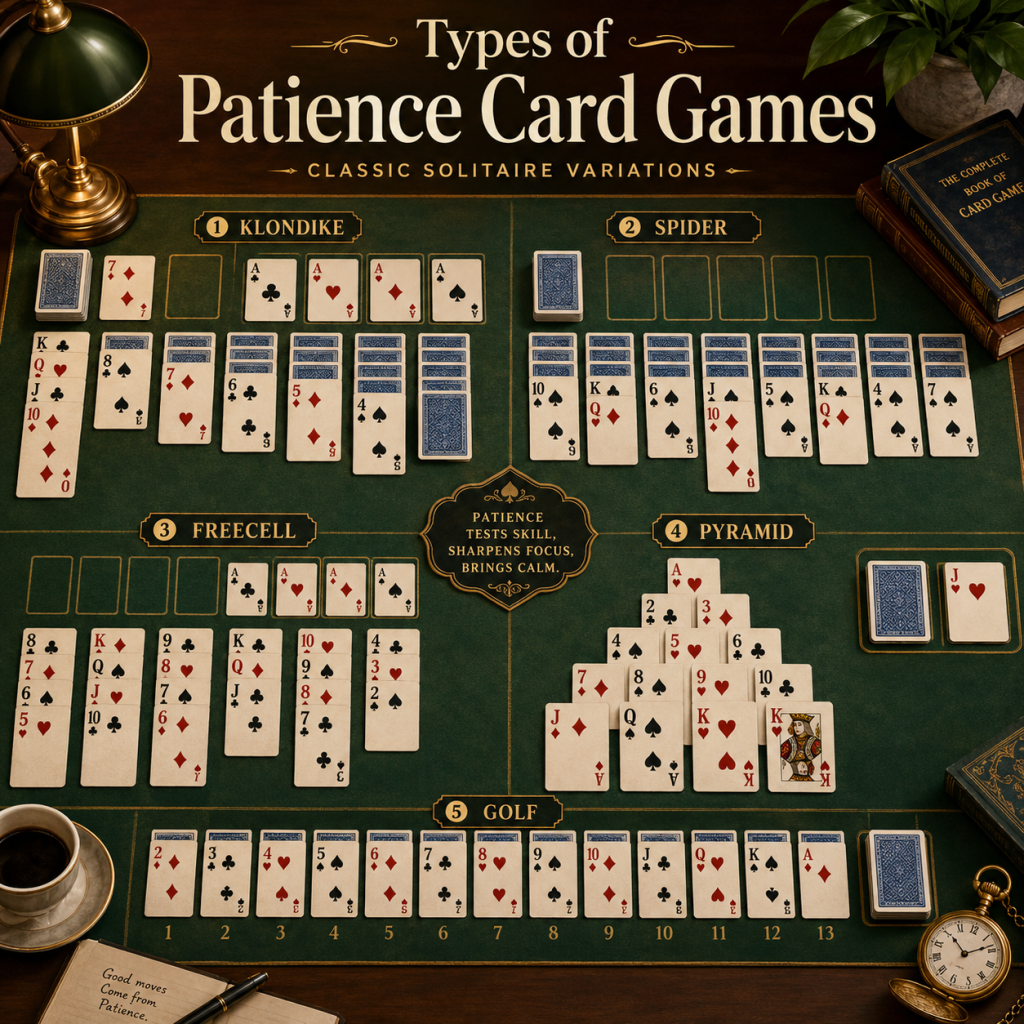
Klondike is the most famous patience card game in the world. It uses one standard deck of 52 cards. The cards are dealt into seven tableau columns, with only the top card of each column face up. The goal is to build four foundation piles from Ace to King by suit.
Klondike is popular because it feels balanced. It is not too simple, but it is not too difficult for beginners. The hidden cards create suspense, while the foundations give the player a clear goal.
Review: Klondike feels like the perfect starting point for anyone exploring patience games. It has enough luck to stay exciting and enough strategy to make every win feel earned.
Spider Solitaire
Spider is a deeper and more demanding patience game. It usually uses two decks, and the goal is to build complete sequences from King down to Ace. Once a full sequence is completed in the same suit, it is removed from the table.
Spider can be played with one suit, two suits, or four suits. One-suit Spider is easier, while four-suit Spider is much more challenging.
Why Spider Feels More Strategic
Spider requires long-term planning. A careless move can trap important cards under messy stacks. Players need to build clean sequences while keeping empty columns available.
Cause: Spider uses many cards and large tableau stacks.
Effect: The game becomes more strategic and less forgiving than simpler patience games.
FreeCell
FreeCell is one of the most logical types of patience card games. Unlike Klondike, most cards are visible from the beginning. The game uses four free cells where players can temporarily store cards.
Because almost all information is open, FreeCell depends more on skill than luck. Good players can analyze the board and plan several moves ahead.
Best for: Players who enjoy puzzles, logic, and careful planning.
Pairing and Removal Patience Games
Not every patience game is about building suits. Some games focus on removing cards from the table by matching values, adding numbers, or playing cards in sequence.
Pyramid
Pyramid is a popular patience game where cards are arranged in a pyramid shape. The goal is to remove pairs of cards that add up to 13. Kings are removed alone because they already count as 13.
Pyramid is easy to learn but still requires attention. You must decide which pairs to remove first because some cards block others.
Golf Solitaire
Golf is a fast and relaxing patience game. Cards are arranged in columns, and players remove cards by playing one rank higher or lower than the current card on the waste pile.
For example, if the waste card is 7, you can play a 6 or an 8. The goal is to clear as many cards as possible.
Review: Golf is great when you want a card game that feels light but still engaging. It does not demand deep calculation, yet it keeps the mind active.
TriPeaks
TriPeaks is similar to Golf but uses three small pyramid-shaped peaks. The player removes cards one rank higher or lower than the current card. It is quick, visual, and satisfying.
TriPeaks is especially good for beginners because it has simple rules and short rounds.
Open Tableau Patience Games
Open tableau games give the player more visible cards and more freedom of movement. These games often feel less random but more mentally demanding.
Yukon
Yukon looks similar to Klondike, but it allows more flexible movement. You can move groups of cards even if they are not perfectly ordered, as long as the starting card can legally move to the destination.
This freedom makes Yukon exciting. The player sees more possibilities, but also more chances to make a poor decision.
Russian Solitaire
Russian Solitaire is related to Yukon but usually requires building tableau piles by suit instead of alternating colors. This makes the game much harder.
Why Yukon and Russian Solitaire Feel Different
Cause: More cards are visible and more movement is allowed.
Effect: The player has more control, but mistakes can become more serious.
Scorpion
Scorpion is another open-style patience game. The goal is to build complete suit sequences from King to Ace. It feels somewhat like Spider, but the layout and movement rules are different.
Scorpion is not ideal for total beginners, but it is excellent for players who want a more intense single-deck challenge.
Difficult Patience Games for Advanced Players
Some patience games are known for being tough. These are best for players who enjoy slow thinking, careful planning, and repeated attempts.
Forty Thieves
Forty Thieves uses two decks and has a strict layout. Cards are dealt into ten tableau columns, and foundations must be built from Ace to King by suit. Tableau building is usually done by suit, one card at a time.
This game is challenging because movement is limited. Every decision matters, and empty columns are extremely valuable.
Canfield
Canfield is a classic patience game with a reserve pile that plays a major role. The goal is to build foundations, but the starting foundation rank is not always Ace. This gives the game a different rhythm from Klondike.
Baker’s Dozen
Baker’s Dozen uses 13 columns and one deck. All cards are visible, which makes the game feel more strategic. The goal is to build foundations by suit.
Review: Advanced patience games feel rewarding because they do not hand out easy wins. When you finally clear the layout, the victory feels genuinely satisfying.
Simple Patience Games for Beginners
Not every patience game needs to be difficult. Some are perfect for casual play, children, or short breaks.
Clock Patience
Clock Patience arranges cards in a clock shape. Players reveal cards and place them according to rank. The game is mostly luck-based, but it is easy and visually fun.
Accordion
Accordion is a compact patience game where cards are laid out in a row. Cards can be stacked if they match by rank or suit with nearby cards. The goal is to compress the entire row into as few piles as possible.
Aces Up
Aces Up is quick and simple. Cards are dealt into piles, and lower cards of the same suit can be removed. The goal is to leave only the four Aces.
Why Beginner Games Are Worth Playing
Cause: Simple patience games have short rules and quick rounds.
Effect: New players can enjoy the experience without feeling overwhelmed.
How to Choose the Right Patience Card Game
Choosing the right game depends on your mood. Some patience games are calm and casual, while others feel like serious puzzles.
| Mood or Situation | Best Game Choice |
| You want a classic experience | Klondike |
| You want a deep challenge | Spider |
| You prefer logic over luck | FreeCell |
| You want a quick game | Golf |
| You enjoy matching pairs | Pyramid |
| You want something visual | TriPeaks |
| You want advanced strategy | Forty Thieves |
| You want a simple luck-based game | Clock Patience |
Practical Tips for Enjoying Patience Games
- Start with easier games before trying advanced variants.
- Keep empty spaces available whenever possible.
- Avoid moving cards too quickly without checking future options.
- Learn one game deeply instead of switching too often.
- Replay difficult layouts to improve pattern recognition.
FAQ About Types of Patience Card Games
1. What are the most popular types of patience card games?
The most popular types include Klondike, Spider, FreeCell, Pyramid, Golf, TriPeaks, Yukon, and Forty Thieves.
2. Are patience and solitaire the same thing?
Yes, in most cases. Patience is commonly used in British English, while solitaire is more common in American English. Both refer to single-player card games.
3. What is the easiest patience card game for beginners?
Golf, Clock Patience, Aces Up, and TriPeaks are among the easiest patience games for beginners because the rules are simple and rounds are short.
4. Which patience card game requires the most skill?
FreeCell, Spider, Forty Thieves, and Yukon require more skill because they involve planning, card management, and careful sequencing.
5. Can patience card games be played with a normal deck?
Yes. Many patience card games can be played with a standard 52-card deck. Some games, such as Spider and Forty Thieves, usually require two decks.
Conclusion
Types of patience card games offer far more variety than the single word “solitaire” might suggest. Klondike gives the classic experience, Spider brings deeper strategy, FreeCell rewards logic, Pyramid and Golf offer quick removal-based fun, while Yukon, Scorpion, Canfield, and Forty Thieves challenge players who want something more demanding. The beauty of patience card games is that they fit almost any mood: quiet, focused, casual, strategic, or relaxing. With just one deck of cards, a player can explore a whole world of thoughtful challenges that remain enjoyable year after year.