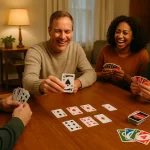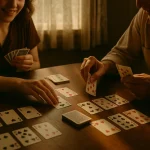
Oh Hell! is a trick-taking game with one simple demand: don’t just win tricks—win exactly the number you promised. It first appeared in London and New York in the 1930s, then spread worldwide under a small forest of alternate names.
I don’t know who “invented” Oh Hell—no single creator is consistently credited in reputable rules histories. What we do have is a clear paper trail of its early popularity and its evolution into a family of regional variants.
What Makes Oh Hell Different
Most trick-takers reward you for taking as many tricks as possible. Oh Hell rewards you for accuracy. Overtrick? Still a miss. Undertrick? Also a miss.
And then there’s the famous constraint often called the hook: the dealer is typically not allowed to bid a number that would make the total bids equal the total tricks available. This guarantees at least one player will fail each hand—because the table can’t collectively “solve” the hand perfectly.
Names You’ll Hear Around the World
The original title offended some audiences, so printed sources and households “cleaned it up” (or made it worse, depending on the family). A strong rules history notes common alternatives like Oh Pshaw!, Oh Well!, and also more colorful versions, plus labels tied to scorekeeping habits like Blob and Blackout.
The deal pattern—hands going up and down in size—also created names such as Elevator and Up and Down the River (plus local names in several countries).
What You Need to Play
- Players: commonly 3–7 (many communities say it shines with 4–6).
- Deck: one standard 52-card deck.
- Card rank: typically A high, down to 2.
The Core Loop: Deal, Bid, Take Tricks, Score
Deal and Trump
A classic structure: deal each player the same number of cards for that hand, then turn the next undealt card face up to set the trump suit.
Bidding
Bidding begins left of the dealer and goes around to the dealer last. You must bid something—including 0 (meaning you’re aiming to take no tricks).
With the hook on, the dealer can’t make the total bids match the number of tricks available.
Trick Play
Play is standard trick-taking:
- Left of dealer leads.
- Players must follow suit if possible.
- If not, they may throw off or play trump.
- Highest trump wins; otherwise highest of the led suit wins, and leads next.
The “Elevator” Rhythm: Why Hand Size Changes
Traditional Oh Hell often uses a changing hand size—either increasing, decreasing, or “down then up.”
A popular full arc is 10 down to 1, then back up to 10 (adjusted for player count).
That shifting hand size is more than flavor: it changes the entire math of prediction. Big hands reward long-term planning; tiny hands punish overconfidence and make 0-bids terrifyingly attractive.
Scoring Systems: The Big Fork in the Road
Oh Hell has multiple scoring traditions. Two common ones show up repeatedly in modern explanations:
Method A: “10 + bid if you hit, otherwise 0”
A widely cited “simplest version” awards 10 + the number of tricks you bid if you hit exactly; otherwise you score nothing for that hand.
Method B: “Points for tricks + bonus for accuracy”
Another popular approach gives you 1 point per trick, plus a 10-point bonus if you hit your bid exactly.
There are also formats that penalize misses (especially online implementations), subtracting points for being over or under—Board Game Arena notes that points can be “deducted for missing the bid,” depending on the chosen method.
If you’re writing rules for Cardanoir, pick one scoring system and state it clearly. Oh Hell’s strategy changes a lot depending on whether misses are merely “no bonus” or actual negative pain.
How to Play Oh Hell: A Clean Teaching Script
If you need a simple, table-ready explanation:
- Pick a hand-size pattern (classic: down then up).
- Deal that many cards to each player; flip one card to set trump.
- Everyone bids how many tricks they will take (0 allowed).
- If playing with the hook, dealer’s bid can’t make total bids equal total tricks.
- Play tricks like Whist until hands are empty.
- Score based on your chosen scoring method.
- Move dealer, change hand size, repeat.
Strategy: How to Win Without Needing Perfect Cards
Oh Hell isn’t about “strong hands.” It’s about predictable outcomes.
1) Bid what your hand can’t avoid
In many trick-takers, you can choose to push. In Oh Hell, your enemy is accidental tricks. If you have a hand full of medium winners in trump, bidding low can be suicidal—you’ll stumble into tricks you didn’t want.
2) Treat 0 as a weapon, not a coward’s exit
A 0 bid is explicitly supported in standard rules.
But it’s rarely “easy.” You’re aiming for no tricks while opponents may dump winners into your lap. The best 0 bids usually have:
- lots of low cards in many suits
- little trump control
- and good void potential (being able to discard safely)
3) The hook turns bidding into social math
Because the dealer can’t “complete the equation,” the last bid is forced to be wrong in aggregate.
Good players exploit this by:
- tracking what earlier bidders likely hold
- noticing when the table is trending overbid or underbid
- choosing a bid that makes their own outcome most stable, even if it forces chaos elsewhere
4) Small hands are knife fights
In 1-card and 2-card rounds, you’re basically betting on position, trump visibility, and whether your one card is a trap or a gift. Deal patterns that hit very small hands are where long matches swing hard.
5) Play to protect your bid, not your ego
If you bid 2 and you’re sitting on 2 tricks early, your best move is often to start losing intentionally—ducking leads, shedding winners, and avoiding “helpful” trumping. Oh Hell rewards self-control like a monk with a scorepad.
Variations Worth Knowing
Oh Hell is less one game than a genre label.
- Hand-size patterns: online platforms list multiple common arcs (down-up, up-down, only down, only up).
- Names by region: Contract Whist, Nomination Whist, German Bridge, Boerenbridge, Elevator, Up and Down the River, and more.
- Scoring: from “bonus-only” to “bonus + tricks” to penalty-based systems.
- No-hook tables: some groups remove the hook entirely for a gentler, more solvable game.
Modern & Digital Life
Oh Hell thrives online because it’s easy to host and endlessly replayable:
- You can play it in-browser on sites that document common rules and deal sequences. cardgames.io/ohhell
- Board Game Arena supports it with configurable rules and emphasizes the hook-driven guarantee that someone fails each hand.
It also inspired commercial descendants. For example, the trick-taking game Wizard is often described as closely resembling Oh Hell in its “bid exactly” structure.
Five Surprisingly Fun Facts About Oh Hell
- It’s traced to London and New York in the 1930s—a rare case of a folk card game with a fairly specific early geography.
- The name splintered because “Oh Hell!” was considered impolite, spawning Oh Pshaw and Oh Well, among others.
- “Blackout/Blob” may reference a scorekeeping habit: bids written down, then blacked out when missed.
- The hook rule is deliberately designed so the table can’t collectively be correct.
- Changing hand sizes is so central it created whole alternate names like Elevator and Up and Down the River.
Why Oh Hell Still Feels Modern
Oh Hell survives because it captures a very human skill: making promises under uncertainty—and then living with them.
You learn to read risk. You learn to accept that sometimes the “best” play is to lose a trick on purpose. You learn that confidence without accuracy is just noise. And in a quiet way, Oh Hell turns a standard deck into a small training ground for judgment: not the loud, cinematic kind—but the everyday kind that decides whether you overreach, or land cleanly on what you truly meant to do.
That’s the magic of Oh Hell: it doesn’t ask you to be lucky. It asks you to be honest—and clever enough to make honesty win.