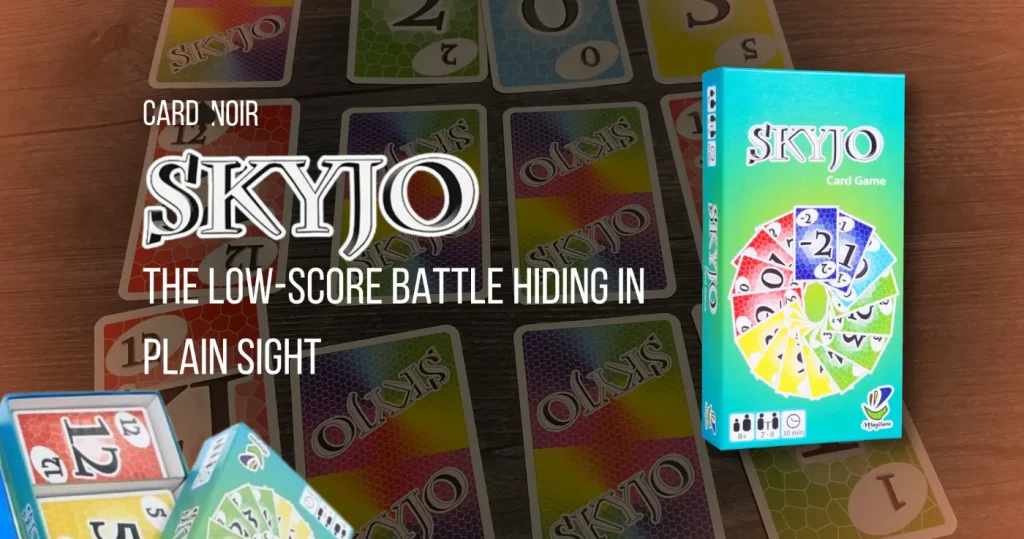
There’s a special kind of tension that only a tableau of face-down cards can create. You’re staring at a neat grid of twelve—quiet, innocent rectangles—while your brain fills the silence with worst-case scenarios. Somewhere in that grid is a 12, and you can almost feel it smirking.
That’s the hook of the Skyjo card game: a modern, family-friendly game where the most satisfying moment isn’t building something bigger—it’s shaving points off your own little mess, one swap at a time. Skyjo is fast to teach, surprisingly tactical, and just mean enough (in the best way) to keep everyone leaning in.
Below is the Cardanoir-style deep dive: where Skyjo came from, how it works, why the “triplet rule” changes everything, and how the game evolved into versions like Skyjo Action and Skyjo Junior.
Where Skyjo Came From
Skyjo is a contemporary card game published by Magilano and designed by Alexander Bernhardt, first released in 2015.
Mechanically, it sits in the “low score wins” family of games often compared to traditional Golf-style card games—those classic formats where you’re constantly trying to replace high cards with low ones and manage hidden information. BoardGameGeek even places Skyjo in that neighborhood through its classification and community framing.
But Skyjo’s identity isn’t just “Golf with better packaging.” It has two signature ideas that make it feel like its own thing:
- a 3×4 personal grid that slowly reveals itself
- the vertical triplet discard rule, which can erase points off your board in one clean, dramatic snap
What’s in the Box
Most editions of the classic Skyjo set include:
- 150 game cards
- a score pad/notepad
- instructions
The cards range from −2 up to 12, which is a big reason Skyjo stays spicy: negative numbers exist, but they’re rare enough that you can’t build your whole plan around them.
A commonly referenced distribution is:
- 5 cards of −2
- 15 cards of 0
- 10 cards each of −1 and 1 through 12
That spread matters. A lot. Because Skyjo is ultimately a game about probability wearing a party hat.
The Core Objective
Skyjo is played over multiple rounds. The game ends as soon as a player reaches 100 points or more, and the overall winner is the player with the lowest total score.
That’s the whole philosophy: you’re not trying to “win a round” in the heroic sense. You’re trying to lose better than everyone else—with a smile.
Setup: Building the Grid
Each player receives 12 cards face down from the shuffled deck and arranges them into a grid of 4 rows with 3 cards per row (a 3×4 layout). One card is placed face up to start the discard pile; the rest become the face-down draw pile.
At the start of a round, each player reveals two cards in their grid (your choice).
Who Goes First?
This is a small rule with big consequences: the first player is the one whose two revealed cards have the highest combined value.
Skyjo basically begins by rewarding bad luck. It’s funny. It’s also fair: the player who starts with a rougher opening gets first crack at fixing it.
How a Turn Works
On your turn, you draw one card in one of two ways:
- Take the top face-up card from the discard pile
If you do this, you must exchange it with one card in your grid—either a face-up card or a face-down card. If you replace a face-down card, you don’t get to peek first. The replaced card becomes the new top of the discard pile. - Draw the top face-down card from the draw pile
You may look at it and then choose:
- Exchange it with any one card in your grid (same rule: no peeking at face-down cards before choosing), or
- Discard it immediately—and if you discard it, you must flip one face-down card in your grid face up.
Then your turn ends. Skyjo stays quick because turns are short, but every turn forces a choice: certainty vs mystery.
Ending a Round
A round ends when a player has revealed all cards in their grid.
Then, importantly: each other player gets one final turn. After that, everyone reveals remaining face-down cards and adds up their grid for round scoring.
This last-turn rule is subtle but crucial. It’s the reason “ending the round” is not always automatically good.
Scoring: The Rule That Punishes Premature Victory
At the end of the round, you total the values of your 12 cards and add them to your running score.
But the player who ends the round (the one who revealed all cards) has a risk:
- If they do not have the lowest score for the round, their points for that round double (with a key caveat: this doubling applies only to positive points, not zero or negative).
That rule is Skyjo’s built-in anti-rush system. It tells you: don’t sprint to the finish unless you’re sure you’re actually ahead.
The Signature Twist: The Vertical Triplet Rule
Skyjo has one rule that players remember even after they forget everything else:
If you uncover or create three cards of the same value in a vertical column, you discard that entire column (all three cards) and those cards are no longer scored.
A few details make this more than a gimmick:
- It triggers when the column is formed by placing a card via exchange.
- It still applies during the final reveal/scoring moment.
- The triplet is removed even if it would have been “good” to keep—yes, even if those are negative or low cards; it’s not always an automatic blessing.
This is where Skyjo becomes psychological. You start seeing columns not just as “three slots,” but as possible escape hatches. Sometimes you’ll keep a mediocre number face up because it might complete a triplet later. Sometimes you’ll sacrifice a nice card because a column clear is worth more than the math suggests.
The Real Game: Information Management
Under the cute simplicity, Skyjo is basically three mini-games at once:
1) Timing your reveals
Flipping a face-down card happens most often when you draw from the deck and choose to discard the drawn card.
So every time you discard, you’re paying a price: you gain information, but you also expose yourself.
2) Controlling the discard pile
The discard pile is shared information. Every card on top is a public offer. Taking it is safe—but you’re also telling the table what you’re hunting. If the discard is a −1 and you don’t take it, you’re basically announcing confidence… or bluffing.
3) Building “soft columns”
Because columns clear vertically, smart players start thinking in sets of three. Your grid isn’t just 12 independent cards—it’s four columns that can potentially vanish.
Strategy: How to Win More Often
Skyjo has luck, sure—but the same people tend to do well over and over. That’s a tell.
Start with damage control
Early game, your biggest gains come from replacing obvious high cards (10–12). Since the first player starts because they revealed a high sum, going first can be a gift: you get first access to a fresh discard pile and early swaps.
Use the draw pile option as a “free scout”
Drawing from the face-down pile gives you a decision point. If the card is bad, discarding it lets you flip one of your hidden cards—meaning you still got something: information.
That flexibility is why many players prefer drawing blind in the early game.
Don’t rush the end unless you’re sure
Because ending the round can backfire via the doubling rule, “finishing first” is only good if your grid is truly low.
Sometimes the correct move is to not flip your final face-down card yet—especially if the table still has time to improve.
Treat 0 as the real currency
With 15 copies in the deck, 0 is common compared to most values.
That makes 0 a strategic anchor: it’s not flashy, but building around zeros makes your grid stable—and stability wins long games.
Column clears are worth planning for—but not worshipping
Clearing a column deletes three cards from scoring, which can swing a round hard.
But chasing a triplet too aggressively can trap you into keeping suboptimal numbers face up “for later.” Skyjo punishes wishful thinking.
Variations and Modern Editions
Skyjo didn’t stay frozen. Magilano expanded the system into a small family of related games.
Skyjo Action
Released in 2019, Skyjo Action adds additional card types—most notably action cards and star cards—which increase tactical options and player interaction.
Magilano describes action cards as enabling moves like looking at face-down cards in a row/column, swapping within your display, swapping with other players, and more—pushing the game toward higher chaos and sharper reads.
Skyjo Junior
Released in 2023, Skyjo Junior is a kid-friendly adaptation designed for younger players, centered around simpler collection and set-building concepts.
Skyjo Voyage
A compact “take-it-anywhere” version. BoardGameGeek lists Skyjo Voyage as released in 2025. (1)
Each edition keeps the recognizable Skyjo feel—swap, reveal, manage your grid—but adjusts the complexity and vibe depending on audience and setting.
Cultural Footprint: Why Skyjo Travels So Well
Skyjo’s popularity makes sense once you watch it land at a table:
- It teaches fast because the turn structure is simple
- It stays interesting because decisions compound—what you reveal now changes your options later.
- It fits mixed groups: kids, adults, casual players, and quietly-competitive people who “don’t care who wins” (they care the most).
It also has that rare quality: it’s a game that feels social without forcing social performance. You don’t need to roleplay. You don’t need to talk. But you’ll still end up reacting to each other—especially when someone clears a column or flips a painful 12 at the worst possible moment.
Five Surprisingly Interesting Facts About Skyjo
- The starting player is determined by “worst luck”—highest sum of the two revealed cards starts first.
- The deck includes negative values, down to −2.
- Zeros are unusually common (15 copies), shaping how often “safe” boards appear.
- Finishing a round can punish you—if you end the round but don’t have the lowest round score, your round points can double (positive points only).
- The famous triplet discard is vertical-only (columns), and it triggers even in late-round scoring moments if the condition is met. (2)
Skyjo as a Small Lesson in Letting Go
The Skyjo card game looks like tidy arithmetic. In practice, it’s a little mirror.
You’re constantly negotiating with imperfect information. You make peace with risk. You learn that “finishing first” isn’t always winning. You learn that the cleanest move is sometimes to discard a tempting card—because clarity is worth more than a short-term gain.
And maybe that’s why Skyjo works so well across cultures and ages: it turns a simple grid of numbers into a story about judgment. About patience. About knowing when to chase the perfect column and when to accept the decent board you’ve earned.
In Skyjo, you don’t win by grabbing the biggest prize. You win by choosing what not to carry.