cardanoir.com – Card games have accompanied human civilization for centuries. Originating as simple ink drawings on thick paper during the Tang Dynasty, they have evolved into a massive global industry that captivates millions. Why does this medium remain so timeless? The answer is simple: flexibility and strategic depth. When we talk about types of card games, we aren’t discussing a single, monotonous pastime, but rather a vast universe of tabletop entertainment.
The core appeal of card gaming lies in how a simple, unassuming deck can be transformed by hundreds of different rulesets. Whether it is a quick casual gathering among friends or a high-stakes competitive environment, pulling out a deck of cards has an unmatched ability to break the ice, spark conversation, and intensely challenge the human intellect.
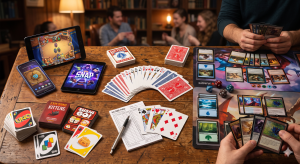
Why Card Games Remain Ageless: A Cause and Effect Analysis
There is a profound psychological reason why humans are drawn to card games. The root cause is the perfect equilibrium between the element of luck and pure tactical skill. Unlike chess, which relies entirely on perfect information and flawless strategy without any random variables, card games introduce uncertainty through the simple act of shuffling a deck.
As a direct effect of this balance, a highly addictive form of psychological tension is born. A player dealt a mediocre hand can still seize victory if they excel at bluffing or accurately reading their opponents’ tells. Conversely, a player holding an excellent hand can suffer a total defeat due to a single strategic blunder. This cause-and-effect dynamic ensures that types of card games possess incredibly high replayability. You can play the exact same game hundreds of times, yet no two matches will ever unfold identical storylines.
Major Categories in the Universe of Card Games
To fully understand this landscape, we need to categorize these games into distinct branches. Each category features its own unique mechanics, target audience, and level of complexity.
Traditional Trick-Taking Games
This is one of the oldest forms of card gaming, typically played using a standard 52-card deck. The primary objective revolves around winning individual rounds, known as “tricks,” by playing the highest-valued card. Globally renowned examples include Bridge, Hearts, and Spades. These games rely heavily on memory, partnership communication, and counting the remaining cards in play.
Modern Trading Card Games (TCGs)
Leaping into the modern era, we encounter Trading Card Games (TCGs), also known as Collectible Card Games (CCGs). Unlike traditional formats, players here do not share a single deck. Instead, each participant builds their own customized deck from thousands of unique cards available in the market.
Key aspects that make TCGs highly popular include:
-
Infinite Customization: Players tailor their decks to match specific playstyles, whether offensive, defensive, or control-oriented.
-
Collectible Value: Cards with high rarity tiers or alternate art often double as valuable economic assets.
-
Global Community: Organized competitive circuits offer massive tournament structures and substantial cash prizes.
Breaking Down Popular Card Game Variations
| Game Category | Prominent Examples | Primary Equipment | Complexity Level |
| Trick-Taking | Bridge, Hearts, Spades | Standard 52-Card Deck | Medium to High |
| Shedding Games | UNO, Crazy Eights | Specialized Deck / Standard | Low (Family Friendly) |
| Trading Card (TCG) | Magic: The Gathering, Yu-Gi-Oh! | Customized Player Decks | High (Deep Strategy) |
| Party Games | Exploding Kittens, Werewolf | Dedicated Thematic Deck | Low (Casual Socializing) |
Real Review: Experiencing Magic: The Gathering (MTG)
As an avid tabletop enthusiast who has explored countless types of card games, I want to share an honest, firsthand review of an absolute titan in the industry: Magic: The Gathering (MTG).
“Stepping into MTG for the first time feels exactly like learning a complex new language. However, the moment you grasp the resource mechanics of the mana pool and understand how combat phases stack, the game transforms into a deeply satisfying psychological chess match.”
Visually, the dark fantasy illustrations on each card are standalone masterpieces. From a gameplay perspective, the strategic variance is practically limitless. The main drawback is the financial entry barrier required to stay competitive in physical formats. Fortunately, digital platforms like MTG Arena offer an excellent, budget-friendly gateway for beginners wanting to experience the game’s intense tactical depth.
Universal Strategies to Master Card Gaming
While rulesets change across different types of card games, certain fundamental principles remain universally true. To consistently increase your win rate, focus on mastering these core pillars:
-
Card Advantage: Always aim to maintain more card options in your hand or on your field than your opponent. More cards directly equate to more strategic branches.
-
Probability Tracking: You do not need to be a mathematical genius, but you must keep track of what resources have been played and what likely remains hidden in the deck.
-
Emotional Control (The Poker Face): Never let your expressions betray a weak hand. A calm, unwavering demeanor is the foundation of any successful bluff.
The Digital Future of Card Gaming
The rise of digital technology has not killed physical card games; instead, it has created a brilliant ecosystem of mutual growth. The emergence of Digital Card Games (DCGs) like Hearthstone and Marvel Snap has opened the floodgates for a massive new demographic who previously avoided the hobby due to physical cleanup or setup clutter.
As a result of this digitalization, global accessibility has skyrocketed. Players can now match with opponents across the globe within seconds. Interestingly, this digital popularity frequently acts as a funnel, inspiring digital players to visit local hobby shops to purchase physical versions, keeping the tabletop community vibrant and thriving.
Ultimately, exploring various types of card games demonstrates that a simple stack of cards can hold boundless human creativity. Whether you enjoy the straightforward, chaotic fun of UNO during family nights, the complex deck-building theory of Yu-Gi-Oh!, or the psychological intensity of traditional poker, there is a seat at the table for every type of player. Card games are far more than just winning or losing; they are about genuine social interaction, mental sharpness, and the unforgettable moments created over the table.
FAQ (Frequently Asked Questions)
1. What is the main difference between TCGs and traditional card games?
Traditional card games use a static, shared deck (like a standard deck of cards) where everyone plays with the same pool. TCGs require players to collect, trade, and build their own individualized decks from randomized booster packs.
2. Are card games beneficial for cognitive development?
Absolutely. Most variations actively train rapid mental math, probability calculation, risk management, pattern recognition, and the ability to decode an opponent’s behavioral tells.
3. What is the best way for a beginner to get into TCGs?
The most optimal route is starting with digital clients (such as MTG Arena or Yu-Gi-Oh! Master Duel). Digital versions feature automated rule enforcement and tutorials that prevent illegal plays while learning.
4. Why do certain individual cards cost so much money?
Card values are dictated entirely by secondary market supply and demand: specifically, the rarity of the print run combined with how essential that card is to winning in the current competitive meta.
5. Which card games are best suited for casual family gatherings?
Shedding and party games like UNO, Exploding Kittens, or Sushi Go! are highly recommended. Their rules can be fully explained and understood in under five minutes.