Among the many card games that helped shape everyday American family life, few carry a legacy as distinctive as Rook. First published in 1906, the game didn’t emerge from smoky parlors or gambling halls but from a company that would later become one of the most influential names in modern tabletop culture—Parker Brothers, now part of Hasbro. At a glance, Rook may look like a cousin to Spades or Hearts, yet its identity rests on a single, defining choice: the use of a specially designed deck that sidestepped the imagery and associations of traditional playing cards.This choice was more than marketing. It reflected the values of entire communities.
In the early 20th century, many Christian households refused to use standard cards because face cards — Kings, Queens, and Jacks — were seen as symbols of vice or gambling culture. Parker Brothers recognized this cultural divide and created a deck that made card play acceptable in communities that had long rejected it.
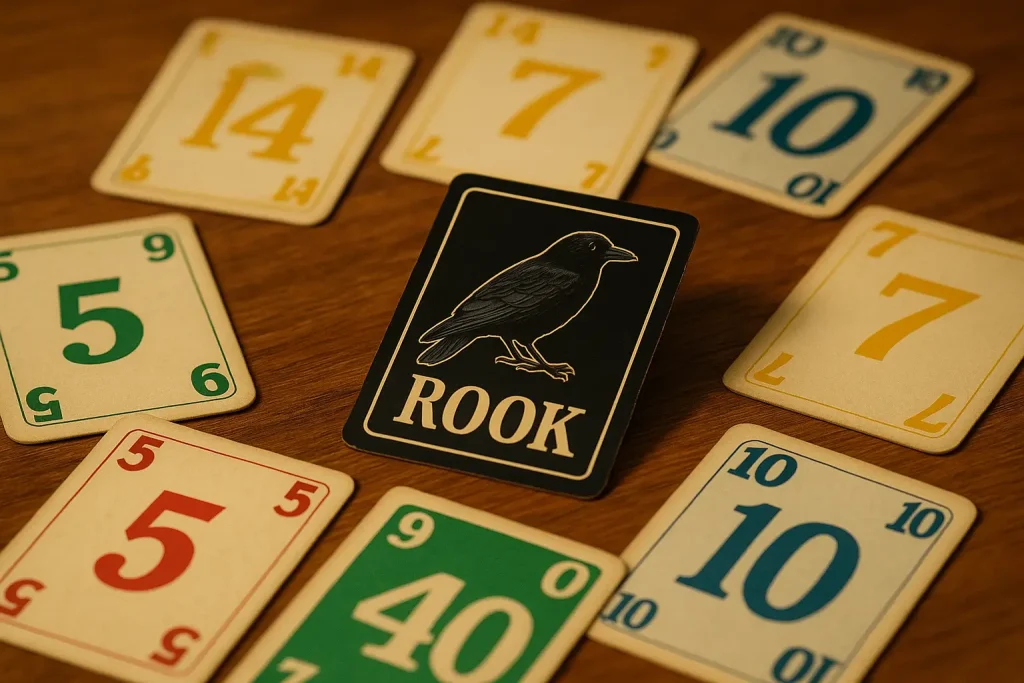
The result was the Rook deck:
• numbers 1 through 14
• four suits represented by colors
• and a single special card, the black Rook bird, the powerful trump that defines the game.
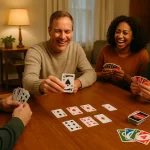
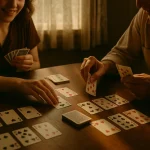
Over time, Rook grew far beyond its origins as a “safe alternative.” It became a folkloric game across the American South and Midwest — a game of churches, family gatherings, long kitchen tables, and late-night laughter. Rook lived not through casinos or tournaments, but through homes, community halls, and tradition.
Understanding Rook means understanding not only its rules, but also its cultural beats: its simplicity, its warmth, and its ability to bring people together.
- Parker Brothers and a Card Game Without Face Cards
- A Trick-Taking Structure Built for Clarity and Tension
- How Classic Rook Is Played
- The Rook Card: A Trick-Taking Legend
- Rook in American Culture: A Game of Kitchen Tables and Church Halls
- How Rook Relates to Familiar Games
- Why Rook Feels Different From Other Trick-Taking Games
- The Secret Soul of Rook
- The Art of Bidding: Where Instinct Meets Calculation
- The Nest: A Moment of Discovery and Drama
- Rook’s Regional Identity: The Game of the American South
- Why Rook Endured for More Than 100 Years
- The Warm, Human Rhythm of a Rook Game
- What Rook Teaches Us About Play
Parker Brothers and a Card Game Without Face Cards
Rook’s creation is unusual in the world of card games. Instead of evolving from centuries-old European traditions, it was designed — intentionally, thoughtfully, and with a specific purpose.
In the early 1900s, Parker Brothers already understood the power of games as a household staple. But they also saw an untapped market: religious families who refused to allow standard playing cards in their homes. These families sought innocent entertainment, free from vice, and Parker Brothers delivered exactly that.
The Rook deck replaced hearts, diamonds, spades, and clubs with Red, Yellow, Black, and Green.
No royalty.
No medieval imagery.
Just numerals and colors.
The Rook bird card — a striking black illustration — was introduced both as branding and as a gameplay twist. It acted as a wild card or a master trump depending on the rule set. Its presence gave the game a personality, an icon that children and adults alike could immediately recognize.
By removing the face cards, Parker Brothers created a game that felt wholesome, accessible, and appropriate for all ages. But Rook’s appeal extended much further. The gameplay turned out to be excellent — strategic yet intuitive — and the game spread quickly beyond its target demographic.
A Trick-Taking Structure Built for Clarity and Tension
At its heart, Rook is a trick-taking game, part of the same family as Spades, Euchre, and Whist. But the custom deck changes its rhythm and flow in subtle ways.
Here’s the foundation:
Players
Most classic games use four players in two partnerships, seated opposite one another.
Partnership play adds camaraderie, tension, and shared strategy.
The Deck
- Four colors: Red, Yellow, Black, Green
- Numbers 1–14 in each color
- The Rook card (the highest trump)
Some regional variations remove the 2s, 3s, or 4s, creating the well-known “No. 1 Rook deck,” but the classic configuration uses all numbers.
Objective
The goal is not to win the most tricks — it’s to win the tricks containing point cards, which are:
- 5s
- 10s
- 14s
- the Rook
Players must balance bold bidding with careful play, choosing when to assert control and when to sacrifice. This structure rewards players who can read the table, track which high cards have been played, and anticipate their opponents’ strategies.
How Classic Rook Is Played
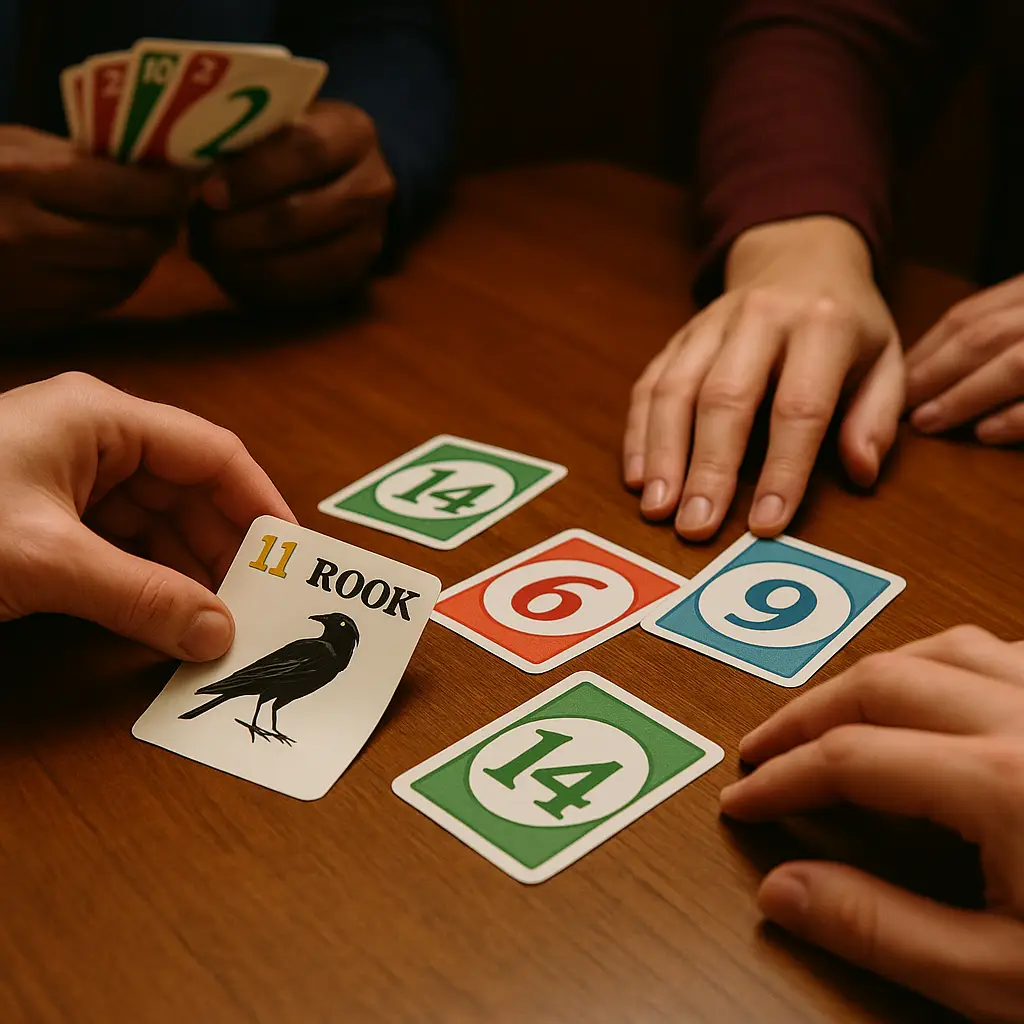
Because many people encountering Rook for the first time wonder if it’s similar to Spades or Rummy, the gameplay deserves a clear, human explanation.
1. Bidding
Each player evaluates their hand and bids the number of points they believe their team can win.
Bidding injects psychology into the game: confidence, risk, bravado, restraint.
The highest bidder names the trump color.
2. The Nest or Kitty
Several cards are set aside as a small pile, often called the “nest.”
The highest bidder gets to claim this hidden set of cards, folding it into their hand — but they must then discard an equal number of cards.
This creates a thrilling blend of luck and strategy.
3. The Play
Players take turns laying one card in a trick.
Highest card of the lead color wins — unless a trump color is played.
And above all trumps stands the Rook card, the pinnacle of power.
4. Scoring
Only certain cards give points, meaning a hand full of high numbers may win tricks but still lose the game.
This nuance separates skilled Rook players from beginners.
Rook is easy enough for children to learn and deep enough for adults to master — a rare balance in card game design.
The Rook Card: A Trick-Taking Legend
In most trick-taking games, the highest-power trump is simply the top number or suit. Rook does something more imaginative.
It gives the game a character.
The Rook bird can soar above every other card, turning the tide of a hand instantly.
Some regions call it the “Big Bird,” others simply “the Rook.”
The psychological weight of holding this card is unmistakable:
- Should you use it to secure a crucial point trick?
- Should you save it for a late-game reversal?
- Should you force out your opponents’ trumps early?
Even among experienced players, the Rook card brings drama and suspense.
Rook in American Culture: A Game of Kitchen Tables and Church Halls
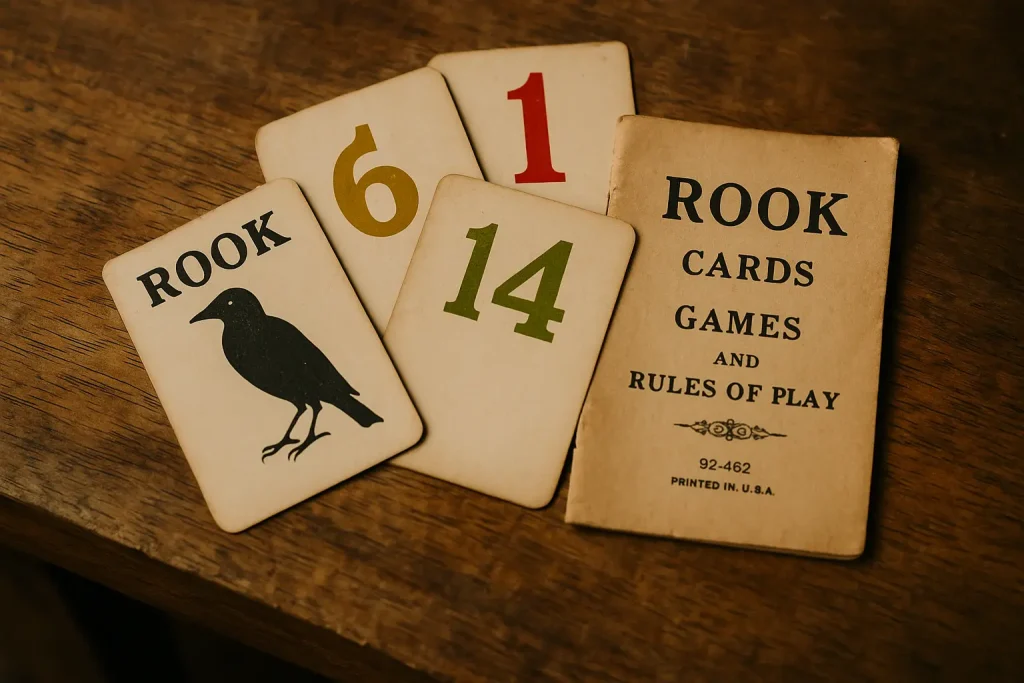
While poker tables dominated saloons, Rook tables filled churches and small-town kitchens.
Across the American South, Midwest, and Appalachia, Rook became a generational ritual — often passed from grandparents to children.
It was:
- a game played after potlucks
- a companion to long evenings
- a family staple during holidays
- common at youth retreats and summer camps
- a source of friendly rivalry in church basements
Because it avoided the imagery and connotations of gambling, Rook flourished in communities that frowned upon standard playing cards. This created a warm and unique subculture — a world where card play meant fellowship rather than risk.
To this day, Rook remains one of the most nostalgia-rich games in the United States, especially in areas with deep Protestant roots.
How Rook Relates to Familiar Games
Many newcomers compare Rook to well-known card games, and the comparison is fair but incomplete.
Is Rook like Spades?
Yes, both involve partnerships, bidding, and trick-taking.
But Rook’s scoring system and special card create a more dynamic point chase.
Is Rook like Rummy?
Not structurally.
Rummy is about patterns and melds.
Rook is about timing, partnerships, and trick control.
Is Rook easy to learn?
Yes, both involve partnerships, bidding, and trick-taking.
But Rook’s scoring system and special card create a more dynamic point chase.
Can two people play Rook?
Yes, though the partnership structure is part of the classic charm.
Two-player variants exist and are quite engaging, but the classic four-player format is the heart of the game.
Is Rook a cousin to Spades?
Absolutely — the skeleton is similar.
But the soul is different.
Spades rewards tactical trick management.
Rook rewards managing which tricks matter.
Through these comparisons, Rook shows its true nature: familiar enough to feel welcoming, yet distinct enough to feel meaningful.
Why Rook Feels Different From Other Trick-Taking Games
Even if someone has played Spades or Hearts for years, the first few rounds of Rook often feel surprising.
Rook changes the emotional tempo of the table.
Not because its rules are complex, but because the value of each trick feels more intimate and focused.
In Spades, you often chase quantity.
In Rook, you chase meaning.
Only certain cards contain points, and this transforms the psychology of the table. A small, seemingly low-stakes trick without point cards can be sacrificed without worry. But the moment a 10, 14, or 5 lands on the felt, the air shifts. Players lean in. Eyes sharpen. Every card feels heavier.
Rook narrows the battlefield to select high-value cards, making decisions feel surgical, not generic. Every choice becomes intentional rather than habitual.
This is the precise reason many experienced players quietly describe Rook as “more human” than most trick-taking games. It sharpens your attention to what truly matters — both in a hand and in a partnership.
The Secret Soul of Rook
Partnership games are rare treasures in a world dominated by individual competition. Rook’s social structure is one of the biggest reasons it has remained a family and community staple for more than a century.
The heart of Rook lies in:
- reading your partner’s intentions
- signaling through play style
- supporting one another’s bids
- recovering together from a weak hand
- celebrating shared triumphs
Partnerships in Rook feel less like formal alliances and more like friendships sharpened through small, wordless gestures. A well-timed trump or a carefully given trick feels like a message: I’ve got you.
And in a game born from church communities and family gatherings, this interpersonal warmth is fundamental. You are not just winning — you are working together. And that makes every hand feel like a memory in the making.
The Art of Bidding: Where Instinct Meets Calculation
Many who encounter Rook for the first time wonder how challenging the game really is. In truth, the rules are straightforward. But the bidding phase? That’s where its brilliance lies.
Bidding is both a mathematical assessment and a test of nerve. Players must weigh:
- how many point cards they hold
- whether their hand can lead the flow of tricks
- the strength of their trump color
- the hidden information in the nest
- their partner’s potential support
A confident bid can inspire your partner and intimidate opponents.
A miscalculated bid can unravel an entire round.
Bidding is where players reveal their personalities.
Some bid conservatively.
Some bid boldly.
Some bluff, some hesitate, and some treat every hand like a negotiation between risk and reward.
Even after decades of play, many lifelong Rook fans say the same thing:
The bidding round is the heartbeat of the entire game.
The Nest: A Moment of Discovery and Drama
Few card games contain a moment as quietly dramatic as the instant the highest bidder turns over the nest.
The table watches silently.
The bidder’s expression shifts — excitement, disappointment, or determination.
The nest can elevate a good hand into a dominant one, or it can fill the bidder with dread as they prepare to discard.
This moment exemplifies Rook’s deep tension.
You can make the best bid of your life and still receive a nest that forces you into a strategic detour.
The nest is the game whispering:
“You thought you knew. Now show me how you adapt.”
Rook’s Regional Identity: The Game of the American South
Few card games carry such a strong sense of place. Although Rook spread nationwide, it developed a particularly strong identity in:
- Tennessee
- Kentucky
- North Carolina
- Virginia
- West Virginia
- Georgia
- Deep-rural communities across the Midwest
In these areas, Rook isn’t just a pastime — it’s cultural grammar.
Generations learned it at kitchen tables.
Grandparents taught grandchildren.
Church circles played after fellowship meals.
Large families brought it to every gathering.
Rook survived because it never depended on trend, marketing, or media presence. It survived because places with strong interpersonal culture embraced it as one of their rituals.
In an increasingly digital age, Rook became a counterbalance — a game that demands presence, conversation, and the warmth of shared space.
Why Rook Endured for More Than 100 Years
Rook’s longevity is not an accident.
It is the product of several timeless qualities:
1. Accessibility
Anyone can learn quickly, regardless of age or gaming experience.
2. Social design
Partnership play fosters bonding rather than competition alone.
3. Emotional pacing
Rounds shift between calm and intensity in a way that feels satisfying.
4. Portable and family-friendly
The custom deck feels wholesome and safe across generations.
5. Flexible but consistent
House rules vary by region, but the core experience stays intact.
6. A sense of identity
The Rook bird card gives the game a mascot, a symbol, a soul.
When you hold a Rook card, you aren’t just playing. You’re participating in a century of tradition.
The Warm, Human Rhythm of a Rook Game
One thing becomes clear after spending time with Rook:
This is not a game driven by luck alone.
Nor is it obsessed with strategy.
It lives somewhere in the middle — in the subtle space where intuition, risk, and shared understanding converge.
A well-played Rook game feels like conversation:
- small signals
- soft risks
- bold declarations
- laughter
- thoughtful silence
- triumph and surprise
It feels alive.
Rook doesn’t overwhelm players with complexity or distance them through abstraction.
Instead, it invites them into a collaborative dance, where every round feels like a miniature story — beginning, middle, climax, conclusion.
This gentle but gripping structure is one of the reasons the game has never faded.
In an era of digital distraction, Rook’s tactile simplicity feels refreshing, grounded, and human.
What Rook Teaches Us About Play
Every classic card game captures something about the people who played it first. Poker captures risk. Bridge captures complexity. Solitaire captures solitude.
Rook captures togetherness.
It teaches:
- timing
- trust
- subtlety
- restraint
- partnership
- the value of choosing the right moment
It survived not because of marketing or competition, but because it fostered connection — between spouses, families, friends, and communities who gathered around tables to play something simple, meaningful, and quietly dramatic.
Rook endures because it reflects what card games once were at their best:
not distractions, not contests, but bridges — small, beautiful ways for people to share time, stories, and themselves.
This is why Rook, more than a century after its creation, remains one of the most beloved trick-taking games in American culture — and a timeless reminder that the most enduring games are not about winning, but about playing together.