cardanoir.com – The Egyptian Ratscrew rules describe two games stacked on top of each other. Underneath sits a quiet Victorian card game where you flip cards and occasionally win a pile. On top sits a reflex contest where everyone slams their hand onto the table.
Because those two layers run at once, the game is far more interesting than it looks. You are tracking patterns, counting face cards, and watching five other hands, all while flipping a card every two seconds.
What Egyptian Ratscrew Actually Is
The Egyptian Ratscrew rules govern a fast reflex game — also called Egyptian War, Egyptian Rat Slap, or simply ERS — played for two to eight players using one standard 52-card deck. The aim is simple: collect every card.
Its skeleton is Beggar-My-Neighbour, a British game from the 1800s where face cards force your opponent to pay a penalty in cards. Somewhere along the way, American players bolted slapping onto it, and the result took over college dorms and family kitchens alike.
Note that it is also the older, rowdier cousin of Slapjack, where the only slappable card is a Jack. If your family already plays that, ERS is the natural upgrade, since the flipping is identical and only the trigger list grows.
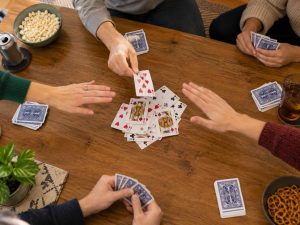
Egyptian Ratscrew Rules: Setting Up
- Deal the entire deck face-down, as evenly as possible. Uneven stacks are fine.
- Nobody looks at their cards. Ever. Your stack stays face-down in front of you.
- The player left of the dealer starts, flipping their top card into the centre.
- Flip away from yourself, so everyone sees the card at the same moment.
That fourth rule is not decoration. Turning a card toward yourself gives you a fraction of a second of advance warning on a slap, and most groups treat it as cheating. So flip outward, every time.
Egyptian Ratscrew Rules: The Face Card Challenge
Play continues around the table until somebody flips a face card or an Ace. At that moment they become the challenger, and the next player owes them cards.
| Card played | Chances the next player gets |
|---|---|
| Ace | 4 |
| King | 3 |
| Queen | 2 |
| Jack | 1 |
The challenged player flips one card at a time. If a face card or Ace appears within their allowance, the challenge passes onward to the next player with a fresh count. If they exhaust their chances without one, the challenger takes the entire pile and adds it to the bottom of their stack.
Consequently, chains build quickly here. Four players each answering a challenge can pile up twenty cards, which is exactly when someone slaps and takes the lot.
Egyptian Ratscrew Rules for Slapping
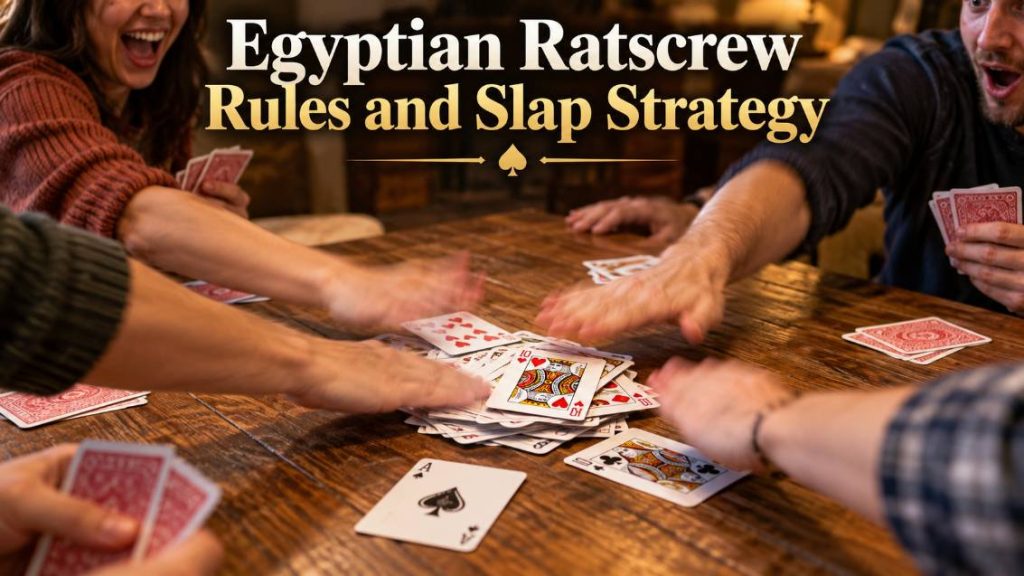
In the Egyptian Ratscrew rules, slapping overrides everything, including an active challenge. First hand flat on the pile wins it.
- Double — two matching ranks back to back, such as 7, 7
- Sandwich — matching ranks separated by one card, such as 7, 4, 7
- Top-bottom — the card just played matches the card at the bottom of the pile
- Marriage — a King followed immediately by a Queen, or the reverse
- Tens — two consecutive cards adding to ten, such as 6 and 4
- Hoagie — matching ranks separated by two cards
- Run — three or more consecutive ranks in order, such as 5, 6, 7
- Joker — always slappable, if you play with them
Of course, only the first three are near-universal. Everything below that is a house rule, so agree on your list before dealing rather than mid-argument.
If several hands land at once, the hand touching the pile wins. Consequently, slapping flat and low beats slapping hard.
Burning: The Penalty for Slapping Wrong
Naturally, the Egyptian Ratscrew rules punish a bad guess. Slap a pattern that is not there and you burn a card: take the top card off your stack and push it into the pile, face-down and dead to you.
This penalty is what keeps the game honest. Without it, the correct strategy would be slapping constantly, and the game would collapse into noise within a minute. Burning also applies to playing out of turn or grabbing a pile you did not win.
Many groups add a further rule requiring one designated flipping hand and one slapping hand, which stops fast players from doing both in a single motion.
Running Out of Cards Is Not the End
Here is the part of the Egyptian Ratscrew rules that newcomers always miss. Losing your last card does not eliminate you, at least in the common version. You stay at the table, and you may slap back in on any valid pattern to claim a pile and rejoin.
However, a false slap while you are out usually removes you permanently. Meanwhile, if a player runs out mid-challenge, the next player may either continue the challenge with the remaining chances or concede the pile.
The game ends when one player holds every card.
Egyptian Ratscrew Rules Groups Argue About
Almost every table plays a slightly different version. These are the ones worth settling in advance:
- Which slaps count. Doubles and sandwiches always; the rest by agreement.
- Whether burnt cards are dead. Some groups make them recoverable by whoever wins the pile.
- Whether eliminated players can slap in. Some say no, and the game ends much faster.
- Jack and King order. A few groups reverse the chances, giving the Jack three and the King one.
- Hovering. Most tables require your hand to start at least six inches above the pile.
None of these are more correct than the others. Still, discovering the disagreement halfway through a pile is how good evenings turn sour.
Strategy That Actually Works
Once you know the Egyptian Ratscrew rules, the rest comes down to habits.
- Watch the pile, not people’s hands. Reacting to another player’s movement is always slower than reading the card yourself.
- Remember the bottom card. Top-bottom slaps are the ones nobody sees coming, and only you will remember what you buried.
- Flip deliberately during a challenge. You are allowed to take your time on each card, which gives you an extra beat to spot a double.
- Count face cards. Sixteen exist. Once most have gone, challenges stop landing and the pile keeps growing.
- Skip the marginal slaps. A burnt card costs you more than a small pile gains, so leave the ambiguous patterns alone.
- Slap flat, not hard. The bottom hand wins, and force does nothing at all.
Playing It Safely
This section sounds cautious until somebody’s ring meets somebody’s knuckle at speed.
First of all, take rings off before you start. Keep the pile on a soft surface rather than a glass table, and clear the area around it — drinks especially. Trim your nails if you are playing with children, and agree that hands come straight down onto the pile rather than sweeping sideways across it.
For the full pattern list and the regional variants, the Egyptian Ratscrew entry on Wikipedia is unusually thorough. Our family and party card games section covers more games for loud groups, and the Spoons guide is the obvious companion piece — another reflex game where the rules are trivial and the reaction time is everything.