cardanoir.com – Star Wars Unlimited does one thing no other major trading card game does: it takes away turns. You do not play a turn, do everything you can afford, and pass. Instead you take a single action, then your opponent takes one, back and forth, until somebody stops.
That structure changes the whole feel of a match. Nobody sits watching a four-minute combo turn, and every decision you make hands the opponent an immediate chance to answer it.
What Star Wars Unlimited Actually Is
Fantasy Flight Games launched the game in March 2024 with Spark of Rebellion, designed by Danny Schaefer. It draws from the entire franchise at once — Original Trilogy, prequels, The Mandalorian, Clone Wars — with original artwork throughout rather than film stills.
Matches run two players, take roughly 30 minutes, and the box says ages 12 and up. Your goal is blunt: reduce the opponent’s base from 30 health to zero.
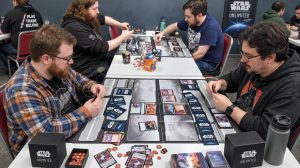
Star Wars Unlimited Rules: Leader and Base
Every deck starts with two cards outside the deck itself.
Your leader is double-sided. It begins on the table in leader form, giving you an ability you can use each round. Later, once you can afford its deploy cost, you flip it and it becomes a full unit on the battlefield. Timing that flip is one of the real skill tests in the game.
Your base is your life total. It sits on the table with 30 health, and it also contributes an aspect to your deck. Then the deck itself is at least 50 cards, with a maximum of three copies of any card.
The Six Aspects
Star Wars Unlimited replaces colours with aspects, and there are six of them:
- Vigilance (blue) — defensive, controlling the pace
- Command (green) — resource growth and wide boards of units
- Aggression (red) — fast, risky, damage-focused
- Cunning (yellow) — disruption and trickery
- Heroism (white) — the heroes, almost always paired with another aspect
- Villainy (black) — the villains, likewise
Your leader and base together grant you two or three aspect icons. Crucially, you may still play cards outside them — but each unmatched icon costs two extra resources. So off-aspect cards are legal, merely expensive, which is a far gentler restriction than the hard colour locks in Lorcana or One Piece.
Resources: Any Card Can Be Money
Star Wars Unlimited has no resource cards at all, and no card is ever dead. During the regroup phase at the end of each round, you place one card from your hand face-down as a resource.
That card is gone as a card forever, but it now pays for everything else. Consequently, every hand presents the same question this genre loves: is this card worth more as a play or as fuel?
You also draw two cards each regroup, so your hand refills faster than it drains. In practice, that keeps games moving and stops the slow, card-starved openings that plague some competitors.
Star Wars Unlimited Rules: The Alternating Action Phase
This is the mechanic that defines the game. During the action phase, players alternate taking one action each:
- Play a card from hand
- Attack with a ready unit
- Use an action ability on a card already in play
- Take the initiative — effectively passing
When you pass, you claim the initiative token, which means you act first next round. So passing is not surrender; it is a deliberate trade. You give up the rest of this round in exchange for the first move of the next one, and knowing when to take that deal separates good players from new ones quickly.
Once both players pass, the round ends. Then everyone readies their cards, draws two, resources one, and the next round begins.
Star Wars Unlimited Rules: Two Arenas
Units deploy into either the ground arena or the space arena, and this is not flavour. Ground units cannot attack space units, and space units cannot attack ground units.
Therefore board control happens twice, in parallel. A player dominating space while losing ground is in a genuinely different position than one simply behind, and many decks deliberately contest only one arena while racing in the other.
Both arenas can attack your opponent’s base, though, which is why ignoring one entirely rarely works.
Combat and Damage
Combat in Star Wars Unlimited is simple and brutal. Exhaust a ready unit, choose a target in the same arena — an enemy unit or the base — and deal damage equal to its power.
If you attack a unit, that unit deals its damage back at the same time. Both can die. Damage stays on units until the end of the round rather than healing immediately, so a wounded unit is a liability you have to plan around.
Units cannot attack the round they arrive unless they have Ambush, which is this game’s version of haste.
Keywords You Will Meet Early
- Ambush — attack immediately on arrival
- Sentinel — enemies must attack this unit first
- Shielded — arrives with a shield token that absorbs one hit
- Raid — extra power when attacking
- Grit — gains power for each damage on it
- Overwhelm — excess damage carries through to the base
- Restore — heals your base when it attacks
- Bounty — gives the opponent a reward when it is defeated
Sentinel and Shielded are the two that most change how you attack, so learn those first.
Where the Game Stands in 2026
Fantasy Flight ships roughly three Star Wars Unlimited booster sets a year plus supplementary products. This year brought A Lawless Time in March and Ashes of the Empire in July, with Homeworlds arriving as the ninth set on 1 October 2026, carrying over 260 new cards built around the defenders and invaders of various planets.
Then in November comes Icons, a smaller set deliberately designed as a low-barrier entry point. Fantasy Flight moved it back specifically so it would land closer to the holidays and catch new players, which makes it worth waiting for if you are buying gifts.
The Twin Suns format also got dedicated support this year, with four preconstructed decks released in spring, each built around two leaders designed for that format specifically.
How to Start Playing
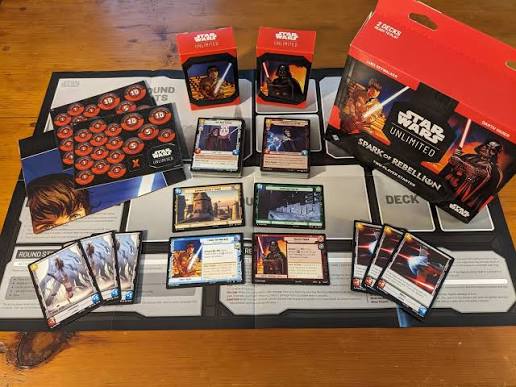
Start Star Wars Unlimited with a two-player starter set rather than boosters. It contains two complete decks, both leaders and bases, and everything needed to play immediately — which is the cheapest way for two people to learn together.
After that, pick one leader and build toward it. Because off-aspect cards only cost extra rather than being banned, you can play a rough version of almost any deck long before you own the right cards, and upgrade gradually.
If you are buying your first boosters this autumn, Homeworlds in October is the natural choice, though Icons in November may suit a genuine beginner better. The full rules reference and current banned list live on the official Star Wars Unlimited site.
For how this compares with the rest of the field, our collectible and trading card games section covers the wider category, and the Disney Lorcana guide is the closest comparison — another 2020s licensed TCG that solved the colour problem in almost the opposite way.