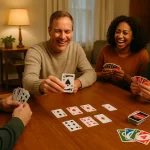
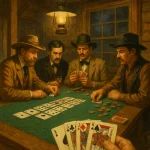
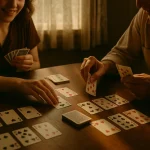
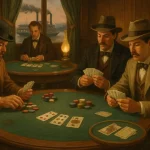
Long before neon casinos and televised poker tournaments, there was a card table in an English tavern. Three players leaned forward, laughter mixing with the clink of pints. They weren’t playing for fortune but for pride — and the game was Three Card Brag.
This 16th-century blend of chance, bluff, and bravado became the ancestor of modern poker, a piece of living heritage still played across Britain’s pubs and parlors today.
Origins and Early History

Historians trace Three Card Brag back to Elizabethan England, evolving from earlier gambling games such as Primero and Post-and-Pair.
By the 1700s it had spread through inns and coffee houses across London, often called Bragg or Bragging. The term “brag” itself — meaning boast or bluff — perfectly captured the spirit of the game: confidence could win even when the cards could not.
Unlike French Brelan or Italian Primero, English Brag required only three cards per hand, creating faster rounds and livelier banter. Soldiers carried the game abroad; Victorian households kept it as a parlor pastime; and to this day it remains a Christmas-table tradition in many British families.
The Deck and Setup
Three Card Brag uses a standard 52-card deck without jokers.
- Players: 2 – 8 (commonly 3 – 6)
- Ante: Each player contributes a small stake to start the pot.
- Goal: Hold the best three-card hand — or bluff opponents into folding.
Hand Rankings
Brag hands may look like poker, but their order — and odds — differ slightly.
Here’s the traditional ranking from highest to lowest:
| Rank | Hand Name | Description |
|---|---|---|
| Prial | “Pair Royal” — three of a kind | 3 Aces > 3 Kings > 3 Queens … > 3 Twos |
| Running Flush | Consecutive cards, same suit | e.g. Q♠ J♠ 10♠ |
| Run | Straight (sequence, mixed suits) | e.g. 9♣ 8♦ 7♥ |
| Flush | Same suit, not consecutive | e.g. K♦ J♦ 7♦ |
| Pair | Two cards of same rank | e.g. 8♠ 8♣ K♥ |
| High Card | None of the above | Highest card wins; then second; then third |
The Ace is both high and low in runs, allowing sequences such as A-2-3 or A-K-Q.
How to Play
1 – The Deal
Each player antes up, and the dealer gives three cards face-down to each player clockwise.
2 – First Betting Round
Players look at their cards and decide whether to see (continue), raise, or fold.
There are two play modes:
- Blind: Player hasn’t looked at their cards; bets are half the normal value.
- Seen: Player has viewed their hand; must bet double the blind amount.
Blind players may “look” at any time but immediately become seen and adjust stake sizes.
3 – Chasing and Folding
Betting proceeds clockwise until one player calls the previous bet to compare hands, or all others fold.
When only two remain, either may call “see” to reveal both hands — the higher hand wins the pot.
The Art of Bluff and “Bragging”
What makes Three Card Brag electric isn’t the math — it’s the psychology.
A weak hand played boldly can outlast kings and aces. The social tension between “blind” and “seen” players creates dramatic moments:
- Blind confidence: Playing without seeing your cards makes you unpredictable.
- Timing the peek: Looking too soon can betray nervousness.
- Mimicry: Experienced players imitate gestures or tone to mislead rivals.
In a good game of Brag, the loudest laugh can be the deadliest weapon.
Variants and Family Forms
Because the game spread through households rather than casinos, regional variants abound.
Classic Pub Brag
The purest form — one ante, free betting, best hand wins.
Seven-Card Brag
Each player receives seven cards and chooses the best three; often used in tournaments.
Dealer’s Choice Brag
Before dealing, the dealer declares a twist — wild cards, shared cards, or special prials (e.g. three 6s beating three Aces).
Stop the Bus
A social variant with three cards each but a rotating community “bus” card; immensely popular at Christmas parties.
Progressive Brag
Combines poker structure with brag ranking — multiple betting rounds, community cards, and escalating blinds.
Mathematics and Probability
A deck of 52 yields 22,100 unique three-card combinations.
Odds of landing a Prial are 1 in 425; a Running Flush about 1 in 460.
This rarity hierarchy makes bluffing mathematically viable: strong hands are so uncommon that consistent aggression can dominate if timed well.
For students of probability, Brag is a miniature laboratory of risk — fewer cards, faster feedback, and pure decision-making under uncertainty.
Three Card Brag vs Poker
Though related, Brag and Poker differ in rhythm and tone.
| Feature | Three Card Brag | Poker |
|---|---|---|
| Cards per hand | 3 | 5 – 7 |
| Betting style | Single round; blind/seen rules | Multiple rounds; structured raises |
| Hand names | Prial, Run, Flush, etc. | Pair, Straight, Full House |
| Origins | 16th-century England | 19th-century America |
| Spirit | Fast, loud, social | Strategic, calculated |
Many historians consider Brag the direct ancestor of modern Poker — exported to the New World by English settlers, where it evolved into Three Card Poker and Texas Hold’em.
Cultural Legacy
Across the UK, Three Card Brag remains a symbol of community.
It’s a staple at pub nights, holidays, and barracks tables, bridging generations. Phrases like “having a good brag” survive in everyday slang, meaning both a chat and a bluff.
In popular media, Brag has cameoed in British films and TV dramas — shorthand for working-class camaraderie and quick wit. Some casinos now host “Heritage Brag” nights to celebrate the game’s lineage beside its modern descendants.
Digital Revival
Online card platforms and mobile apps have revived interest among younger players.
Casual modes mimic pub-style Brag, while casino variants adopt poker-like betting but preserve the classic hand hierarchy.
This new wave reintroduces Brag not as gambling, but as cultural storytelling through play — a link between history, math, and human behavior.
Five Fascinating Facts

- Oldest surviving poker relative — documented before 1630.
- “Brag” influenced the phrase “bragging rights.”
- A Prial of threes beats all runs — the rare “running threes” legend.
- Queen Victoria reportedly played Brag at Balmoral Castle.
- World Brag Day events appear annually in some UK pubs and student unions.
Every generation rediscovers this little game of nerve.
In an era of algorithms and online rankings, Three Card Brag endures because it celebrates something timeless — the courage to act confident when you’re uncertain. It’s the same psychology behind negotiations, leadership, and love: showing strength, reading signals, calling bluffs. The rules are simple; the lesson is eternal. To sit at a Brag table is to glimpse the DNA of all modern card games — a centuries-old conversation between luck and human daring.