cardanoir.com – The rummy rules are the most widely borrowed set of instructions in card gaming. Draw a card, form matched groups, discard, repeat. That one loop powers Gin Rummy, Canasta, Indian Rummy, Rummy 500, Mahjong’s card cousins, and a hundred family house rules that nobody wrote down.
So learning the base game is unusually good value. Once you know it, you are roughly ninety percent of the way into every other game in the family.
What Rummy Actually Is
The rummy rules describe a draw-and-discard game for two to six players, using one standard 52-card deck. Your goal is to arrange your entire hand into melds — matched groups — before anyone else manages it.
A round takes a few minutes, and matches usually run to an agreed target such as 150 or 500 points across many rounds. Because of that structure, a bad hand costs you very little, which is exactly why the game survives family gatherings so well.
Rummy Rules: The Setup
First, the hand sizes, which change with the number of players:
- 2 players — 10 cards each
- 3 or 4 players — 7 cards each
- 5 or 6 players — 6 cards each
Then place the rest of the deck face-down as the stock, and turn one card face-up beside it to start the discard pile.
Aces are low in the standard game, so A-2-3 is a valid run while Q-K-A is not. Some groups allow aces high or low, and when they do, aces are usually worth 15 points instead of 1. Agree on this before you deal, because it changes which cards are worth holding.
Sets and Runs: What Counts as a Meld
The rummy rules recognise only two shapes, and both need at least three cards.
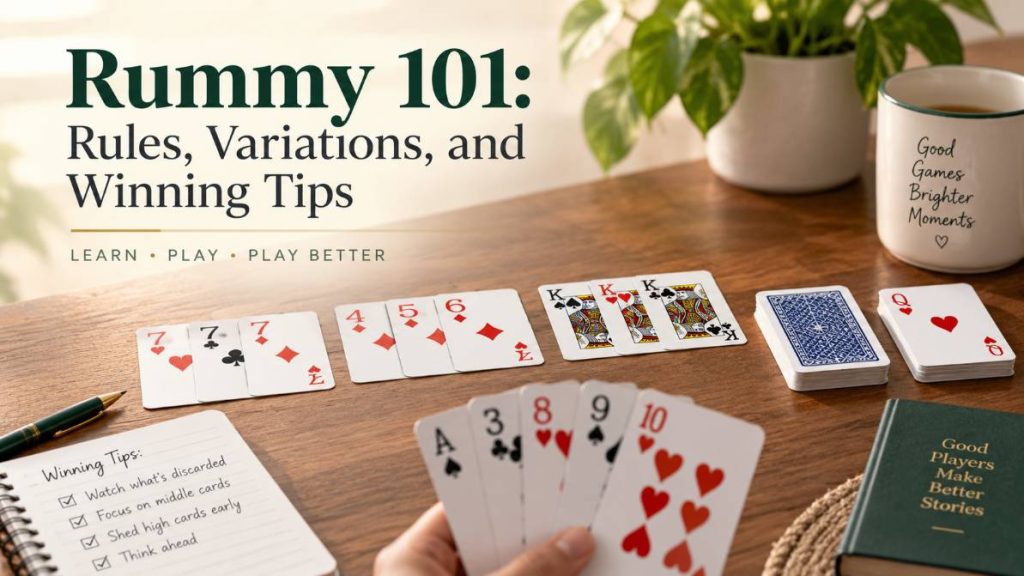
A set is three or four cards of the same rank, in different suits — three Sevens, for example. A run is three or more consecutive cards in the same suit, such as the 4, 5, and 6 of diamonds.
Note that mixed-suit runs do not count in almost any version, even though beginners try it constantly. Furthermore, once a meld is on the table it cannot be rearranged, so a run you lay down early locks those cards permanently.
Rummy Rules: How a Turn Works
Every turn follows the same three steps, in this exact order:
- Draw one card — either the top of the stock, or the top card of the discard pile.
- Meld or lay off, if you want to. You may put down a new set or run, or add cards to melds already on the table.
- Discard one card face-up, ending your turn.
Two details trip people up. If you take a card from the discard pile, you cannot discard that same card on the same turn. Also, if the stock runs out, set aside the top discard, shuffle the rest of the pile, and it becomes the new stock.
Laying Off and Going Out
Two rummy rules govern the end of a round. Laying off means adding a card to a meld already on the table, including your opponents’ melds. If someone has laid down 7-8-9 of diamonds, you may add the 6 or the 10. Some groups require you to have melded something yourself first, so settle that in advance.
You go out when you have melded or laid off every card in your hand. Many groups require a final discard to finish, which means you need one spare card at the end.
Then there is going rummy. If you have not melded anything at all during the round and you put down your entire hand in a single turn, your score for that round doubles. It is rare, it is satisfying, and it is worth holding a nearly complete hand for one extra turn when the chance appears.
Rummy Rules for Scoring
Only the player who goes out scores. Everyone else counts the cards left stranded in their hand, and the winner collects that total.
| Card | Value |
|---|---|
| Ace (low) | 1 |
| 2 through 10 | Face value |
| Jack, Queen, King | 10 |
Consequently, face cards are dangerous to hold. A hand full of Kings and Queens that never melds hands your opponent thirty or forty points in one round, which is why experienced players shed high cards early unless they are close to a set.
Gin Rummy Rules in Brief
Gin Rummy is the two-player version most people eventually graduate to, and it changes three things.
You each hold ten cards. Rather than melding as you go, you keep everything hidden until you knock, which you may do once your unmatched cards — your deadwood — total 10 points or less. Melding your entire hand with zero deadwood is gin, and it earns a 25-point bonus.
The clever part is the undercut. If the player who did not knock ends up with equal or less deadwood, they score the difference plus a bonus instead. Knocking early is therefore a real risk rather than a free win.
Indian Rummy and the Pure Sequence
The Indian Rummy rules deal 13 cards from two decks with jokers, and it adds one rule that reshapes everything: you must form at least one pure sequence — a run with no joker in it — before any of your other melds count.
That single requirement changes your priorities completely. In standard rummy you chase whatever fits. Here, your first job is always a clean run in one suit, and players who ignore it lose enormous scores even with an otherwise tidy hand.
Other Variations Worth Knowing
- Rummy 500 — the rummy rules here score points for the cards you meld as you go, not just for going out, and play continues to 500. You may also take several cards from the discard pile at once.
- Canasta — partnership play with two decks, melds of seven cards, and wild cards. Technically rummy, practically its own sport.
- Kalooki — a joker-heavy variation popular in Jamaica and Britain, with fixed contracts each round.
- Contract Rummy — each round demands a specific combination of sets and runs, escalating as the game goes on.
- Oklahoma Gin — Gin Rummy where the first upturned card sets the knocking limit for that hand.
Tips That Actually Improve Your Game
- Watch what everyone discards. In practice this tells you more than your own hand does, since a rank nobody throws is a rank somebody is collecting.
- Favour middle cards. A 7 can build runs in both directions; a King can only build downward.
- Shed high cards early. Deadwood points hurt most when you lose, and you lose most rounds.
- Do not hoard for the perfect hand. Two solid melds and a small discard beat a beautiful hand that never lands.
- Think twice before taking from the discard pile. Everyone sees you do it, so you are telling the table exactly what you are building.
- Count what is gone. If all four Nines have appeared, that run is dead and you should release the cards waiting on it.
For the complete standard rule set plus the house variations most families argue about, Pagat’s Rummy page is the reference to trust. Our traditional and classic card games section covers the wider family, and the Bridge walkthrough is a natural next step once melding feels automatic.