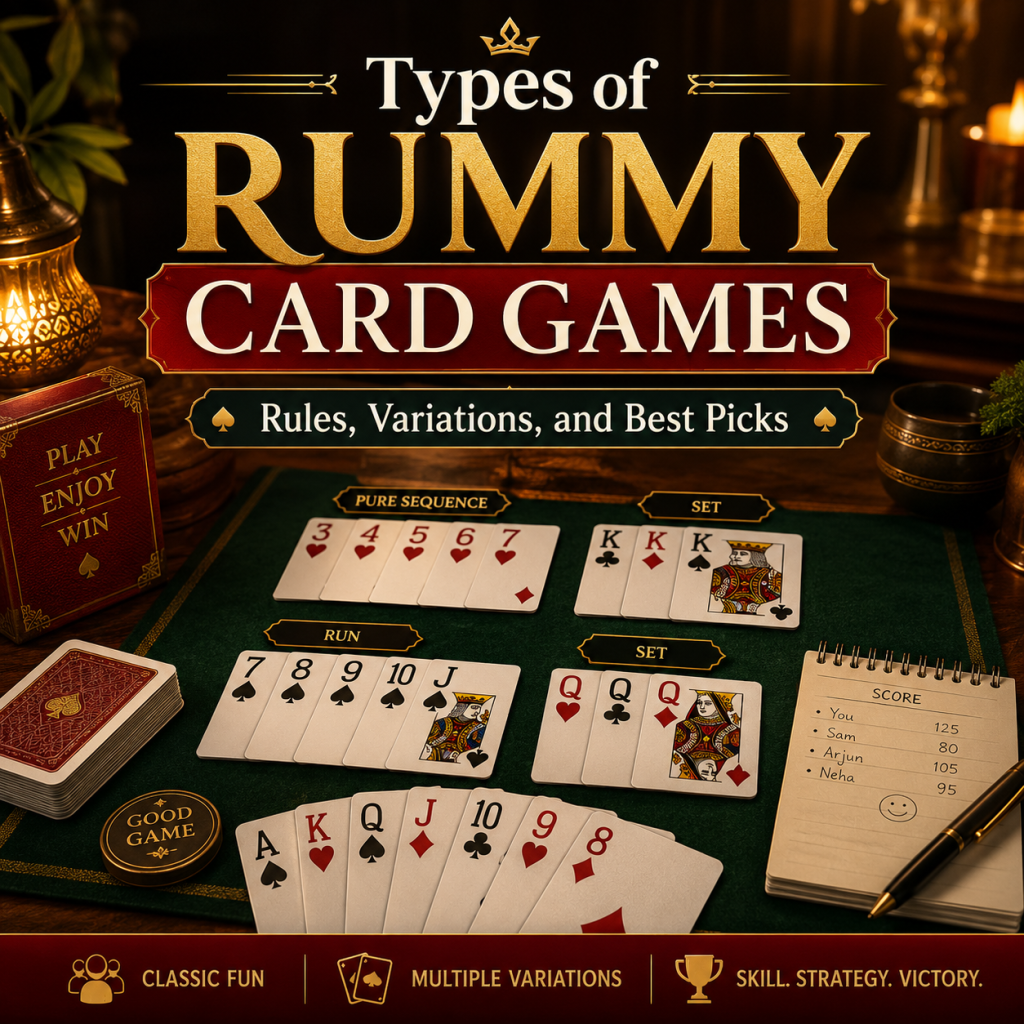
cardanoir.com – Rummy is not just one card game. It is a large family of matching games built around a simple idea: arrange cards into valid groups before the other players do. Those groups usually take the form of sets, which contain cards of the same rank, or runs, which contain consecutive cards from the same suit.
The basic idea may sound straightforward, but the many types of rummy card games create very different experiences. Some versions are fast and easy enough for a casual family evening, while others involve multiple rounds, complex scoring, wild cards, and careful long-term planning.
That variety is one reason rummy has remained popular across different countries and generations. Players can learn a simple version in minutes, then continue exploring deeper variations as their confidence grows.
A beginner may enjoy Gin Rummy because it uses only two players and has a clean structure. A larger group may prefer Contract Rummy, while players who enjoy quick decisions might choose Indian Rummy or Oklahoma Gin.
Understanding the differences helps players choose a version that matches their group size, available time, and preferred level of strategy.
What Makes a Card Game Part of the Rummy Family?
Most rummy games share several core features even when their rules differ.
Players are usually dealt a hand of cards and take turns drawing from either a face-down stock pile or a face-up discard pile. After drawing, they discard one card. The main goal is to improve the hand by creating legal combinations.
The Two Main Rummy Combinations
The most common combinations are:
- Set: Three or more cards of the same rank, such as 7♣, 7♦, and 7♥.
- Run: Three or more consecutive cards in the same suit, such as 4♠, 5♠, and 6♠.
Some versions also include:
- Wild cards
- Jokers
- Mandatory contracts
- Multiple decks
- Special scoring systems
- Bonus combinations
- Knock or declaration rules
Because these elements can be changed, one basic structure produces many distinct games.
The rules may vary, but the heart of rummy remains the same: draw carefully, organize efficiently, and discard without helping your opponent.
Quick Comparison of Popular Rummy Variations
| Rummy Variation | Typical Players | Main Feature | Average Difficulty | Best For |
|---|---|---|---|---|
| Gin Rummy | 2 | Knocking and deadwood scoring | Medium | Competitive pairs |
| Indian Rummy | 2–6 | Two sequences, including one pure run | Medium | Fast multiplayer games |
| 500 Rummy | 2–8 | Picking multiple discard cards | Medium | Social groups |
| Contract Rummy | 3–8 | Different required combinations each round | High | Longer game nights |
| Oklahoma Gin | 2 | First card affects the knock limit | Medium | Gin Rummy fans |
| Canasta | 2–6 | Seven-card melds and team play | High | Strategic groups |
| Kalooki | 2–5 | Melds, jokers, and penalty points | High | Experienced players |
| Shanghai Rummy | 3–8 | Progressive contracts | Medium to high | Family gatherings |
| Liverpool Rummy | 3–8 | Contract-based multi-round format | High | Patient groups |
| Basic Rummy | 2–6 | Simple sets and runs | Easy | Beginners |
1. Basic Rummy: The Best Starting Point
Basic Rummy is the easiest introduction to the wider rummy family. Players draw one card, attempt to create sets or runs, and discard one card at the end of the turn.
The first player to arrange all cards into valid combinations usually wins the round.
Why Basic Rummy Is Beginner-Friendly
The rules are easy to explain because there are no complicated contracts or advanced scoring systems. Players can focus on the three essential skills:
- Watching the discard pile
- Organizing cards efficiently
- Deciding which card is safest to discard
A beginner may initially discard a card without thinking about what an opponent needs. After a few rounds, however, players begin noticing patterns.
For example, if an opponent repeatedly picks up heart cards, discarding another heart may help them complete a run. This cause-and-effect relationship is what gradually turns a simple matching game into a strategic one.
Realistic Review
Basic Rummy is excellent for learning, although experienced players may find it too predictable after several rounds. It works best when teaching children, introducing new players, or playing a quick game without lengthy explanations.
2. Gin Rummy: A Classic Two-Player Strategy Game
Gin Rummy is one of the most recognized rummy card game variations. It is normally played by two people using a standard 52-card deck.
Players attempt to form melds while reducing the value of unmatched cards, known as deadwood. A player can end the round by knocking when the deadwood value is low enough, or by reaching gin with no deadwood at all.
What Makes Gin Rummy Different?
Unlike basic rummy, players do not usually place combinations on the table during the round. The hand remains hidden until someone knocks.
This hidden information creates tension. Each discard gives the opponent a clue, but no one knows exactly how close the other player is to finishing.
Key Gin Rummy Skills
- Remembering discarded cards
- Tracking what the opponent collects
- Reducing high-value deadwood
- Knowing when to knock
- Avoiding useful discards
Realistic review: Gin Rummy feels simple during the first few turns, but it becomes increasingly tactical. Knocking too early can produce a weak score, while waiting too long may allow the opponent to finish first.
It is one of the best options for two players who want a fast game with meaningful decisions.
3. Indian Rummy: Fast, Structured, and Highly Popular
Indian Rummy is commonly played with 13 cards per player and often uses two decks, including jokers. The goal is to arrange the entire hand into valid sequences and sets.
A valid declaration normally requires at least two sequences, with at least one being a pure sequence that does not use a joker.
Why the Pure Sequence Matters
The pure sequence rule prevents players from relying entirely on wild cards. Even if a player has several jokers, the hand cannot be declared unless it contains the required natural run.
For example:
- 4♥, 5♥, 6♥ is a pure sequence.
- 4♥, Joker, 6♥ is an impure sequence.
The player must create at least one combination like the first example.
Cause and Effect in Indian Rummy
Keeping too many disconnected high-value cards increases the possible penalty score. Because of that, experienced players often discard isolated kings, queens, and jacks early unless they are close to forming a sequence.
Realistic review: Indian Rummy moves quickly and offers more flexibility than Gin Rummy. Jokers help difficult hands, but the pure sequence requirement keeps the game from becoming entirely dependent on luck.
It is a strong choice for players who enjoy fast multiplayer rounds.
4. 500 Rummy: A More Flexible Discard System
500 Rummy is a points-based variation that usually allows players to take more than one card from the discard pile.
If a player chooses a buried card, they may also be required to collect every card placed above it. The selected card must normally be used immediately in a meld.
This rule creates interesting decisions. A valuable card may be available deep in the discard pile, but taking it can add several unwanted cards to the hand.
Scoring in 500 Rummy
Players earn points for cards placed in melds and may lose points for cards left in their hands.
As a result, the game is not only about finishing first. A player can build a strong score across several rounds by placing many cards on the table.
Realistic Review
500 Rummy is more open and social than Gin Rummy because players can see melds developing on the table. It also rewards careful observation of the discard pile.
However, the ability to collect multiple cards can make the hand messy. New players sometimes take too many cards for one useful combination and then struggle to reduce the rest.
5. Contract Rummy: Different Challenges in Every Round
Contract Rummy introduces specific requirements that must be completed before players can place cards on the table.
The contract changes from one round to the next. A round might require two sets, while another may require one set and one run.
Example Contract Progression
A typical sequence may include:
- Two sets
- One set and one run
- Two runs
- Three sets
- Two sets and one run
- One set and two runs
- Three runs
The exact order varies by house rules.
Why Contract Rummy Feels More Difficult
Players cannot simply create any useful combination. They must create the specific combinations required for that round.
A hand containing several good sets may still be weak if the current contract demands runs.
Realistic review: Contract Rummy is satisfying for players who enjoy structured challenges. The changing goals prevent repetition, but rounds can become long when someone repeatedly receives cards that do not fit the contract.
It is best for groups that enjoy patient, strategic play.
6. Oklahoma Gin: Gin Rummy with a Changing Limit
Oklahoma Gin is closely related to Gin Rummy, but the first face-up card determines the maximum deadwood value allowed for knocking.
If the opening card is a seven, for example, players may only knock with seven or fewer deadwood points. Some rules treat an ace as one point, while a spade may double the round’s score.
How the Changing Limit Affects Strategy
A low opening card makes knocking more difficult. Players must create stronger melds before ending the round.
A high opening card allows earlier knocks, which can make the game faster and more aggressive.
Because one card changes the round’s entire rhythm, Oklahoma Gin feels less predictable than standard Gin Rummy.
Realistic Review
This version is ideal for players who already understand Gin Rummy and want additional variety. Beginners may prefer standard Gin first because the changing knock limit adds another rule to remember.
7. Canasta: Team Play and Powerful Melds
Canasta belongs to the broader rummy family but has a very distinct structure. It is commonly played by four players in two partnerships using two decks and jokers.
The central goal is to create a canasta, a meld containing at least seven cards of the same rank.
Natural and Mixed Canastas
A natural canasta contains no wild cards, while a mixed canasta includes one or more wild cards. Natural canastas generally score more points.
Team play changes the strategy. Partners share melds and must think about the combined hand rather than individual progress.
Why Canasta Requires Patience
Canasta uses larger hands, more cards, and detailed scoring. Players also need to understand rules involving frozen discard piles, wild cards, red threes, and minimum meld values.
Realistic review: Canasta offers deep strategy and memorable team moments, but it is not the easiest version to teach. The first game may feel slow because players frequently check rules.
Once everyone understands the system, however, it becomes one of the most rewarding rummy variations for regular groups.
8. Kalooki: Competitive Rummy with Jokers
Kalooki, sometimes written as Kaluki, is a joker-heavy version of rummy played in several regions, particularly in Europe and the Caribbean.
Players create sets and runs while trying to reduce the penalty value of cards left in the hand.
Why Jokers Change the Game
Jokers provide flexibility because they can replace missing cards. However, they also create tactical opportunities.
In some versions, a player may replace a joker in an existing meld by placing the natural card it represents. The recovered joker can then be used elsewhere.
This means a meld on the table is not always finished. Other players may modify it later.
Realistic Review
Kalooki feels lively and interactive. Players who enjoy manipulating table combinations will appreciate it.
The main difficulty is that house rules can vary significantly. Before beginning, the group should agree on joker limits, opening requirements, and scoring.
9. Shanghai Rummy: Progressive and Social
Shanghai Rummy is a contract-based game usually played across several rounds. Each round requires a different combination of sets and runs.
It shares similarities with Contract Rummy but often includes its own rules for buying discarded cards, using jokers, and completing contracts.
Why It Works Well for Groups
The multi-round format gives players time to recover from a poor start. Winning one round does not automatically guarantee overall victory.
Because the contracts change, every hand creates a different challenge.
Realistic review: Shanghai Rummy is particularly enjoyable for family gatherings because it supports several players and encourages conversation. The disadvantage is its length. A full game can take a significant amount of time, especially with six or more players.
10. Liverpool Rummy: A Longer Contract-Based Challenge
Liverpool Rummy is another progressive variation that combines elements of Contract Rummy and Gin-style matching.
Players must complete specific contracts in each round, often involving combinations such as:
- Two sets
- One set and one run
- Two runs
- Three sets
- Two sets and one run
- One set and two runs
- Three runs
Wild cards are commonly used, and players may be able to add cards to existing melds after completing their own contract.
Who Should Play Liverpool Rummy?
This variation is best for groups that enjoy long sessions and gradual scoring. It rewards memory, organization, and patience.
Realistic Review
Liverpool Rummy can become very competitive because one difficult round may create a large penalty. It remains engaging because the required combinations keep changing.
However, it is not ideal for a quick 20-minute game.
How to Choose the Best Type of Rummy
The best variation depends on the players and the occasion.
Choose Basic Rummy When:
- Teaching complete beginners
- Playing with children
- Looking for simple rules
- Wanting a relaxed game
Choose Gin Rummy When:
- Only two players are available
- You prefer hidden hands
- You enjoy memory and deduction
- You want short, competitive rounds
Choose Indian Rummy When:
- Playing with several people
- You enjoy jokers
- You prefer fast declarations
- You like structured sequence rules
Choose Contract or Liverpool Rummy When:
- The group has plenty of time
- Players enjoy multi-round games
- You want changing objectives
- Everyone is comfortable with more rules
Choose Canasta When:
- Team play is preferred
- Players enjoy scoring systems
- The group meets regularly
- A deeper strategic game is desired
Common Mistakes New Rummy Players Make
Even simple rummy games reward careful decisions. Beginners frequently make several avoidable mistakes.
Holding High Cards Too Long
Face cards often carry large penalty values. Keeping an isolated king or queen for too many turns can produce a costly hand.
Ignoring Opponent Discards
Every discarded card provides information. If an opponent rejects several low clubs, they may not be collecting a club run.
Picking Up Every Useful Card
A card may appear helpful but still make the overall hand less organized. Collecting too many possibilities often delays a clear plan.
Using Jokers Too Early
A joker can rescue a difficult combination later. Using it immediately in an easy set may reduce future flexibility.
Focusing on Only One Combination
Players sometimes become attached to a specific run even when the necessary card is unlikely to appear. A flexible hand is usually stronger than a perfect plan that never develops.
Review: Which Rummy Variation Offers the Best Experience?
For two players, Gin Rummy provides the strongest balance between simple rules and deep decisions. It is fast, competitive, and easy to replay.
For casual multiplayer games, Indian Rummy and 500 Rummy offer greater interaction without requiring an extremely long session.
Contract Rummy, Shanghai Rummy, and Liverpool Rummy are better for groups that enjoy extended game nights. Their changing requirements keep the experience interesting, although slow rounds can test the patience of younger players.
Canasta provides the richest team experience, but it also demands the longest learning period.
Overall, no single variation is perfect for every group. The most enjoyable choice is usually the one whose pace and complexity match the players around the table.
Frequently Asked Questions
1. What are the most popular types of rummy card games?
Gin Rummy, Indian Rummy, 500 Rummy, Canasta, Contract Rummy, and Basic Rummy are among the most widely recognized versions.
2. Which rummy game is easiest for beginners?
Basic Rummy is generally the easiest because players only need to understand drawing, discarding, sets, and runs.
3. What is the best rummy game for two players?
Gin Rummy is one of the best two-player choices because it combines quick rounds with memory, timing, and tactical discarding.
4. What is the difference between Indian Rummy and Gin Rummy?
Indian Rummy usually uses 13 cards, jokers, and a requirement for at least two sequences. Gin Rummy normally uses 10 cards, no standard joker requirement, and a deadwood-based knocking system.
5. Which rummy variation is best for large groups?
Contract Rummy, Shanghai Rummy, Liverpool Rummy, and 500 Rummy work well for larger groups, depending on the number of decks and house rules used.
Conclusion
The many types of rummy card games prove how one simple matching concept can create a wide range of experiences. Basic Rummy introduces sets and runs, Gin Rummy adds hidden information and deadwood scoring, while Indian Rummy brings jokers and pure-sequence requirements. Players seeking longer challenges can explore Contract Rummy, Shanghai Rummy, or Liverpool Rummy, while Canasta offers deeper team-based strategy. Because every variation changes the pace, scoring, and decision-making process, choosing the right version can turn an ordinary deck of cards into an engaging game night. The best place to begin is with a simple format, then gradually explore more complex versions as the group becomes comfortable with the rules.