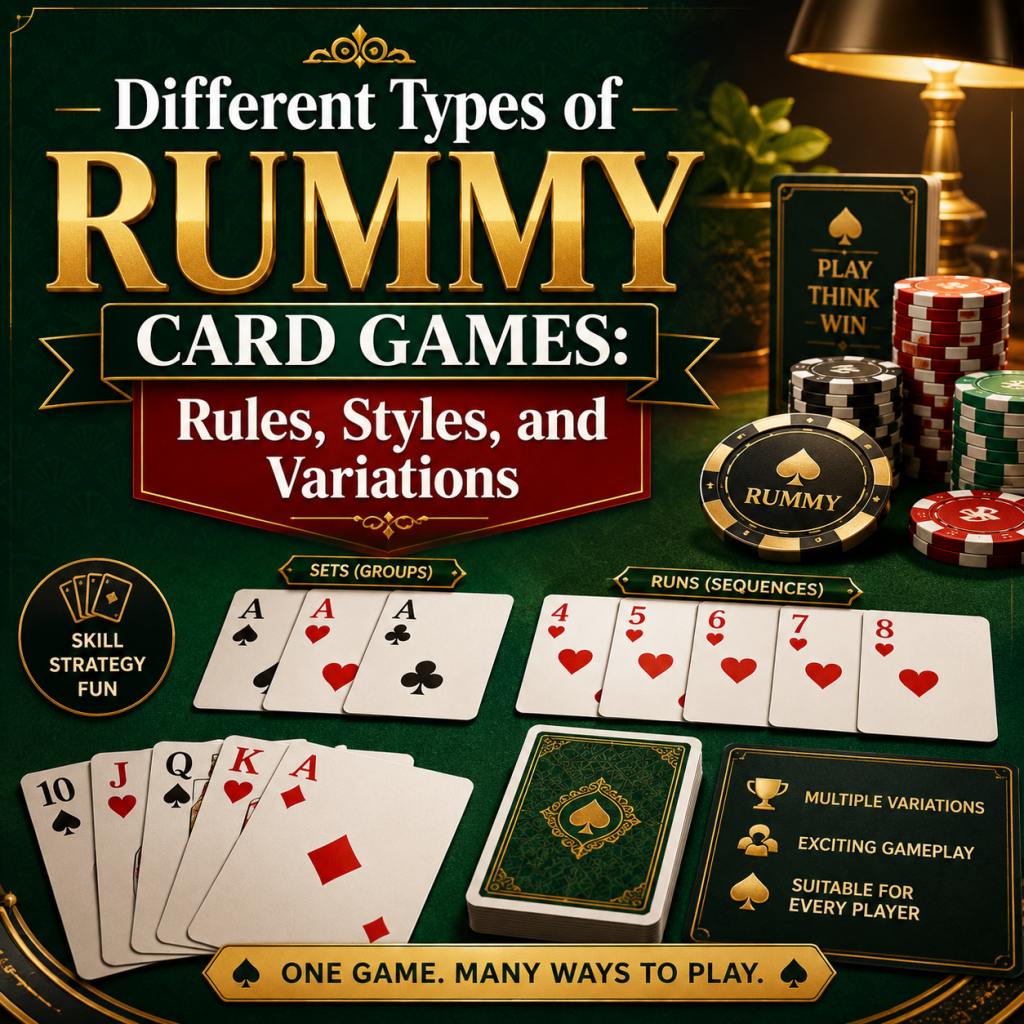
cardanoir.com – Rummy is not just one card game with a single universal rulebook. It is a broad family of draw-and-discard games built around arranging cards into valid combinations. Depending on the variation, players may race to empty their hands, reduce unmatched cards, complete a predetermined contract, or collect points from valuable melds.
That flexibility explains why there are so many different types of rummy card games. Classic Rummy provides a straightforward introduction, Gin Rummy creates a tactical two-player contest, Indian Rummy requires a complete 13-card arrangement, and Canasta rewards larger melds built over several turns.
The games may look similar at first because they often use terms such as set, run, meld, stock, and discard pile. However, the experience can change dramatically depending on whether cards remain hidden, melds are placed immediately, jokers are used, or a player can end the round with unmatched cards.
Some versions move quickly and can be learned within a few rounds. Others involve multiple decks, progressive contracts, partnerships, and detailed scoring systems. Understanding their differences makes it easier to choose a version that suits the number of players and the level of strategy desired.
What Makes a Card Game Part of the Rummy Family?
The central idea behind most rummy games is melding. A meld is a valid arrangement of cards, normally formed as either a set or a run.
A set generally contains cards of the same rank, such as:
7♠ – 7♥ – 7♦A run or sequence normally contains consecutive cards of the same suit, such as:
4♣ – 5♣ – 6♣In standard Rummy, players draw one card, evaluate their hand, and discard one card. The objective is usually to form sets and runs before the opponents do. Bicycle’s standard rules describe valid melds as groups of three or four cards of the same rank or sequences of at least three cards in one suit.
The Typical Draw-and-Discard Cycle
Although exact rules vary, a normal turn often follows this pattern:
- Draw the top card from the stock or discard pile.
- Examine whether the new card improves a possible meld.
- Place valid combinations on the table if the variation permits it.
- Add cards to existing melds when allowed.
- Discard one unwanted card.
This simple cycle creates an interesting cause-and-effect relationship. Because every visible discard gives information to the table, opponents can begin estimating which ranks or suits a player may be collecting. As a result, discarding a useful-looking card can reveal almost as much as picking one up.
Main Categories of Rummy Games
Rummy variations can be divided into several broad categories.
| Rummy Category | Main Feature | Common Examples |
|---|---|---|
| Basic Rummy | Empty the entire hand through sets and runs | Classic Rummy |
| Knock Rummy | End the round with low unmatched-card value | Gin Rummy, Tonk |
| Meld-Scoring Rummy | Earn positive points through exposed combinations | 500 Rummy |
| Contract Rummy | Complete a required combination in each round | Contract Rummy, Shanghai Rummy |
| Canasta Family | Build large same-rank melds for bonuses | Canasta, Hand and Foot |
| Manipulation Rummy | Rearrange existing table melds | Machiavelli-style Rummy |
| Concealed-Hand Rummy | Keep combinations hidden until declaring | Indian Rummy |
Pagat classifies the wider family into basic, contract, manipulation, knock, meld-scoring, and Canasta-style groups. The categories share the use of melds but differ in how players go out and how points are calculated.
Quick Comparison of Popular Rummy Variations
| Variation | Typical Players | Main Objective | Distinctive Feature |
|---|---|---|---|
| Classic Rummy | 2–6 | Empty the hand through melds | Simple draw/meld/discard play |
| Gin Rummy | 2 | Reduce deadwood and knock or go gin | Melds remain in the hand |
| 500 Rummy | 2–5+ | Reach 500 points | Positive and negative scoring |
| Indian Rummy | Usually 2–6 | Arrange all 13 cards correctly | Requires two sequences |
| Contract Rummy | Usually 3–5 | Complete progressive contracts | Requirements change each round |
| Continental Rummy | Multiple players | Meld the complete 15-card hand | Sequence-heavy winning patterns |
| Canasta | Commonly 4 | Score through same-rank melds | Seven-card canastas |
| Kalooki | 2–5 or more | Go out after meeting an opening requirement | Often uses two decks and jokers |
| Tonk | Usually 2–4 | Empty the hand or finish with low points | Very fast knock-style play |
| Conquian | Usually 2 | Complete a hand of melds | Uses a reduced 40-card pack |
1. Classic Rummy
Classic Rummy is the best starting point for understanding the family. It uses one standard deck in many home versions, although larger groups may use additional cards.
In a typical game, two players receive 10 cards each, three or four players receive seven, and five or six players receive six. The undealt cards form the stock, while one face-up card begins the discard pile. Players attempt to create same-rank sets or same-suit sequences before getting rid of their final card.
Why Classic Rummy Is Beginner-Friendly
The objective is easy to follow:
- draw one card;
- improve the hand;
- create sets or runs;
- discard one card;
- become the first to empty the hand.
There are no changing contracts or complicated partnership rules. A beginner can focus on recognizing useful combinations without learning several scoring layers at once.
Practical Review of Classic Rummy
Classic Rummy provides the clearest balance between accessibility and decision-making. It moves faster than contract-based games but still rewards attention to the discard pile.
Its main weakness is that experienced players may find it predictable after several rounds. The game becomes more interesting when players begin remembering discarded cards and withholding cards that opponents appear to need.
2. Gin Rummy
Gin Rummy is traditionally designed for two players. Each receives 10 cards and tries to organize them into sets and runs while minimizing the value of unmatched cards, known as deadwood.
Unlike standard Rummy, combinations normally remain concealed in the hand until the round ends. A player may knock when the unmatched cards meet the permitted point limit, or declare gin when all 10 cards belong to valid combinations.
Knocking Versus Going Gin
A player has two important choices:
- Knock: End the round while holding a small amount of deadwood.
- Go gin: Arrange every card into combinations with no deadwood.
Knocking early can protect a lead, but it may produce an undercut if the opponent holds an equal or lower deadwood total. Waiting for gin offers a stronger reward but gives the opponent more time to improve.
Because the player must decide when the hand is good enough, Gin Rummy creates psychological pressure. As a result, the strongest decision is not always to continue chasing the perfect combination.
Practical Review of Gin Rummy
Gin Rummy is one of the most strategic versions for two people. Players need to monitor discards, estimate the opponent’s hand, and control deadwood.
It is ideal for people who prefer quiet tactical competition rather than a large social table. The hidden-meld format also creates more suspense because neither player knows exactly how close the other is to going out.
3. 500 Rummy
500 Rummy, also known as 500 Rum, shifts the focus from simply emptying the hand to accumulating points. Players receive credit for the cards they place in melds, while cards left in their hands count against their scores.
The standard objective is to form sets or same-suit sequences and become the first player to reach 500 net points. When a player goes out, each participant adds the value of exposed melds and subtracts the value of cards still held.
Why the Scoring Changes the Strategy
In Classic Rummy, going out first is normally the dominant priority. In 500 Rummy, a player must also consider the value already placed on the table.
A player may decide to:
- expose a high-value meld early;
- hold cards for a potentially larger run;
- add cards to another player’s meld;
- take several cards from the discard pile when the rules permit;
- go out before an opponent scores a valuable combination.
Practical Review of 500 Rummy
This version is more rewarding for players who enjoy visible progress. Every meld matters, even if another player ends the round.
The scoring creates longer-term strategy across several deals. However, calculating positive and negative totals makes it slightly less suitable for a group seeking a very casual game.
4. Indian Rummy
Indian Rummy is commonly played with 13 cards per player and often uses multiple decks plus printed and selected wild cards.
The objective is to arrange all 13 cards into valid combinations. A winning hand must contain at least two runs, with at least one being a pure sequence formed without using a joker as a substitute. The remaining cards can be arranged into additional runs or sets.
Pure and Impure Sequences
A pure sequence might be:
5♥ – 6♥ – 7♥An impure sequence may contain a wild card replacing a missing card:
9♣ – Joker – J♣The pure-sequence requirement changes the order of priorities. A player holding several sets but no natural run is not yet close to a valid declaration.
Why Indian Rummy Requires Careful Planning
The player must solve several problems simultaneously:
- Protect at least one pure sequence.
- Create a second sequence.
- Use wild cards efficiently.
- Reduce the value of unmatched high cards.
- Avoid discarding cards that help an opponent.
- Declare only after every card is correctly grouped.
Because an incomplete declaration may be invalid, players cannot judge progress only by counting melds. As a result, hand structure matters more than the appearance of having many matching cards.
Practical Review of Indian Rummy
Indian Rummy offers greater hand-building depth than Classic Rummy. The 13-card format provides more possible arrangements, while the pure-sequence rule prevents wild cards from solving every problem.
It is engaging for players who enjoy pattern recognition, but beginners may need a few practice hands before confidently validating a declaration.
5. Contract Rummy
Contract Rummy is played over a series of deals. In each deal, players must complete a specific combination before they are allowed to place their first meld on the table.
The requirements become progressively more demanding. One round may ask for two sets, while another may require a set and a run or several long sequences.
Example Contract Progression
A home version may use contracts such as:
- Two sets of three
- One set and one run
- Two runs
- Three sets
- Two sets and one run
- One set and two runs
- Three runs
The exact schedule differs between versions, including Shanghai Rummy, Progressive Rummy, and “May I?” formats.
Why Contract Rummy Feels Like a Campaign
A player can perform well in one round but struggle in the next because the required structure changes.
Someone who easily finds sets may have difficulty building long runs. Another player may collect useful sequences but become trapped by a set-heavy contract.
Practical Review of Contract Rummy
Contract Rummy works especially well for family gatherings because each deal feels different. It also provides a clear beginning, middle, and final round.
Its disadvantage is length. A complete session may take considerably longer than Gin or Classic Rummy, particularly when several players repeatedly miss a difficult contract.
6. Continental Rummy
Continental Rummy is a sequence-focused variation in which players may receive 15 cards. Bicycle’s published rules list several valid complete-hand arrangements, including five three-card sequences or combinations of three-, four-, and five-card sequences. Melds remain concealed until a player can place the entire winning hand.
What Makes Continental Rummy Different?
Many rummy games balance sets and runs. Continental Rummy gives sequences a more central role.
This creates a hand-management challenge because connecting 15 cards requires:
- watching several suits at once;
- deciding whether an ace belongs at the top or bottom;
- keeping flexible middle cards;
- using wild cards strategically;
- avoiding isolated high-value cards.
Practical Review of Continental Rummy
Continental Rummy is satisfying when a large hand finally connects. The concealed format creates a dramatic ending because a player can appear inactive and suddenly reveal a complete arrangement.
It can also feel unforgiving. One missing card may prevent an otherwise strong 15-card hand from going out.
7. Canasta
Canasta belongs to a distinct branch of meld-scoring rummy. Instead of forming runs, players primarily create melds of cards with the same rank.
A canasta is a seven-card meld. Wild cards can assist some melds, but classic rules restrict their number and generally require natural cards as the foundation. Sequences are not valid melds in standard Canasta.
Natural and Mixed Canastas
A natural canasta contains no wild-card substitutes. A mixed canasta includes permitted wild cards.
The game is frequently played in partnerships, which changes the atmosphere significantly. Teammates contribute to shared melds and must coordinate through legal card play rather than openly revealing their hands.
Practical Review of Canasta
Canasta is one of the richest social versions of rummy. Large melds, partnerships, bonuses, and multiple decks create a game with substantial depth.
It is less suitable for a quick session. New players need time to understand frozen discard piles, wild-card limits, and going-out requirements. Once learned, however, it offers more teamwork than most other rummy variations.
8. Kalooki
Kalooki or Kaluki refers to several related regional games. A common European/North American version uses two standard decks plus two jokers and can accommodate two to five players. Some versions require 13 or 15 cards and impose a minimum point value for a player’s opening meld.
Caribbean and South African versions may use progressive contracts or allow players to claim discards out of turn under special conditions.
Why Kalooki Has So Many Rule Sets
Kalooki developed through different communities, so the name does not always refer to one identical game.
Before playing, the group should agree on:
- the number of cards dealt;
- the number of decks and jokers;
- the opening meld requirement;
- whether discards can be called out of turn;
- how aces and jokers score;
- whether contracts change between rounds.
Practical Review of Kalooki
Kalooki feels familiar to experienced Rummy players but introduces enough extra rules to create tension. The minimum opening requirement prevents players from exposing weak combinations too early.
Its variety is both a strength and a challenge. The version used by one group may differ significantly from the rules known by another.
9. Tonk or Tunk
Tonk is a quick knock-style rummy game. Bicycle’s version deals seven cards, while other popular formats begin with five. Players attempt to form same-rank sets or same-suit runs and either empty their hands or end play with a favorable low-card total.
What Makes Tonk Fast?
Hands are smaller than in many other rummy games, so useful combinations appear quickly. The game also emphasizes decisive knocking rather than waiting to arrange every card perfectly.
Practical Review of Tonk
Tonk is one of the strongest choices for short, energetic rounds. It works well when players want repeat games without extensive scorekeeping.
The smaller hand size can make the result feel more influenced by the initial deal, but the pace encourages immediate rematches.
10. Conquian
Conquian is an early meld-forming game often discussed as an ancestor or close relative of Western rummy traditions.
A common version uses a 40-card pack created by removing the eights, nines, and tens from a standard deck. Players try to complete their hands with same-rank groups or same-suit sequences.
A Different Way of Handling Discards
In Conquian-style games, a discard may need to be used immediately in a valid meld rather than simply being added to the hand. This creates a more restrictive decision structure than modern basic Rummy.
Practical Review of Conquian
Conquian feels lean and deliberate. The reduced deck and stricter treatment of drawn cards create fewer casual holding options.
It is particularly interesting for players who want to explore an older form of melding rather than another joker-heavy modern variation.
How to Choose the Best Rummy Variation
The right choice depends on the group, available time, and desired complexity.
Choose Classic Rummy When:
- most players are beginners;
- the session should be simple;
- the group wants familiar rules;
- extensive scorekeeping is not desired.
Choose Gin Rummy When:
- only two people are playing;
- both enjoy deduction and memory;
- concealed hands are preferred;
- short but tactical rounds sound appealing.
Choose Indian Rummy When:
- players enjoy organizing larger hands;
- wild cards and sequences are welcome;
- the group wants a clear declaration condition;
- deeper pattern recognition is preferred.
Choose Contract Rummy When:
- a longer game night is planned;
- several players are participating;
- changing objectives keep the group engaged;
- a campaign-style format is desired.
Choose Canasta When:
- partnership play is preferred;
- players enjoy detailed scoring;
- multiple decks are available;
- the group wants a deeper strategic session.
Common Mistakes Across Rummy Games
Although each variation is different, several mistakes appear repeatedly.
Holding High Cards Too Long
Face cards often carry significant penalty value. Keeping several unconnected kings or queens can become expensive when another player suddenly goes out.
Ignoring the Discard Pile
The discard pile reveals which cards opponents reject and which cards they actively collect.
Creating Inflexible Runs
A middle sequence such as 6-7-8 can often grow in two directions. An edge sequence such as A-2-3 has fewer expansion possibilities.
Using Wild Cards Too Early
A joker may complete a weak meld immediately, but it might later solve a much harder gap.
Focusing Only on One Combination
A player who waits exclusively for one card can miss several alternative hand arrangements.
Editorial Review of the Rummy Family
From a practical perspective, Gin Rummy offers the best two-player experience because every discard carries information and the knock decision creates tension.
Classic Rummy remains the easiest version to teach. Its rules are transparent, and players can understand the objective after watching only a few turns.
Indian Rummy provides the most satisfying concealed-hand puzzle. The requirement for two sequences, including one pure sequence, forces players to plan the entire hand rather than collect random matches.
500 Rummy is excellent for people who enjoy point-building because a player can gain value even without winning every hand.
Contract Rummy is the best group-night option when enough time is available. The changing objectives stop the game from becoming repetitive.
Canasta offers the deepest partnership experience, but it also demands the greatest commitment to learning its rules.
There is no single superior version. The most enjoyable choice depends on whether the group values speed, deduction, long-term scoring, partnerships, or complex hand construction.
Frequently Asked Questions
1. How many different types of rummy card games are there?
There is no single fixed number. The family includes basic, knock, contract, manipulation, meld-scoring, Canasta, and many regional variations. Pagat documents numerous games across these categories.
2. What is the easiest rummy game to learn?
Classic Rummy is generally the easiest because players only need to understand drawing, discarding, sets, runs, and going out.
3. What is the main difference between Gin Rummy and Indian Rummy?
Gin Rummy is normally a two-player, 10-card game in which players can knock with low deadwood. Indian Rummy usually uses 13 cards and requires the whole hand to be arranged with at least two sequences, including one pure sequence.
4. Is Canasta considered a type of rummy?
Yes. Canasta belongs to the meld-scoring branch of rummy and emphasizes same-rank combinations, especially seven-card canastas.
5. Which rummy variation is best for a large group?
Contract Rummy, Kalooki, and multi-deck Canasta-family games work well for larger groups because their rules support multiple players and longer sessions.
Conclusion
The different types of rummy card games demonstrate how one simple idea—drawing, discarding, and forming melds—can produce many distinct experiences. Classic Rummy offers accessible family play, Gin Rummy creates a focused two-player duel, 500 Rummy rewards point-building, and Indian Rummy turns 13 cards into a detailed sequencing puzzle. Contract Rummy adds changing round objectives, Continental Rummy emphasizes large concealed sequences, Canasta introduces partnerships and seven-card melds, while Kalooki, Tonk, and Conquian provide regional or faster alternatives. By comparing hand size, scoring, melding rules, and the way each round ends, players can select a variation that matches their preferred pace and level of strategy.