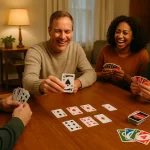
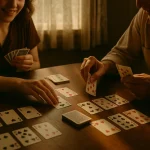
You can almost hear it — the shuffle of cards, the click of mugs, the hum of a radio tuned to a local station.
It’s a Friday night somewhere in Ohio or Michigan, where neighbors gather not for competition, but connection.
This is the quiet Midwest ritual that’s outlasted factories, storms, and time itself: a simple card game that turned into a social tradition.
A Game That Traveled and Found a Home
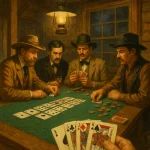
The story begins far from America’s heartland — somewhere in old Europe, in smoky taverns where people played trick-taking games with names that sounded poetic and foreign.
Those early travelers brought their decks across the Atlantic, and something unexpected happened when the cards reached small-town America.
The game changed — simpler, friendlier, more democratic.
It no longer belonged to the elite or the professional gamblers; it became a pastime of farmers, mill workers, and young couples who played after supper.
In that transformation, it found its true home: the Midwest.
Why the Midwest Made It Its Own
There’s a certain honesty to the way people in the region approach life — straightforward, practical, and quietly clever.
It’s no surprise a quick, social, four-player card game caught on so fast.
Unlike poker, this wasn’t about bluffing fortunes or reading strangers.
It was about rhythm, teamwork, and humor — a battle of wits wrapped in warmth.
In farmhouses and small-town diners, it became a symbol of friendliness, where everyone knew the rules and nobody took themselves too seriously.
For generations, that was the essence of Midwest leisure: a little skill, a lot of laughter.
From Riverboats to Barns
Before the railroads carved through America’s interior, steamboats carried people — and their habits — up and down the Mississippi and the Great Lakes.
Card games traveled with them, settling in towns like Cincinnati, Toledo, and Grand Rapids.
By the late 1800s, it wasn’t unusual to see a deck of cards on every kitchen table in the Midwest.
In an era before TV or radio, this was evening entertainment — part game, part storytelling, part social glue.
Neighbors who spent their days working the land would come together in the evenings to play a few rounds, swap news, and catch up on local gossip.
It wasn’t about winning. It was about belonging.
The Midwest Way of Playing
The rules weren’t complicated, but the culture around the game was rich.
A raised eyebrow from your partner said more than words.
The deal might pause for a slice of pie.
Every hand came with a little teasing, and losing was just an excuse to laugh louder.
Each town had its unwritten etiquette — a rhythm that reflected the people themselves.
Call it farmhouse diplomacy: half strategy, half kindness.
If you misplayed a card, you’d hear about it for a week — but always with a smile.
Card Nights and Community Spirit
For decades, weekend card nights were the heartbeat of small-town America.
Church basements, community centers, and fire halls all hosted tournaments and charity games.
The prizes were modest — a homemade cake, maybe a grocery basket — but the memories lasted longer than any trophy.
These nights taught subtle lessons too.
How to be patient.
How to lose gracefully.
How to laugh when your partner made the same mistake three times in a row.
It’s these small rituals, not the cards themselves, that explain why the game still thrives.
A Legacy That Outlived Its Time
When other pastimes faded, this one endured — not because it was flashy, but because it was flexible.
It survived the rise of bridge, the poker boom, and even the digital era.
In a sense, it mirrors the Midwest itself: stable, adaptable, and deeply communal.
Families still play at holidays; college kids pick it up from their grandparents.
Even online versions now have loyal followings from Michigan to Ontario — proof that a good tradition doesn’t need reinvention, only remembrance.
Reflections from America’s Heartland
You can study all the math behind strategy, but what really keeps this tradition alive is emotion.
The same quiet thrill when everyone leans in before a play.
The laughter that comes from a perfectly timed card.
In the Midwest, a simple deck carries more than numbers — it carries memory.
Neighbors, families, friends — all connected by the rhythm of a shared game that never tried to be fancy, only familiar.
And if there’s one name that still echoes through that culture, it’s Euchre — the humble classic that turned small gatherings into lifelong stories.
Because in the end, it’s not about the cards.
It’s about the people sitting around the table, and the history they keep alive with every shuffle.